Get Full Government Meeting Transcripts, Videos, & Alerts Forever!
Get email alerts on the Filter First Implementation topic
No spam. Unsubscribe anytime.
Michigan educators, child-care providers warn Filter First law creates funding, staffing and guidance gaps
Summary
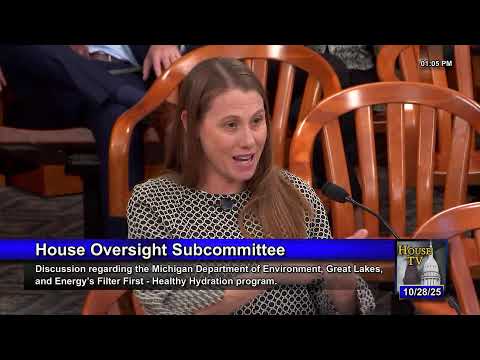
Lawmakers and local education and child-care officials told the Michigan House Oversight Subcommittee on Public Health and Food Security on Sept. 12 that the state's Filter First requirement for certified filters at school and child-care drinking-water outlets is running into practical problems on the ground.
Lawmakers and local education and child-care officials told the Michigan House Oversight Subcommittee on Public Health and Food Security on Sept. 12 that the state's Filter First requirement for certified filters at school and child-care drinking-water outlets is running into practical problems on the ground.
"Every child deserves access to safe drinking water," said Steve Clark, superintendent of Vassar Public Schools, but he said the law is too narrow in focusing only on fixtures in schools and child-care centers and leaves broader water-infrastructure issues unaddressed. Clark said his district received a $46,000 Healthy Schools grant to retrofit hallway fountains and food-preparation sinks, but the grant did not cover classroom sinks and prohibited inline or entry-point systems that would protect entire buildings more cost-effectively.
The witnesses described three recurring implementation problems: inconsistent or changing guidance from the Michigan Department of Environment, Great Lakes, and Energy (EGLE); a funding gap that leaves districts and providers responsible for ongoing cartridge replacement and labor; and substantial new administrative and testing burdens.
"The initial grant covers start up costs only," said Troy Boone, director of facilities at Berrien RESA, summarizing monthly feedback from roughly 30 districts in his region. He and Superintendent Eric Hopstock reported that EGLE has changed fixture-classification and signage guidance several times, that inline filters are excluded from reimbursement, and that districts face a labor-intensive sampling cycle with unclear reporting or certification processes ahead of the 2026 compliance deadline.
Montrose Community Schools's facility projects coordinator Jim Ply estimated the district would need about $24,000 to install six new hallway drinking fountains and about $32,000 total to meet minimum requirements without grant aid; he also estimated yearly cartridge costs for hallway fountains of roughly $4,200. Ply said Montrose would need about 18 inline systems for kitchens, teacher lounges and early-elementary classroom fixtures if inline systems qualify, and that staffing for sampling and documentation is a significant concern for small maintenance departments.
Licensed plumber Steve Shriner of Shriner Mechanical said he has seen inconsistent manufacturer and EGLE direction in site visits and relayed difficulty getting voluntary samples processed by some labs. He described manufacturers and EGLE changing which fixtures require filtration (for example, whether refrigerators with water dispensers or ice machines are included) and said many installations will require permits and qualified installers—resources some districts may lack.
"We need to test before we act," Shriner said, arguing that routine pre-opening and fixture-level testing should guide remediation. He also warned about downstream burdens: "These filters have to be put in a specific way," he said, and maintenance and hands-on training are needed to avoid cross-contamination when cartridges are changed.
Kimberly Zehnder, owner of EduPlay Discovery Center, said her Frankenmuth child-care centers opened in 2018 with modern plumbing and regular environmental-health testing and that the law's one-size-fits-all installation mandate risks diverting scarce operating dollars from staff pay and core services. Zehnder also described login problems that prevented her from applying for early grant rounds and said many small providers are relying on pitchers or nonregulated interim solutions.
Multiple witnesses urged policy changes that would make the law more practical: allow inline or entry-point filtration to be eligible for funding; provide sustainable, recurring funding for cartridge replacement and labor; clarify and stabilize EGLE guidance, signage and reporting processes; and target funds to sites that test positive rather than requiring installation at every fixture regardless of local water quality. Several speakers asked the committee to request more detailed technical guidance from EGLE and the Michigan Department of Health and Human Services.
Committee members asked clarifying questions about whether districts had positive lead results (witnesses said most of their sampled fixtures tested negative), lab turnaround times for voluntary samples (witnesses reported wide variation from 24'48 hours to 5'7 days), and how maintenance responsibility would be handled after installation. Chair Beierlein noted EGLE and MDHHS were invited but did not attend and said the committee hopes to receive departmental responses in a future session.
No formal departmental or statutory changes were made at the hearing; witnesses offered recommendations and requested clearer departmental guidance and additional funding to support compliance.