Get Full Government Meeting Transcripts, Videos, & Alerts Forever!
Get email alerts on the Water Rates topic
No spam. Unsubscribe anytime.
Ukiah Valley rate study proposes phased increases; Millview board seeks more detail before action
Summary
A consultant recommended phased rate increases to fund higher capital spending and reserves across Ukiah Valley water agencies. Millview directors asked for more detailed explanations of the city—s pooled-cash allocation and deferred taking a vote, requesting further briefings before Proposition 218 procedures start.
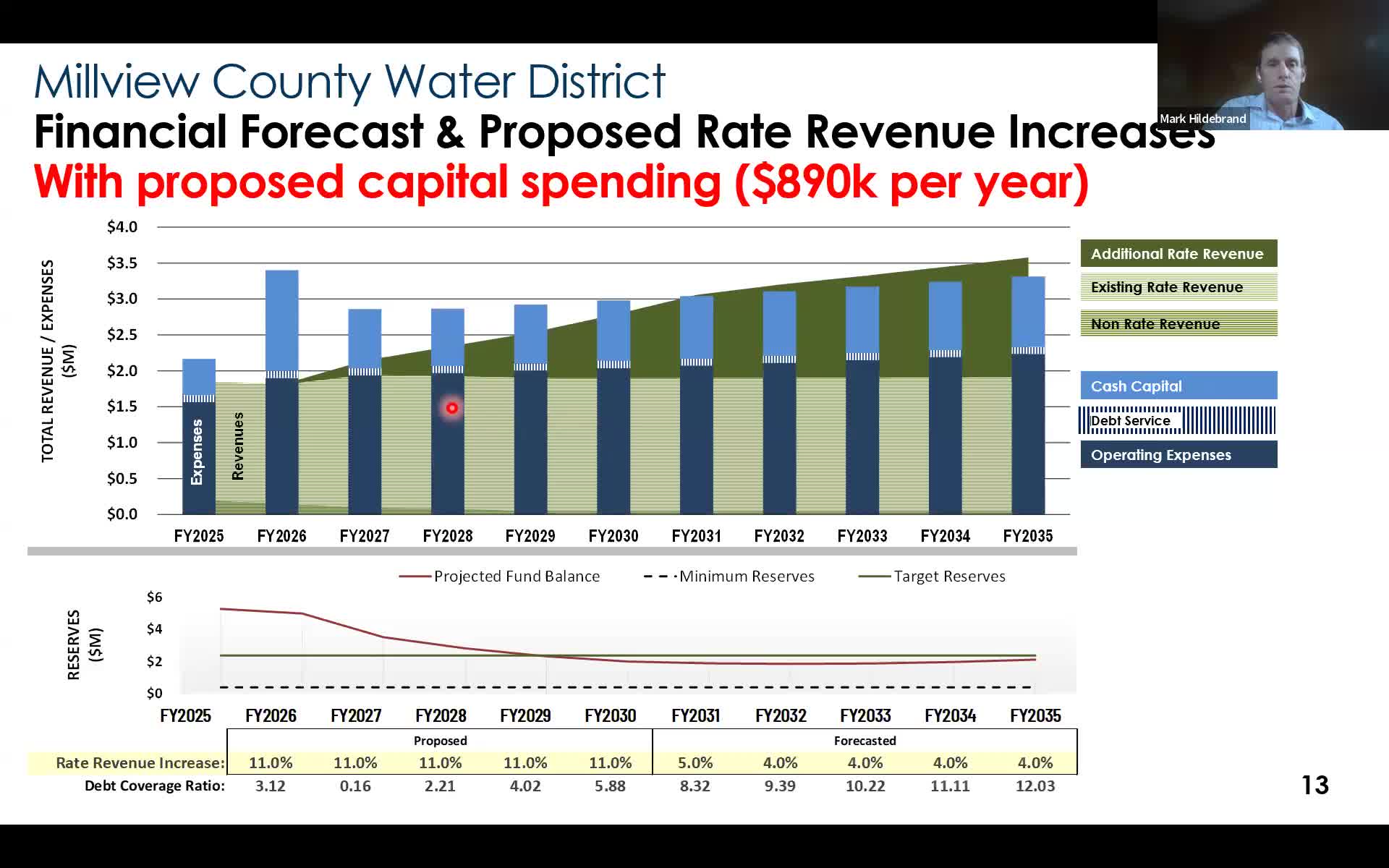
Mark Hildebrand, principal of Hildebrand Consulting, presented a Ukiah Valley Water Authority rate study to the Millview County Water District Board on Oct. 21, recommending a revenue plan that would raise customer rates about 11% annually for five years under the primary scenario to fund operating costs and ramp up capital spending.
Hildebrand said the study is a revenue-requirement plan rather than a full cost-of-service redesign and noted the board must follow Proposition 21820procedures in California for any rate increase, including a public notice and hearing process. He recommended an operating reserve of about $391,000 (roughly three months of expenses) and a capital reserve target of about $2.4 million to protect the utility from revenue interruptions and to smooth large capital projects.
The consultant showed historical capital spending averaging under $300,000 per year and proposed increasing that to nearly $900,000 annually to address aging infrastructure. Hildebrand said the primary rate scenario would allow the district to draw on its healthy reserves and spread increases over several years rather than "spiking" rates up front. He also presented a lower-investment alternative that would cut near-term increases roughly in half but carry higher long-term risk to the system.
Directors pressed staff and Hildebrand on how the city of Ukiah—s pooled-cash accounting and its cost-allocation plan will, in practice, affect Millview. "The pooled cash is only increasing based on the bill that gets sent to each of the member agencies," Hildebrand said, and he emphasized that allocations are based on metrics such as relative water usage and specific operating costs (chemicals, electricity, treatment) rather than a district—s revenue. Olga Keogh, the BPWA controller, said Millview transitioned its accounting to the city—s Munis system in January 2025 and offered to provide a cash-flow diagram to illustrate how funds move between the pooled account and individual fund balances.
Board members said they need a clearer explanation from the city finance director on how the allocation metrics and pooled cash operate before the Ukiah Valley Water Authority executive committee is asked to send Proposition 218 notices. No adoption or final vote on rates occurred at the Millview meeting; staff said a consolidated presentation will go to the executive committee on Nov. 6, and any Proposition 218 mailing and hearing schedule would follow if that body approves moving forward.
The presentation and discussion focused on numbers shown in Hildebrand—s slides, including the recommended contribution to reserves, a projected 10-year cash-flow showing reserve drawdown through 2031 under the primary scenario and slow recovery thereafter, and the trade-offs between more proactive capital investment versus the risks of deferred maintenance. Directors also discussed potential timing for follow-up briefings and whether the district should seek a special meeting with the city finance director to resolve remaining questions before Nov. 6.