
County says HCD comments require additional analysis; Tarpy Flats opposition fuels public push for conservation
Get AI-powered insights, summaries, and transcripts
Subscribe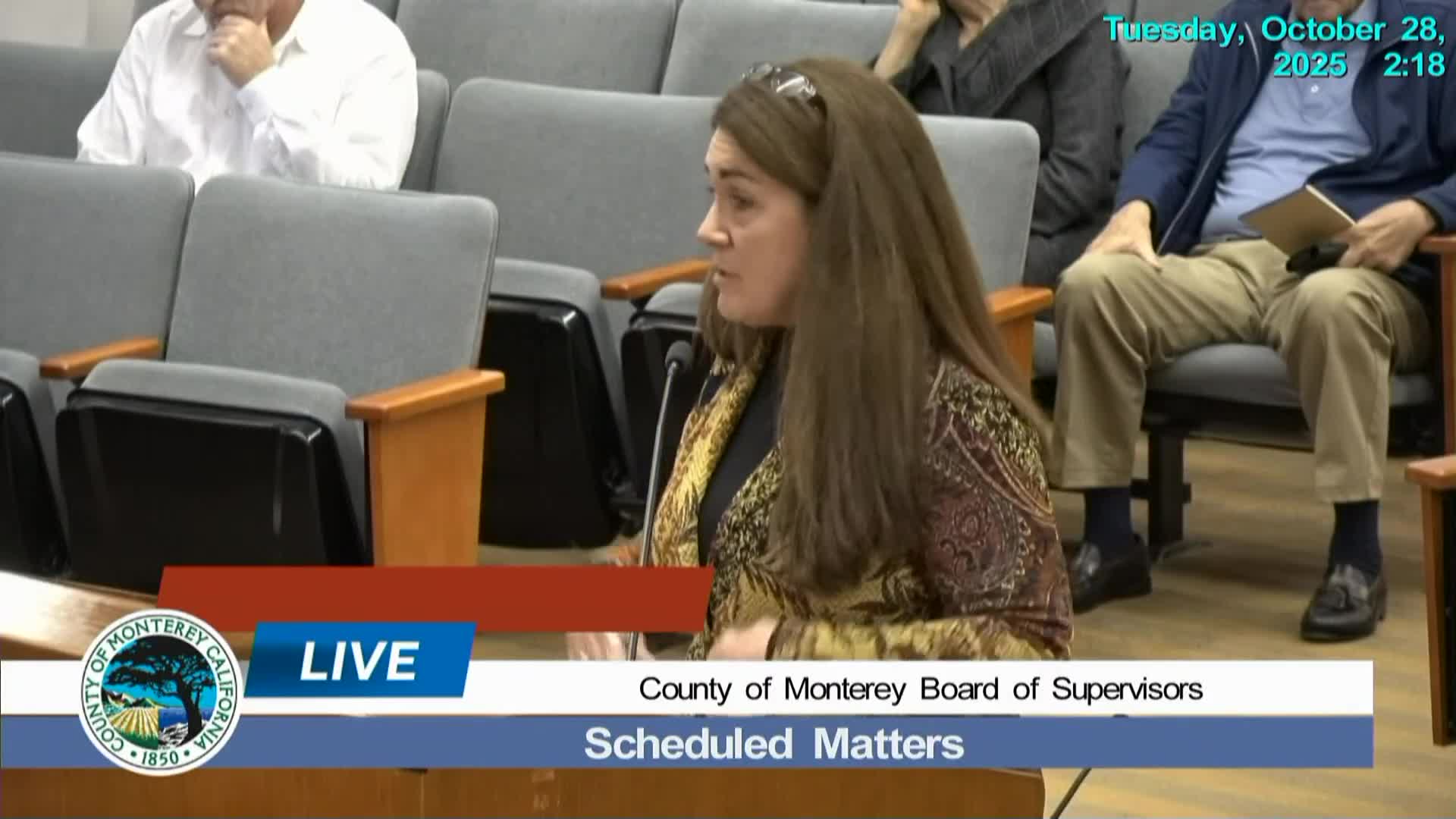
Summary
County planning staff told the board Oct. 28 that California HCD returned a second round of comments seeking more site‑level analysis, permit clarity and fair‑housing assessments before certification of Monterey County raft sixth‑cycle housing element will be granted.
Monterey County planning staff briefed the Board of Supervisors Oct. 28 on responses to California Department of Housing and Community Development (HCD) comments on the county raft sixth‑cycle housing element and on next steps toward certification.
Sarah Weichel of the county—omprehensive planning team said HCD sked for additional information in several areas: how the county treats non‑vacant opportunity sites (existing commercial or other uses on parcels listed for rezone), documentation that pipeline projects will be available in the 2023–2031 planning period, clarification of permit processing standards and ministerial approvals for multifamily projects, and additional analysis showing how site selection furthers fair housing objectives.
“Most of what the state was requesting was additional analysis and information,” Weichel said, adding county staff was preparing written responses and expects to publish a public release draft (paired with the programmatic environmental impact report) in late 2025 with a goal of re‑submitting to HCD and seeking certification in 2026.
One question highlighted by HCD concerns the county pproach to density ranges for rezoned opportunity sites. HCD pointed to legal requirements around the 20‑dwelling‑units‑per‑acre threshold for by‑right development in some cases; county staff said they were negotiating a workable approach with HCD that would allow a range above 20 units per acre (staff recommended the county explore up to 25 units per acre as an initial step, with further options under consideration) while ensuring environmental review aligns with those capacity assumptions.
Public comment strongly focused on a single contentious site known as Tarpy Flats in the Carmel Valley/Monterey peninsula region. Neighbors and organized community groups urged the board to remove the site from the housing element and to pursue conservation measures. Supervisor Kate Daniels, whose district includes the parcel, said removing it from the housing element would not, by itself, prevent development: the site remains listed in the county'010 general plan and, because the county is late in adopting its housing element, the jurisdiction is exposed to the state—uilder pproval provisions. Daniels urged opponents to consider land‑conservation efforts rather than a last‑minute attempt to block the site by deleting it from the housing element.
Several residents highlighted traffic, wildfire risk, habitat and groundwater concerns if Tarpy Flats were developed. Other commenters urged the county to move forward with the housing element so the county can access eligibility for state housing and homelessness funds that require a certified housing element.
Next steps and timing
Staff told the board they plan to finish the PEIR and the final draft housing element, release the documents for public review and re‑submit to HCD. They expect to receive an HCD response after a 60‑day review and are targeting certification in spring 2026, contingent on completion of required rezones, general plan and zoning code amendments to implement the element. Staff noted that, because the county missed the original statutory deadline, HCD expects the county to complete required rezones within the statutory time frame and to demonstrate that those rezones allow the required densities and ministerial processing where appropriate.
Why it matters: Certification opens access to multiple state housing and homelessness funding programs and reduces exposure to builder remedy claims. The public controversy around Tarpy Flats illustrates a common tension counties face between state housing mandates and strong local conservation and infrastructure concerns.
Provenance: Housing element update and public comment Oct. 28, 2025 (Sarah Weichel, Craig Spencer, Supervisor Kate Daniels) (topicintro: 24748.27–24765.44; topfinish: 25331.58–25346.16).