Get Full Government Meeting Transcripts, Videos, & Alerts Forever!
Get email alerts on the Child Welfare topic
No spam. Unsubscribe anytime.
Court reviews foster placement and case service plan at initial disposition hearing
Summary
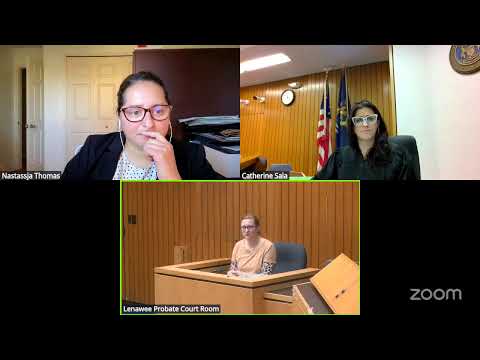
At an initial disposition hearing in Lenawee County Probate & Juvenile Court, attorneys and agency staff updated the court on the status of an infant in foster care and discussed a case service plan that lists reunification as the permanency goal.
At an initial disposition hearing in Lenawee County Probate & Juvenile Court, attorneys and agency staff updated the court on the status of an infant in foster care and discussed a case service plan that lists reunification as the permanency goal.
Carson Howitt, the guardian ad litem, told the court he met the child on Oct. 14, 2025, and described the infant as “just over 3 weeks old” who “appeared to be a big baby.” Howitt said he observed no developmental delays but noted the child was sleeping during visits, which limited fuller observation. He reported the child is placed with foster parents and three foster siblings, ages 17, 8 and 9, and said, “I do believe that this placement is currently in her best interest.” Howitt recommended continued supervised visitation and that the mother be connected with a parenting coach and other hands‑on parenting help.
Britney Delagarza, the department foster‑care worker assigned to the case, testified that she has weekly contact with the mother tied to parenting time and completed a home visit on the morning of the hearing. Delagarza said the mother told staff she planned to attend the hearing but was not present in the courtroom. “She did state that she was coming,” Delagarza said. Delagarza told the court the mother missed one visit because she was arrested on a warrant and otherwise has attended scheduled visits and been “very attentive to the child.”
Delagarza listed the barriers to reunification documented in the court report: untreated mental‑health needs, a history of substance abuse, unstable housing and income, and pending criminal charges. She said the mother has participated only in parenting‑time visits to date and that the department has begun routine drug screening tied to those visits. “We’ve gotten three results back so far, and they’ve all been negative for all substances,” Delagarza said; she added that additional results were pending.
On services, Delagarza said the department will refer the mother to a parenting‑time program at Orchards but acknowledged the program has “an extensive wait list.” She and the guardian discussed the possibility of placing the mother with an interim supervised‑parenting provider while awaiting an Orchards opening. Delagarza also described plans to refer the mother for a psychological evaluation and community mental‑health services and said staff would assist with scheduling those appointments.
Department counsel Sasha Thomas asked the court whether affidavits of publication had been filed for notice to a possible father; court records showed no affidavit on file. Thomas told the court she had paid for publication in Monroe County and Lehi County and would file the affidavits, saying one run was scheduled Oct. 6 and another about Oct. 16. Delagarza said the mother could provide only a first name for a potential father and that the department’s intake listed the child’s race as Caucasian, while the mother described the child as “mixed.”
Thomas asked the court to accept the court report and the attached case service plan. Michael McFarland, the mother’s attorney, responded, “No position without a client. No objection.” The transcript does not record a formal ruling by the judge on that request; the judge instead recessed briefly to allow counsel to speak with the mother and to resolve outstanding questions about the service plan and file matters.
No paternity finding, custody order or final permanency decision was recorded in the portion of the transcript provided. Planned next steps on the record included filing publication affidavits for father notice, referring the mother to parenting services and a psychological evaluation, continuing supervised parenting time at the current cadence and exploring interim supervised‑visitation alternatives while Orchards’ wait list is addressed.