Get Full Government Meeting Transcripts, Videos, & Alerts Forever!
Get email alerts on the Arbitration Confirmation Jurisdiction topic
No spam. Unsubscribe anytime.
Appeals court hears dispute over whether interim arbitration order can be confirmed under Massachusetts law
Summary
The Massachusetts Appeals Court heard expedited arguments in an appeal over whether an interim arbitration order may be confirmed under the Massachusetts Arbitration Act, raising questions about single-justice jurisdiction and whether the statute’s use of the term “award” excludes interlocutory orders.
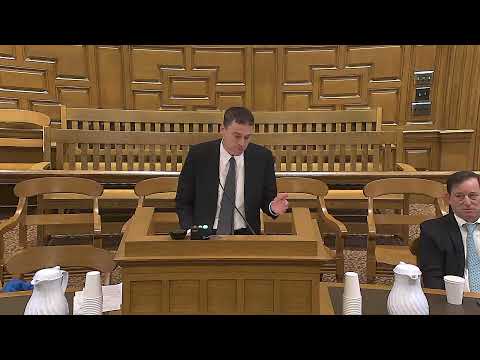
The Massachusetts Appeals Court heard expedited arguments in the matter identified in the transcript as “20 20 five-ten 46, Dominion Builders LLC versus Hennep Properties LLC and others,” focusing on whether a single justice properly treated an interim arbitration order as an "award" subject to confirmation under the Massachusetts Arbitration Act.
Peter Carr, counsel for Hennep Properties, told the court that section 11 of the Massachusetts Arbitration Act uses the word "award," not "order," and that difference matters: "The statute is the statute," Carr said, arguing that an interim arbitration order is not an award and therefore not subject to confirmation under section 11. Carr told the panel he relied on a textual reading of the statute and cited cases (including what he referred to as Murphy v. National Union) to support the view that "award" carries an element of finality.
Carr also pressed the court on jurisdictional consequences. He argued that if the action at issue is not a confirmation of an award, the automatic right under section 18 to an immediate appeal to a three-judge panel should not apply. That position, he said, limits when the Appeals Court may entertain such an appeal and preserves the historical rule that single-justice interlocutory orders generally are not the subject of immediate appeals.
Richard Briansky, counsel for Dominion Builders LLC (d/b/a DAG), urged the court to look at substance over form. Briansky said federal circuit decisions and arbitration practice treat substantively equivalent instruments as confirmable even when labeled "order," and he pointed the court to arbitration rules the party cited in briefing (including Rule 39 of the AAA rules) and to the line of federal decisions interpreting the Federal Arbitration Act. "We're going to look at the substance of the document," Briansky argued, saying the panel should not elevate form over substance when the relief sought was effectively the same as a confirmable interim award.
The justices repeatedly pressed both sides on procedure and practical consequences. The panel questioned why the issue should be resolved now, given the single justice remanded the matter to the superior court for further proceedings, and whether a superior court decision on remand might render an immediate appellate decision unnecessary. The court also focused on the real-world stakes: whether an interim instrument is sufficiently definite to support contempt proceedings or immediate enforcement. Briansky acknowledged the instrument could be more articulate but said it provided the practical relief the parties sought, including a suspension of performance under the contract "without any reciprocal consequence," which he said was the disputed effect.
Counsel for Hennep contended that Massachusetts law, read plainly, does not authorize confirmation of an interim order and that reliance on federal cases (and some parties’ tactical choices to rush to the superior court) cannot rewrite the statutory text. Carr told the court he viewed the question as a novel issue of Massachusetts law that the panel should decide because section 11 refers specifically to an "award." He said that if the panel concluded the act does not permit confirmation of interim orders, the dispute over contempt and enforcement would be resolved in Hennep's favor.
The panel asked several practical questions to both sides: whether a party could return to the arbitrator and ask the arbitrator to "reduce" the interim relief to a form labeled an "award," and whether the existing instrument could be considered an award based on its substantive provisions. Counsel debated the Charles Construction decision cited in briefing (412 Mass. 14) and other precedents, as well as the interplay between sections 11 and 18 of the Massachusetts Arbitration Act and the general statutory framework on judgments and decrees.
At the close of argument, the panel thanked counsel for preparing on short notice, acknowledged the expedited posture of the appeal, and took the case under advisement.
The court’s forthcoming decision will address two principal issues the parties pressed at oral argument: (1) whether a single justice’s construction of section 11 to permit confirmation of an interim arbitration order was reviewable by this court at this stage, and (2) whether, as a matter of Massachusetts statutory construction, an interim arbitration instrument that functionally provides the types of relief at issue here qualifies as an "award" subject to confirmation and immediate enforcement.