Get Full Government Meeting Transcripts, Videos, & Alerts Forever!
Get email alerts on the Public Safety topic
No spam. Unsubscribe anytime.
Committee amends, advances bill targeting interstate/cross‑county absconding after criminal conduct
Summary
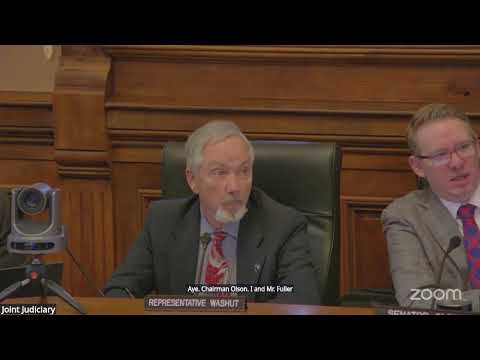
The Joint Judiciary Committee amended and advanced 26LSO0082 on Oct. 13, a draft aimed at penalizing travel across jurisdictional lines when tied to criminal activity, after adopting drafting changes to require intent and align punishment to the most serious underlying offense.
The Joint Judiciary Committee reviewed bill draft 26LSO0082 on Oct. 13, a proposal aimed at making it an offense to travel across county or state lines after committing criminal conduct with the purpose of continuing or concealing the criminal activity.
Alan Thompson, executive director of the Wyoming Association of Sheriffs and Chiefs of Police, testified that law enforcement supports tools to disrupt cross‑jurisdictional retail theft but stressed proportionality: as drafted the statute could elevate low‑level thefts into felony prosecutions. He recommended drafting changes such as graded penalties tied to the most serious underlying offense.
Uinta County Prosecuting Attorney Loretta Kallesen, speaking for the Wyoming County and Prosecuting Attorneys Association, said the association unanimously supports the bill as drafted and advised how intent and grading could be used in drafting. LSO staff highlighted two drafting choices adopted by the committee — (1) amend punishment so that absconding is punished commensurate with the most serious underlying offense, and (2) add an explicit intent element consistent with staff language so the offense requires purpose (for example, disposal of proceeds or intent to commit additional offenses) rather than mere travel.
The committee agreed to adopt those changes and proceeded to a roll call. Committee leadership and LSO also heard public comment on related victim‑safety issues (one commenter urged statutory responses when violent offenders escape detention and asked for stronger administrative and prosecutorial follow‑through; committee members and the Department of Corrections agreed to pursue related statutory and administrative follow‑up outside this bill).
Ending: With the two drafting changes, the committee voted to advance 26LSO0082 for further consideration; LSO will prepare an engrossed version reflecting the intent element and the penalty alignment.