Get Full Government Meeting Transcripts, Videos, & Alerts Forever!
Get email alerts on the Libraries topic
No spam. Unsubscribe anytime.
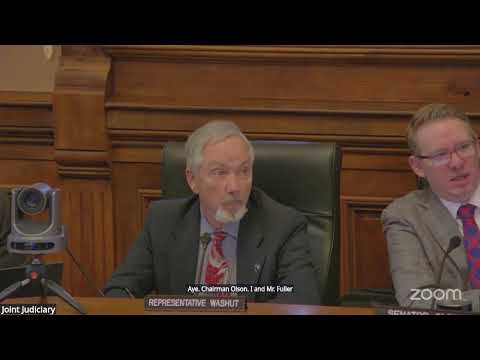
Judiciary committee advances libraries bill after lengthy work session, adds cataloging and review requirements
Summary
After an extended work session on Oct. 13 the Joint Judiciary Committee voted to advance 26LSO0080, a draft that restricts access to sexually explicit materials in libraries and adds local review and cataloging requirements.
The Joint Judiciary Committee on Oct. 13 conducted a multi‑hour work session on bill draft 26LSO0080, a measure that would limit minors’ access to pornography and sexually explicit material in public and school libraries and create a review and appeal process for challenged materials.
Committee members and LSO staff worked line‑by‑line through definitions (including what constitutes a "children's section"), placement and cataloging rules, local review procedures, private causes of action and civil remedies. Representative Lane moved an amendment requiring explicit materials that are part of a library’s collection to be cataloged and shelved in an adult section; the committee ultimately adopted cataloging and placement language designed to give parents greater notice and to make materials easier to locate if they are still to be made available for adult checkout.
Members debated whether remotely hosted or display materials (handouts, pamphlets, non‑cataloged displays) would fall within the rule; the committee adjusted language to try to capture library‑owned materials while preserving common display practices. The committee also adopted a local review procedure giving library boards or school districts a set period (amended during debate to 60 days in committee discussion) to consider a formal challenge and required that successful challenges that are remedied remove a library from civil liability for that occurrence.
Several committee members reiterated that the bill as advanced is not a criminal ban on books: Representative Feiler said, “We’re not banning books with this piece of legislation,” and added the draft focuses on placement and process rather than automatic removal of materials from circulation. Opponents argued the measure could function as a de facto ban in school libraries (which do not have separate adult sections) and raised concerns about legitimate *** education and medically accurate materials; one committee member highlighted concerns about how the bill’s definitions interact with educational materials.
After a sequence of amendments and roll‑call division votes on specific changes, the committee voted in roll call to advance 26LSO0080 (roll call result recorded as 11 ayes, 2 no, 1 excused). Committee chairs said an engrossed version will be prepared for introduction and floor consideration; work remains on narrowing definitions and on conforming language across adopted changes.
Ending: The committee advanced the bill out of committee on the majority vote. The bill will be printed in engrossed form reflecting the committee’s changes and will proceed to the legislative introduction process where other members may further amend or oppose it.