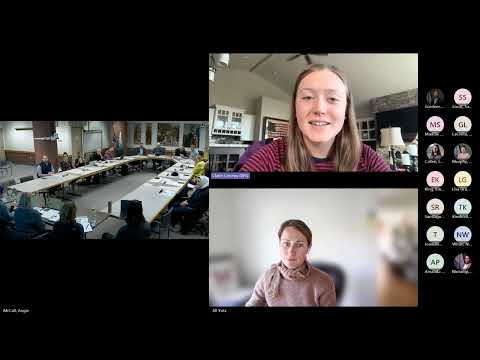
Spokane staff outline EIS schedule, three growth alternatives and climate‑policy integration
Loading...
Summary
City of Spokane planning staff and consultants told a joint meeting of the Climate Resilience and Sustainability Board and the Planning Commission on Oct. 25 that the draft environmental impact statement for the city's comprehensive plan periodic update is being completed and will move into public outreach early next year.
City of Spokane planning staff and consultants told a joint meeting of the Climate Resilience and Sustainability Board and the Planning Commission on Oct. 25 that the draft environmental impact statement for the city's comprehensive plan periodic update is being completed and will move into public outreach early next year.
Tyrrell Black, City of Spokane Planning, said the team "were hoping to have it at this time, but we have run into some issues with our transportation modeling, which we think we have resolved," and that staff expect to roll out an internal draft to the Planning Commission around Dec. 10 and to resume broad community outreach in January. The periodic update work is on a state schedule that staff noted must conclude by Dec. 31, 2026, under state law.
At the meeting staff and consultants described three growth alternatives under study in the draft EIS: a no‑action/current plan; a corridor‑focused alternative that builds on the city's corridors and frequent transit routes; and a center‑city and job‑hub alternative that concentrates additional growth in downtown, the University District/Medical District and major employment areas, including near the airport. Lisa Greeters of BERC Consulting and other consultants said the alternatives are analytical tools; the city may choose a preferred mix of features from more than one alternative when it moves toward a recommendation.
Staff also summarized the planning targets that underpin the alternatives. "The City has a population target of around 23,000 new people," staff said, adding that housing targets are nearly the same and are broken down to meet multiple affordability levels. Consultants said one policy objective is to support housing types that historically produce more affordable units, such as one‑ to three‑story attached units and lower‑rise multifamily.
Maddie Seibert of Cascadia Consulting described required components of the new climate element and the greenhouse‑gas analysis. Seibert said the team prepared a 2022‑based community inventory and projected emissions to 2050 under an adjusted business‑as‑usual scenario that incorporates existing state and federal policies. "We see that natural gas, on road vehicles and aviation are going to make up this whole of 86% of emissions," Seibert said, endorsing a focus on policies that reduce on‑road vehicle emissions and building fossil‑fuel use.
The team also summarized a climate risk and vulnerability assessment completed in June and described plans for further environmental justice and vulnerability analysis tied to land use and transportation policies.
On process and coordination, Planning Director Spencer Gardner outlined a schedule for advisory input: staff proposed a follow‑up joint meeting on Jan. 28 for detailed policy discussion; the CRSB would consider formal climate policy recommendations for forwarding to City Council on Feb. 12; the Planning Commission would recommend a preferred growth alternative in March; and the City Council would be expected to recognize or adopt a preferred approach in April. Gardner and staff asked the CRSB to identify one or two members who could serve as liaisons to Planning Commission land‑use and transportation topical reviews so that the boards'work remains coordinated.
Board and commission members asked staff and consultants for more specific, measurable targets in the policy package (for example VMT and greenhouse‑gas reduction milestones and a tree‑canopy coverage target), discussed the interaction of infill development and tree canopy maintenance, and suggested stronger guidance on how the draft alternatives could support 10‑ to 15‑minute neighborhoods and transit‑oriented development. Speakers also raised implementation questions such as funding for long‑term urban forestry maintenance and measures to make infill development affordable without imposing excessive ongoing utility costs on low‑income households.
Next steps identified by staff include additional advisory‑body meetings in November and December, a workshop series and public outreach in January, and the Jan. 28 joint meeting to review a more developed policy package and EIS findings. The City reiterated that further analysis, including a vehicle‑miles‑traveled study and an environmental justice analysis, will inform staff recommendations to advisory bodies and council.
No formal votes or ordinances were taken at the Oct. 25 joint meeting; staff presented information, received feedback, and set a sequence of upcoming workshops and review steps.