Developer outlines 200‑MW Stateline solar project and safety plans at Edgar County hearing; no decision
Loading...
Summary
The developer of the Stateline Energy Center presented site plans, economic projections, noise and safety analyses at a public hearing in Edgar County. Board members adopted hearing rules and admitted the application into evidence but did not take a final vote; the hearing was recessed to Oct. 20, 2025.
Edgar County held a public hearing Oct. 13 on Stateline Energy Center LLC’s request for a special‑use permit to build a 200‑megawatt commercial solar facility with an on‑site battery energy storage system on about 1,934 acres roughly 2.5 miles east of Paris.
The developer, represented by attorney Seth Upoff and senior development manager Ian Evans, presented a comprehensive application and witness testimony on project design, safety, noise and public‑health topics. The county board adopted hearing rules at the outset, admitted the developer’s written application as Exhibit 1 and a developer PowerPoint as Exhibit 2, and reserved a final decision for a later session; the hearing was recessed to Oct. 20 at 5:00 p.m. in Courtroom 1 of the Edgar County Courthouse.
The project as presented combines ground‑mounted solar arrays and a collocated battery energy storage system (BESS). "It is a solar and battery energy storage hybrid system," Ian Evans said, and he told the board the project would include about 15 acres for battery storage within the larger site. Evans said the developer expects the project to represent "a $400,000,000 capital investment into Edgar County," to create roughly 200 temporary construction jobs and to increase the local property‑tax base. He also stated the developer’s estimate that total property taxes over a defined period would be about $23 million, with roughly $13.3 million directed to local schools; he said a tax‑impact expert would testify later to those numbers.
Evans described site selection and mitigation measures: proximity to a high‑voltage transmission point of interconnection, planned setbacks that meet or exceed the county ordinance (including a 150‑foot minimum to nonparticipating residences and 50 feet to road rights‑of‑way), vegetative screening, locked gated access with Knox Boxes for emergency responders, and a drainage and decommissioning plan filed with the application. He said the project is in the MISO interconnection queue and that interconnection‑study timing affects construction timing; the developer’s stated schedule targets construction start in 2027–2028 and commercial operations in 2028–2029, subject to interconnection and permitting timelines.
Noise and public‑health testimony
The developer’s acoustical witness, Jacob Poling of Stantec, explained a conservative three‑dimensional noise model built with CadnaA and ISO standards. He testified that, under conservative meteorological and operating assumptions, most nearby residences were modeled at about 35 dBA or less; the highest modeled levels were near the battery/substation area and were "expected to be 46 dBA during daytime and 45 dBA during nighttime," which Poling said is below applicable Illinois Pollution Control Board octave‑band limits cited in the report. Poling said the model assumes worst‑case propagation (downwind, no attenuation from vegetation or buildings) to avoid under‑estimating noise.
Dr. Chris Olsen, a public‑health consultant, testified on EMF, materials, glare, and other health concerns. Dr. Olsen said industry and government reviews show EMF levels from the panels, inverters and substation will be far below internationally recommended exposure thresholds, and that studies and standards show minimal risk from panel materials when panels are installed and replaced according to industry and regulatory guidance.
Fire safety and emergency response
Fire‑safety consultant Evan Balcom (FRA) and other witnesses described battery‑specific protections and training. Balcom explained differences between battery chemistries, saying the industry has moved toward lithium‑iron‑phosphate (LFP) chemistries with lower thermal‑runaway risk than earlier chemistries; he also explained UL 9540A testing and NFPA 855 guidance for large‑scale BESS installations. Balcom said modern BESS containers are designed with venting and purge systems and that the industry practice is to treat a container fire as a single‑container loss while protecting adjacent containers and exposures. He and the developer said they have conducted initial training with the Edgar County Fire Department and will provide on‑site annual training and an emergency response plan before commercial operation.
Decommissioning, financial assurances and manufacturers
Board members and county counsel asked detailed questions about the decommissioning plan and financial assurances. The applicant acknowledged a decommissioning cost estimate appears in the application materials and deferred to a technical witness for the precise figure; during questioning the figure cited from the application was approximately $25.25 million (applicant counsel and witnesses said the county application materials include a decommissioning plan and cost estimate). The applicant indicated it proposes staged financial assurance tied to the project life but deferred to the decommissioning expert for final terms and calculations. The applicant also said it would provide a written list of potential equipment manufacturers (tier‑1 solar panel, battery and transformer suppliers) as an addendum to the application.
Public comment and landowner testimony
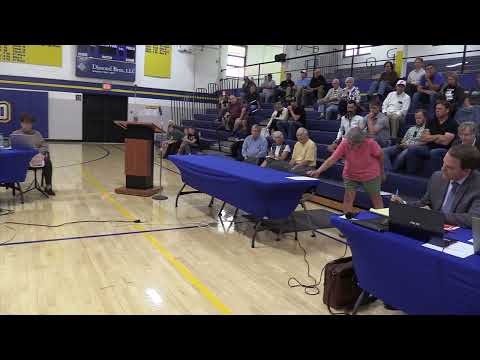
About 60–70 people attended, and several Edgar County landowners and residents questioned witnesses on waterlines, drain tiles, construction methods, and emergency response. Landowner Mike Maggart, who testified in favor of the project, said he and family members had negotiated leases with the developer for acreage in the proposed site area and described the lease negotiation process and concerns addressed, including tile and drainage protections, and said the lease offered family financial stability.
Procedure and next steps
The board adopted hearing rules that define "interested parties" (Edgar County residents and property owners) and set time limits (30 minutes for interested parties and expert witnesses; 3 minutes for non‑resident commenters) and cross‑examination allowances. Two procedural actions were recorded: the agenda as presented was approved by roll call, and the hearing rules were adopted by roll call (votes recorded in the minutes). The applicant’s written permit application and the developer’s PowerPoint were admitted into the hearing record. No final decision was made on the permit; the board recessed the hearing and will reconvene Oct. 20, 2025, at 5:00 p.m. in Courtroom 1 at the Edgar County Courthouse, 115 West Court Street, Paris.
What remains unresolved
The record before the board includes technical studies, the applicant’s decommissioning estimate, and commitments on training and screening, but several items were deferred to later witnesses or to permit conditions: (1) a finalized decommissioning guarantee and posting schedule (applicant cited the plan in the application and said it will work with the county on the posting mechanism); (2) finalized vegetative screening/landscape plans and species lists (applicant agreed to provide a county‑approved planting plan before building permits); (3) manufacturer selections for modules, inverters and BESS containers (applicant agreed to file a tier‑1 manufacturer list as an addendum); and (4) interconnection study timing and final commercial‑operation scheduling (dependent on the MISO process). The hearing record remains open for evidence at the resumed session.