Get Full Government Meeting Transcripts, Videos, & Alerts Forever!
Get email alerts on the Land Use Grocery Access topic
No spam. Unsubscribe anytime.
Seattle council adopts interim rule banning most "negative use" covenants that block grocery stores and pharmacies
Summary
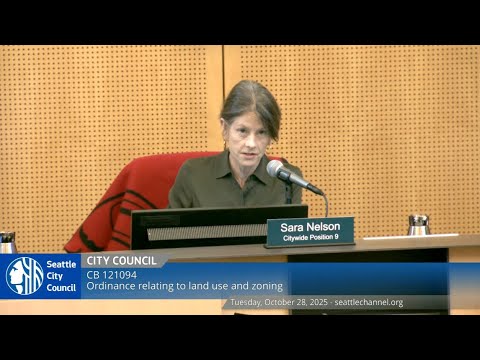
The Seattle City Council on Oct. 28, 2025, adopted interim development regulations to prohibit most private covenants that prevent grocery stores or pharmacies from occupying properties, aiming to prevent creation or expansion of food and pharmacy deserts. The measure passed 9-0 and is temporary for one year while permanent rules are developed.
Seattle City Council on Oct. 28 adopted an interim regulation that prevents most private "negative use" covenants, leases or deed restrictions from blocking a property's use as a grocery store or pharmacy.
Council President Sarah Nelson, the bill's sponsor, told colleagues the measure would ‘‘prohibit the imposition of negative use restrictions on grocery stores and pharmacies’’ while allowing narrow exceptions. Nelson said violations would be enforced through the land use code and could carry fines of up to $1,500 per day. The interim rules take effect immediately and would expire after one year while the Office of Planning and Community Development (OPCD) develops proposed permanent regulations for the council to consider.
The bill was framed by sponsors as a short-term tool to protect neighborhoods facing retail loss while the city seeks longer-term policy options. Nelson described one concern: when a national chain closes a store and retains property rights, that owner can place a covenant that prevents another grocer from opening in the same space, which can worsen local food access.
Council member Juarez, who has led outreach in the Lake City area, said the recent Fred Meyer closure has ‘‘deeply felt’’ impacts and that the office worked with the mayor's office, King County partners, and local nonprofits to identify deed restrictions on affected properties. Juarez urged support of the interim measure to preserve flexibility for properties so small supermarkets, pharmacies or smaller-format grocers could locate there.
Other council members stressed the city's role in creating conditions for store viability, noting factors such as retail theft, transit access and operating margins that affect grocers' decisions. Nelson and supporters said the interim step does not address all causes of store closures but removes a legal barrier that can prevent replacement grocers from opening in affected neighborhoods.
The council voted by roll call; each of the nine members present voted in favor. Nelson directed the clerk to affix her signature to the legislation following passage.
Clarifying details: the bill would not apply to negative use restrictions already in place when a grocery or pharmacy is relocating to a site within a half-mile of a current location, and it would not apply to restrictions imposed within an individual shopping center that merely limit placement of a competing store inside that center. The interim ordinance authorizes civil enforcement through the land use code and cites fines up to $1,500 per day for violations. The interim regulations expire after one year unless replaced by permanent rules from OPCD.
The ordinance passed 9-0.