
City agencies and neighbors disagree over proposed rule to allow 90-foot lights at District recreation fields without BZA review
Get AI-powered insights, summaries, and transcripts
Subscribe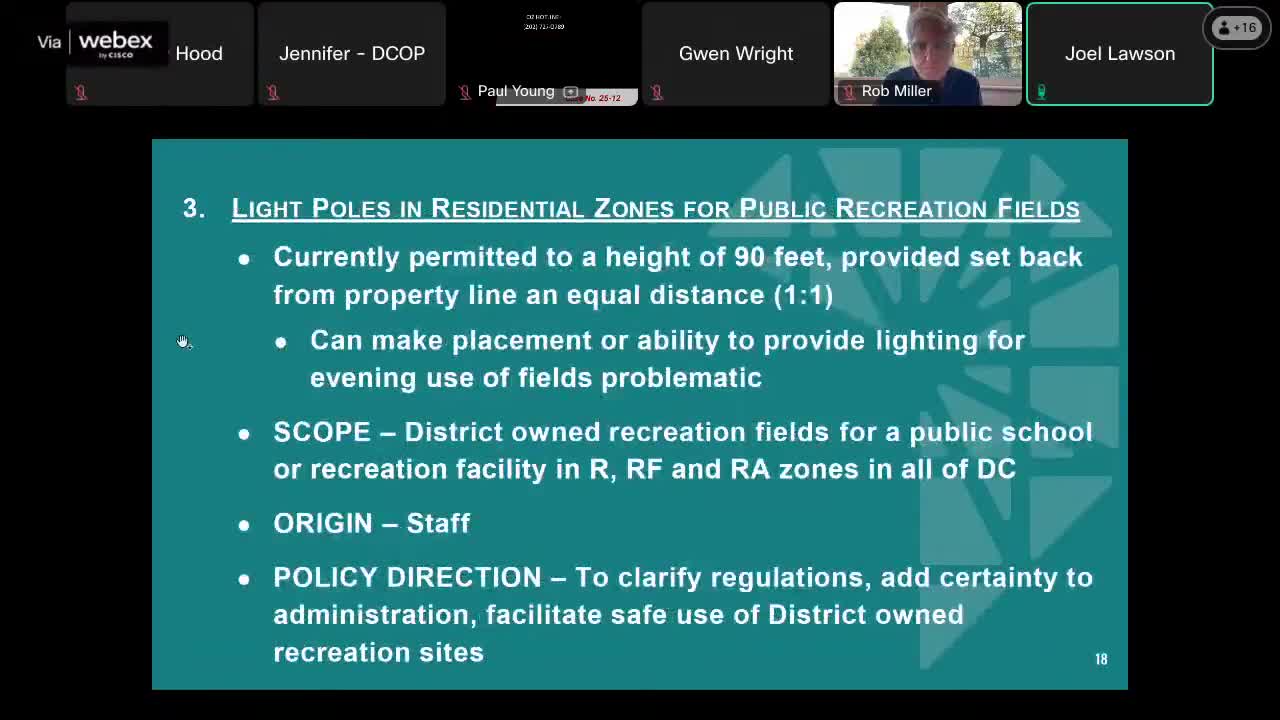
Summary
OP proposed clarifying zoning treatment of field lighting so District-owned school and recreation fields could use light standards up to 90 feet without the current 1:1 setback in certain zones.
The Office of Planning proposed a zoning-text change to explicitly address light standards for District-owned recreation fields and public school athletic facilities. Under OP's draft, light poles serving District recreation and school fields in the R, RF and RA zones could reach up to 90 feet without the existing 1-to-1 setback from the property line.
Meredith Moldenhauer, counsel for the Department of General Services (intervener in a pending BZA appeal), urged the commission to retain the longstanding practice that has allowed many fields to be lit as a matter of right. "Maintaining this approach through the proposed amendment directly supports the district's ability to deliver high quality, safe, and inclusive recreational opportunities for all residents," she said, and she suggested limited drafting fixes to make the scope clearer and to grandfather existing installations.
Why neighbors object: Neighbors, ANCs and Committee of 100 raised light spill, nighttime noise from evening games, and the loss of a public review step as the central concerns. ANC 6C provided a detailed example: Stuart Hobson Middle School, a field bounded on three sides by rowhouses, where commissioners said 90-foot poles could increase night noise, glare and perceptible intrusion into long-established residential areas.
OP and agencies' position: OP said the proposal applies only to District-owned school and recreation facilities and that Department of Parks and Recreation (DPR) standards for fixture design, shielding and hours would still apply. OP stressed the intent is to enable safe evening programming on limited public fields while minimizing off-site impacts.
Next steps and open questions: The issue generated the most neighborhood opposition of the night; commissioners asked OP to collect DPR's lighting policies and to explain how DPR standards could be enforced administratively or through interagency agreements. The commission left the item in the record for further review and additional written comments; a BZA appeal relevant to the provision is pending and the BZA postponed action to await guidance from the commission.