
Glendora council adopts objective design standards to streamline housing approvals
Get AI-powered insights, summaries, and transcripts
Subscribe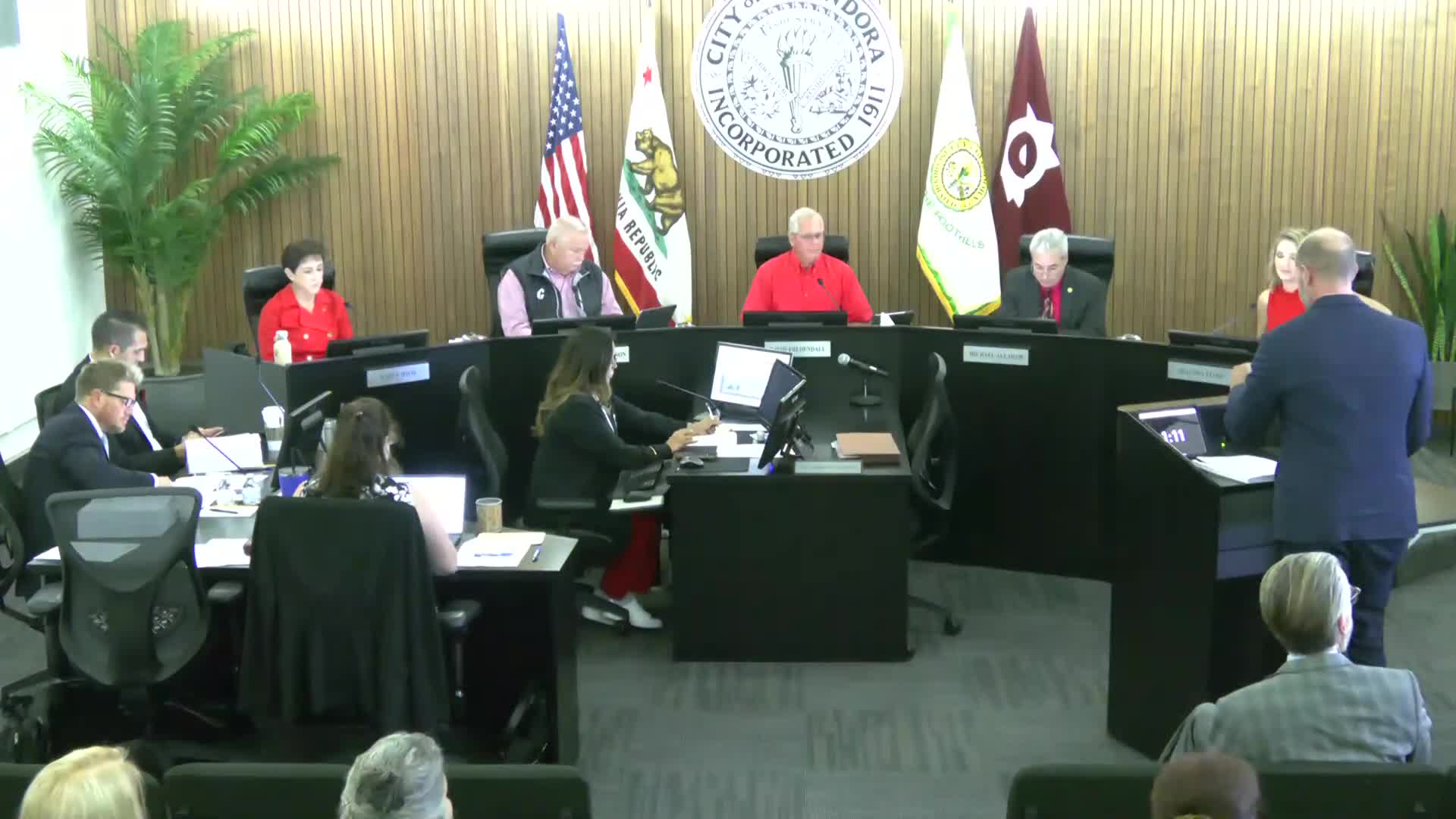
Summary
After a multi‑year process, the City Council approved an ordinance adopting objective design standards and related zoning cleanup intended to provide clearer, quantifiable design rules for residential, commercial and mixed‑use development and to align local rules with state housing law.
The Glendora City Council on a 5‑0 vote approved an ordinance amending Title 21 of the municipal code to adopt objective design standards (ODS) and a comprehensive cleanup of zoning regulations.
The rules, a three‑year effort presented by Principal Planner Hans Bridal and consultant Alan Loomis of PlaceWorks, replace subjective design guidelines with measurable requirements intended to speed permit reviews for qualifying residential and mixed‑use projects while preserving local character. "Objective design standards as a design standard that involves no personal or subjective judgment by a public official and is uniformly verifiable by reference to an external and uniform benchmark or criterion," Bridal said during the public hearing.
City staff said the standards were driven by state housing laws that require objective criteria for projects invoking several state tools (density bonus, SB 35, ADU provisions and others) and by local policy directives in Glendora’s housing element and strategic plans. The code consolidates overlapping guidelines, sets clear thresholds for facade articulation, height modulation and open‑space and amenity requirements for multifamily developments, and restricts architectural styles for larger multifamily buildings to a narrowed menu (for example, Craftsman and Spanish Revival were identified as preferred options for larger buildings).
Consultant Alan Loomis described a menu‑based approach in which applicants must meet quantified options for elements such as height modulation and facade articulation. He told the council the standards do not change basic development entitlements—density, allowable uses or base height limits—but supplement those rules with clear design metrics. Staff emphasized the ODS were written so that a developer could not seek a blanket waiver of the entire standardbook if seeking concessions under state density bonus law; instead waivers would be considered line‑by‑line.
Council members pressed staff on stepbacks and transitions where taller buildings abut single‑family homes, and on how the standards would apply to single‑family infill and small multifamily projects. Staff pointed to a specific ‘‘transitional massing’’ standard requiring additional setbacks, window offsets to protect privacy, and limits on balcony encroachments within 50 feet of low‑rise residential properties.
Bridal and Loomis said the ODS package includes an illustrated users’ guide and a checklist for applicants. The council voted to adopt the ordinance and related code amendments after planning commission recommendation and multiple public outreach events that generated nearly 600 survey responses.
What happens next: The city’s amended code and user's guide will be posted for applicants and staff; developers may still request waivers or concessions under state law, but staff said the structure of the zoning amendments reduces the risk of wholesale exemptions.