Get Full Government Meeting Transcripts, Videos, & Alerts Forever!
Get email alerts on the Bylaws Overhaul topic
No spam. Unsubscribe anytime.
RCSC board adopts special rules and approves first readings of comprehensive bylaw revisions
Summary
The Recreation Centers of Sun City Incorporated board on Nov. 10 adopted special rules for debating proposed bylaw revisions and approved first readings of a comprehensive set of amendments prepared by its bylaws working group.
The Recreation Centers of Sun City Incorporated board on Nov. 10 adopted special rules for debating proposed bylaw revisions and approved first readings of a comprehensive set of changes prepared by its bylaws working group.
The board, led by President Tom Foster, first voted to adopt special rules to structure discussion and public input on the revisions. Secretary Keis moved the rules, which the board approved by roll-call vote, 9-0. The rules specify that discussions will proceed section-by-section, require speakers to sign up for the specific revision they wish to address, limit public and board-member speaking times, and allow the chair of the bylaws working group to speak without a time limit.
The working group presented revisions intended to align the RCSC bylaws with the Arizona Nonprofit Corporation Act (ANCA) and to reorganize and clarify existing provisions. Secretary Keis said the definition updates and other changes were reviewed with a nonprofit bylaws attorney to ensure consistency with state law. "The most impactful recommended changes to the definitions area ... have to do with updating them to match changes to the Arizona Nonprofit Corporation Act," Keis said.
The board took first-reading votes, all passing by unanimous roll-call votes (9-0), on each of the proposed articles. Motions approved on first reading included amendments to the definitions section; Article 1 (corporate office); Article 2 (membership cardholders and guests); Article 3 (assessments and fees); Article 4 (membership meetings); Article 5 (board of directors); Article 6 (officers); Article 7 (nomination and appointment procedures); Article 8 (election of directors); the replacement of Article 9 (initiative, referendum and removal petitions) with a reorganized Article 9 (committees); a relocated and revised discipline proceedings article (renamed Article 10); relocation of indemnification and risk management (Article 11); investments (Article 12); and a new severability article (Article 13).
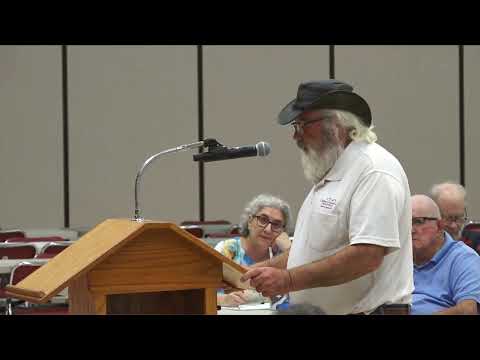
During the Article 2 discussion on membership cardholders and guests, members raised concerns about guest-card rules for single deed holders. Pamela Brasher, a member who identified herself and provided a member number, asked the board to revisit a request for a second card for single dwellers, proposing a restricted "member plus" card that could be used only when the deed-holder is present. "If there's a single deed holder that they get, call it whatever you want, a member plus card. And in order to use that member plus card, the member must always be there," Brasher said. Betty Bishop similarly urged the board to give the issue more thought, saying single residents pay assessments yet receive only one card.
Board members responded that the corporation's articles and prior court decisions have shaped assessment and membership rules and that the working group sought to balance member access with concerns about misuse of guest privileges at facilities. Director Collins noted the corporation's authority to levy annual property assessments "by property, not by person," and said court guidance supports that approach. Directors said board policies will be revisited to address operational concerns and that the guest-card question could be further studied.
Article 4, on membership meeting procedures, drew sustained discussion. The working group's proposal expands member access to propose and refine motions well before an annual meeting, provides a six-week pre-vote period with multiple voting mechanisms beyond an in-person annual meeting, and seeks to give members fuller information about the corporation's state before votes. Director Gray described the revisions as increasing membership input and reducing the potential for last-minute amendments without member review.
The replacement of Article 9 with a committees article consolidates committee rules and moves some petition procedures into a board policy. Candy Rogerio, who said she serves on the long-range planning committee, welcomed a requirement that the long-range planning committee look at projects five or more years into the future but asked whether there is sufficient oversight for near-term "big-ticket" items in the PIF (project/investment forecast).
The board also advanced changes to discipline proceedings intended to add procedural safeguards. The proposal moves the discipline provisions into the amended Article 10 and describes requirements such as providing redacted incident reports when a hearing is scheduled, giving affected parties opportunities to attend hearings, and routing personnel-related reports to human resources. Member Laurie Ellingson pressed for additional clarity in the discipline language, asking how terms such as "jeopardizes the rights or privileges" will be defined, what standard will be used to determine whether a report "has merit," how frivolous or hearsay reports will be handled, and whether redaction could leave the accused unable to prepare. Directors and the secretary said many procedural specifics will be developed in a corresponding board policy.
All motions before the board during the special session passed their first readings on roll-call votes of 9 in favor and 0 opposed. Secretary Keis and other directors said that many bylaw provisions will be followed by work to align board policies with the revised bylaw structure, and that some procedural details will be addressed in those policies rather than in the bylaws themselves.
The board announced upcoming meetings and a tentative annual membership meeting under the proposed bylaws for March 10, 2026, at 6 p.m. The meeting adjourned after the final votes.
Votes at a glance: definitions (first reading) — adopted 9-0; Article 1 (corporate office) — adopted 9-0; Article 2 (membership cardholders and guests) — adopted 9-0; Article 3 (assessments and fees) — adopted 9-0; Article 4 (membership meetings) — adopted 9-0; Article 5 (board of directors) — adopted 9-0; Article 6 (officers) — adopted 9-0; Article 7 (nomination and appointment procedures) — adopted 9-0; Article 8 (election of directors) — adopted 9-0; Article 9 (committees, replacement) — adopted 9-0; Article 10 (discipline proceedings, relocated/revised) — adopted 9-0; Article 11 (indemnification/risk management, relocated) — adopted 9-0; Article 12 (investments, relocated) — adopted 9-0; Article 13 (severability, new) — adopted 9-0.
What remains: the board recorded that many of the operational details flagged by members and directors (for example, discipline hearing procedures, redaction standards, guest-card operations and the PIF oversight mechanisms) will be drafted or revised in board policy and returned for further review and vote. The votes taken at the special session were first readings; the bylaws process calls for subsequent readings and associated policy alignment before final adoption.