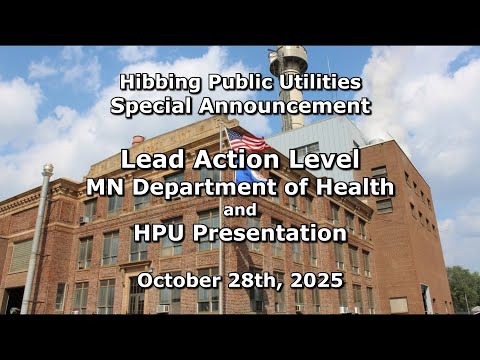
Hibbing utility alerts residents after lead action level exceedance; officials outline testing and replacement plan
Loading...
Summary
Hibbing Public Utilities announced this week that testing required under the Safe Drinking Water Act produced a lead action level exceedance for the city’s drinking water system, prompting additional testing, public outreach and a push to identify and replace lead service lines.
Hibbing Public Utilities announced this week that testing required under the Safe Drinking Water Act produced a lead action level exceedance for the city’s drinking water system, prompting additional testing, public outreach and a push to identify and replace lead service lines.
Hannah Mendez, a compliance engineer with the Minnesota Department of Health’s Drinking Water Protection Section, told the Hibbing Public Utilities Commission on Oct. 28 that Hibbing collected 29 lead samples between June and September and that six of those samples were above the U.S. Environmental Protection Agency action level, resulting in a 90th‑percentile exceedance. “It does not mean that every tap in the community that is used for drinking water has elevated levels of lead,” Mendez said, but she added the exceedance requires the utility to investigate causes, notify residents and take actions to reduce lead exposure.
The exceedance triggered several immediate steps, Mendez said: the utility must provide public notice (which HPU has done within 24 hours of receiving results), conduct additional sampling including testing source water, evaluate corrosion‑control treatment at the plant and expand public education. “Homes and buildings that do not have lead service lines or lead plumbing components are less likely to have elevated levels,” she said, explaining that sampling focuses on higher‑risk sites.
Why it matters: Lead in drinking water can pose health risks, especially to infants and young children. Stephanie Bridal, supervisor of MDH’s blood lead surveillance program, told the commission that Minnesota’s routine pediatric guidance remains in place: “Children should be tested at age 1 and age 2 for lead,” and parents who are unsure should consult their pediatrician. Bridal said the system‑level sampling results do not by themselves require immediate blood‑lead testing for all residents.
What HPU is doing: Brian, a Hibbing Public Utilities staff member, said the utility is pursuing multiple tracks. The utility is evaluating corrosion‑control additives at the treatment plant (any change will require MDH approval and will take several months to implement). HPU has been conducting a service‑line inventory to identify materials on both the private and public sides of connections; the utility reports roughly 33% of the system has been identified so far. To date, HPU has replaced 23 known lead service lines.
HPU also said it received approximately $1,000,000 in state funding last year to help with the inventory and replacements. Staff stressed that fully funded replacements are available for eligible households and urged residents to take part in the inventory so lines can be located and replaced when funding allows. Brian said HPU will use its existing contract with Bogales Construction to perform replacement work once lines are identified and homeowners are notified and scheduled.
Field work described: HPU staff described potholing at curb stops using a vacuum truck to expose and identify pipe materials at the public side of the curb stop. Because each service connection has a private side (from the indoor shutoff to the house) and a public side (from the curb stop to the main), a connection remains “unknown” if either side is unverified. Brian said roughly 60% of private sides are identified but a smaller share of public sides are confirmed because those pipes are buried.
Outreach and resident options: MDH and HPU advised homeowners to reduce exposure immediately by using cold water for drinking and food preparation, running taps before use, cleaning faucet aerators and using a filter certified to reduce lead. MDH provided a QR code and link to its “lead in drinking water” guidance; HPU said it will post resources and the QR code on its website. HPU also announced free utility‑scale home water testing and asked residents to call the office to schedule tests and interior inspections needed to complete the service‑line inventory.
Cause investigations and sampling notes: HPU staff said there is no evidence the treatment‑plant chemistry changed in a way that would explain the exceedance; some distribution projects and disturbances can affect localized lead release, and updated sampling that targets suspected lead service lines can increase the chance of detecting elevated values. HPU will test source water (wells) to rule out naturally occurring lead in the aquifer.
Notification scope: HPU confirmed that homeowners whose samples were elevated were notified immediately and that the utility issued the required systemwide public notice. Staff said they plan additional targeted outreach based on neighborhood construction age and urged neighbors to consult the statewide service‑line inventory tool.
What remains unresolved: HPU and MDH said they will continue follow‑up sampling, corrosion control evaluation and inventory work. The utility encouraged residents to participate in inspections and to schedule free testing; the timeline for large‑scale replacements depends on the inventory results and scheduling with contractors and funding availability.
Residents seeking more information can contact Hibbing Public Utilities or consult the Minnesota Department of Health’s lead‑in‑drinking‑water guidance (MDH link/QR code provided in HPU public notice).