Get Full Government Meeting Transcripts, Videos, & Alerts Forever!
Get email alerts on the Stormwater topic
No spam. Unsubscribe anytime.
Kirkwood holds lengthy public hearing on proposed stormwater ordinance changes; residents and builders raise cost and clarity concerns
Summary
Assistant City Engineer Jennifer Brown presented proposed updates to Kirkwood’s stormwater ordinance and design manual during a public hearing, saying the staff and HR Green recommend lowering the mitigation threshold from 1,000 to 500 square feet and capping impervious lot coverage at 55%.
Assistant City Engineer Jennifer Brown presented proposed updates to Kirkwood’s stormwater ordinance and design manual during a public hearing, saying the changes are based on HR Green’s stormwater master plan and staff recommendations. Brown told the council the staff recommendation would "lower the threshold for requiring stormwater mitigation from a thousand square feet to 500 square feet" and include a maximum impervious coverage cap of 55% on a lot.
The proposals also would limit new home basement depths unless a geotechnical report shows groundwater is at least 2 feet below the proposed finished floor or unless a provided groundwater map applies; require that sump-pump discharge not be routed into site BMPs; and tighten inspection and maintenance rules tied to stormwater permit refunds.
Why it matters: staff and the consultant framed the changes as an effort to reduce off-site flooding and improve water quality amid increased infill development. Councilmembers and residents said the city’s existing system has been strained and that the changes would help “catch up” with development patterns and regional expectations. Metropolitan St. Louis Sewer District (MSD) programs and grants were cited repeatedly during the hearing.
Residents, builders and technical commenters raised several sets of concerns. Resident Lauren Gramlich, who purchased and redeveloped a small lot last year, asked for clearer, lot-specific examples and said: "Can you build a house there? And can you build a house that can include a family?" Builders warned the rule changes could sharply increase costs for common renovations: contractor Jared Keplinger said real-world mitigation work can add "a topography survey that's 2 to $3,000," engineering $3,000–$4,000, and dry wells "about $8,000 to $12,000," producing incremental project costs he estimated at "$16,000 to $25,000." Several smaller-project contractors and residents urged exemptions or clearer net‑zero provisions for routine porch, deck or porch‑replacement work to avoid imposing large retroactive costs on small homeowners.
Technical commenters and nearby residents pressed staff on local soil and site conditions. Architect and longtime resident Daniel Erlanger described a neighboring project that struck an underground spring and left a BMP that remained full; Erlanger said local silty clay loam soils have very low infiltration rates and that, in some places, on-site infiltration BMPs are not effective. He and others urged the city to clarify when infiltration-based BMPs are appropriate and suggested the manual require soil infiltration testing rather than rely on a generic assumed rate.
Other residents supported stronger on-site mitigation and tree preservation. Gwen Wallman said costs of mitigation should not be shifted to downstream neighbors and voiced support for lowering the mitigation threshold and counting all impervious surfaces (driveways, patios, accessory structures) toward the total.
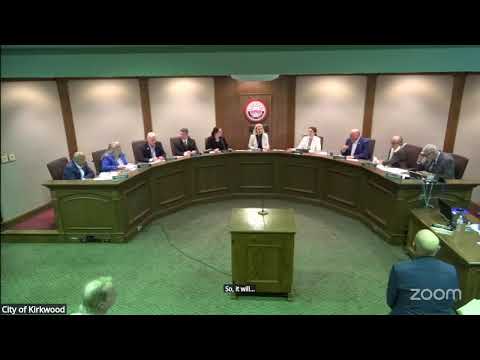
Staff responses and next steps: Brown and other staff answered technical and procedural questions but did not propose immediate changes at the hearing. Staff confirmed earlier outreach including two open houses, and Brown said parts of the draft manual provide different or more detailed language than the slide presentation. The mayor closed the public hearing and said council will consider ordinance revisions at a later date.
What remains unclear: participants asked for more explicit examples showing how the 55% cap and basement-depth rule will apply to smaller Kirkwood lots; for clarity on how MSD grant reimbursements would work with city requirements; and for improved guidance about when a project must undertake costly mitigation. Several speakers asked the city to provide parcel‑level illustrations or maps for residents and to consider affordability impacts on long‑time homeowners.
Officials and stakeholders proffered a mix of policy tradeoffs: staff and supporters said tighter on‑site requirements and tree protections can reduce downstream flooding and improve water quality; builders and some residents said that absent coordinated public infrastructure investment the regulations will shift substantial costs to owners and small projects. Council gave no vote on the ordinance at the hearing; Brown said staff will return with more information and any recommended ordinance language for future council consideration.