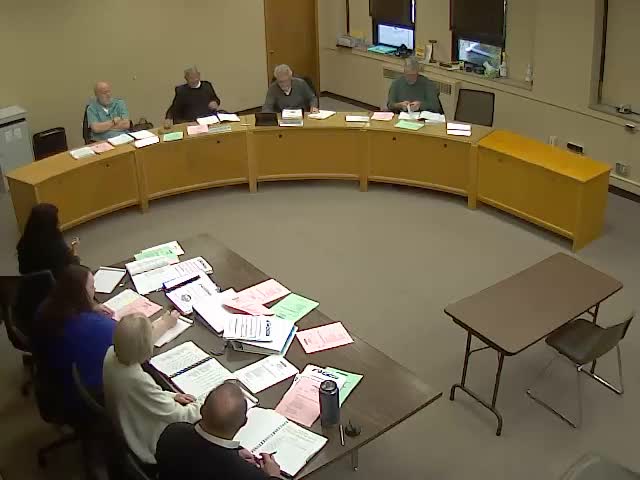
Committee moves Kenosha police 2026 operating budget and vehicle costs into CIP, flags cybersecurity and camera storage
Loading...
Summary
The Public Safety & Welfare Committee on Oct. 29 voted to recommend the Kenosha Police Department’s 2026 operating budget and the department’s 2026–2030 capital improvement plan to the Finance Committee.
The Public Safety & Welfare Committee on Oct. 29 voted to recommend the Kenosha Police Department’s 2026 operating budget and the department’s 2026–2030 capital improvement plan to the Finance Committee.
Mayor (name given as Mayor in the record) told the committee that ‘‘you’ll see $657,000 that has been moved out of their budget and into the capital improvement plan,’’ describing the shift as driven by higher vehicle prices and longer in‑service life for patrol vehicles.
Chief of Police (referred to in the record as the chief) told the committee the department does not issue take‑home cars and uses a ‘‘hot‑seating’’ model in which vehicles are used 24/7 by successive shifts. The chief said the department has moved to hybrid (HEV) patrol SUVs to reduce idling fuel use and improve performance; fully electric patrol vehicles are not operationally feasible in the chief’s view because of charging time and the department’s constant turn‑over of vehicles.
The chief also explained the move of squad‑car purchases to CIP is intended to better match the vehicles’ acquisition cost with their multi‑year service life. He estimated patrol vehicles reach roughly five years or 100,000–125,000 miles before warranties expire and individual evaluations decide whether to continue investing in a unit.
Committee members and the chief discussed staffing: the police authorized full‑time positions show no net change under the proposed budget. The department said several patrol officers have been assigned to a newly formalized Community Services Division (the Impact Team) focused on community engagement and event presence, not a reduction in street patrol strength.
On information technology, the chief described required upgrades to meet Criminal Justice Information Services (CJIS) security standards overseen by the FBI. ‘‘This is not a want. This is a need,’’ the chief said, noting CJIS mandates—such as dual‑factor authentication and stricter cybersecurity controls—require moving servers and services to compliant cloud environments and buying supporting hardware and software.
The committee also heard that body‑worn camera systems and related storage costs remain a growing budget driver. The chief and mayor described a rise in open records requests and the adoption of AI‑assisted redaction tools that speed processing but add subscription and storage costs. The department and mayor said the body‑camera system is now treated like a core public‑safety tool with ongoing operational expenses for storage and retention.
A motion to recommend the police executive budget and the police CIP to the Finance Committee passed on a voice vote; the transcript records the chair and members saying ‘‘aye’’ but does not list a roll‑call tally.
The committee forwarded the police materials to Finance for further review.
Votes at a glance: the committee moved the police department 2026 operating budget and 2026–2030 CIP to the Finance Committee for consideration (voice vote recorded as ayes).