Get Full Government Meeting Transcripts, Videos, & Alerts Forever!
Get email alerts on the Behavioral Health topic
No spam. Unsubscribe anytime.
Behavioral health directors outline Care Court, assisted outpatient treatment and diversion options
Summary
County behavioral health officials outlined voluntary services and court‑based pathways into treatment, including assisted outpatient treatment, Care Court, mental‑health diversion (Penal Code 1001.36) and conservatorship processes.
County behavioral health leadership briefed elected officials on the range of voluntary and involuntary pathways used to engage people with serious mental illness and co‑occurring substance use disorders.
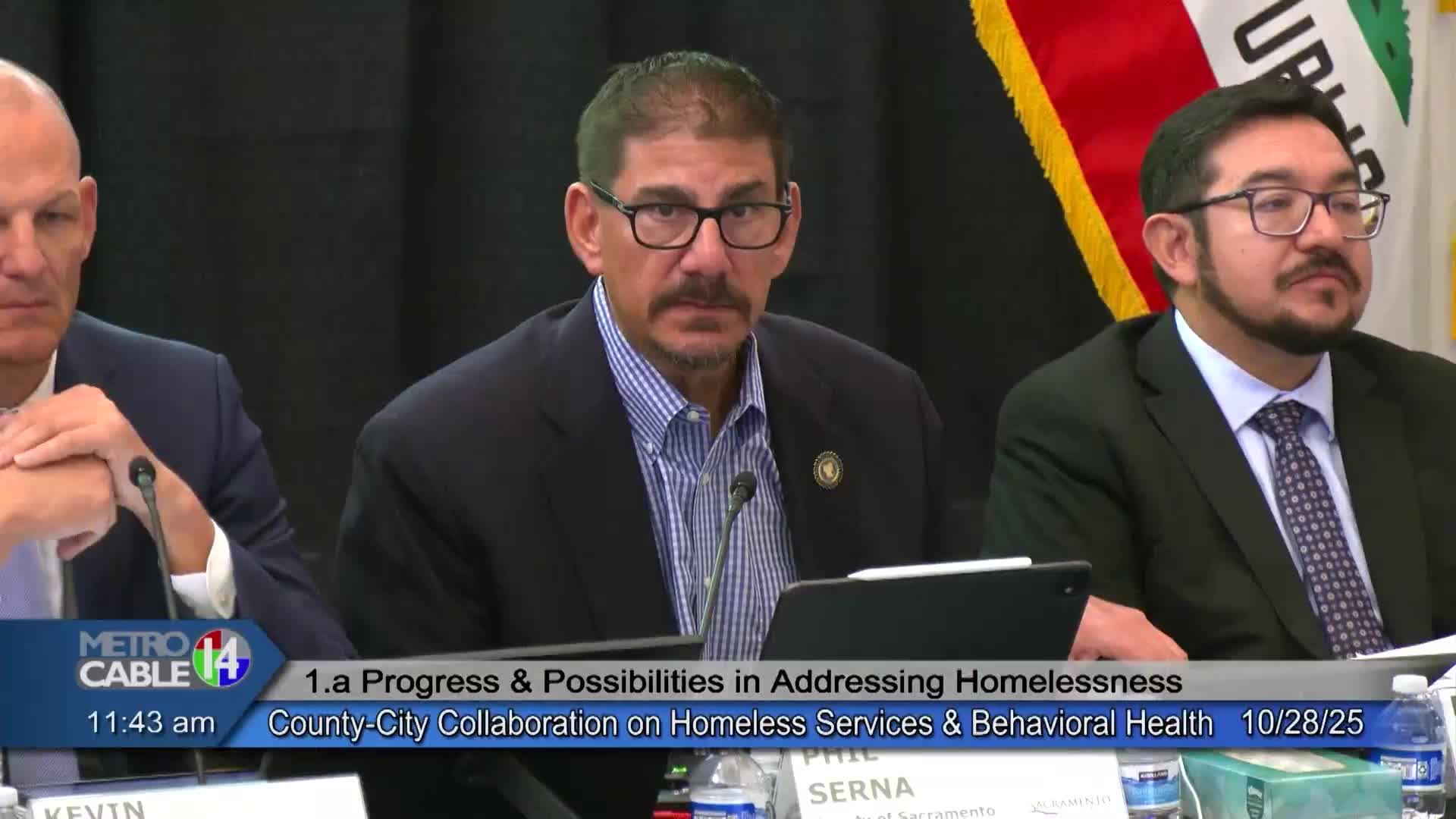
Ryan Quist, Sacramento County Behavioral Health director, described the full continuum of care and emphasized outreach and walk‑in access through 11 geographically distributed "core sites" and community wellness centers. Quist described court‑involved pathways that local officials asked about in depth:
• Assisted outpatient treatment (AOT): county staff outlined referral sources and the eligibility criteria focused on repeated hospitalizations or prior acts of serious harm and described how the program is intended to help people who will not engage voluntarily.
• Care Court: Quist explained Care Court’s eligibility is diagnosis‑based (schizophrenia and, newly added, bipolar I) and that petitions go directly to the court; Care Court petitions may be filed by family members, service providers and first responders.
• Mental‑health diversion (Penal Code 1001.36): Quist noted the program offers pretrial dismissal for eligible defendants who agree to and complete treatment; behavioral health conducts the clinical eligibility assessment while the court decides participation.
• Conservatorship: Quist summarized the standard LPS (Welfare & Institutions Code) conservatorship pathway that typically begins with a 5150 hold in an emergency department, then progresses through temporary holds and court hearings toward a possible LPS conservatorship if the person remains gravely disabled and unable to care for basic needs.
Sheriff Jim Cooper said law enforcement has built a 30‑officer HOT and POP response and that direct lines between supervisors and patrol sergeants speed field responses. He provided data from county enforcement: large numbers of citizen complaints, thousands of pounds of trash removed and arrests for violence and other crimes tied to some encampments. Cooper told electeds some sheriff’s data are maintained internally and are not automatically in HMIS; he said the sheriff’s office is open to improved data sharing so that operational teams and electeds can make better decisions.
Why it matters: behavioral health pathways provide tools to compel treatment in narrowly defined circumstances, but officials cautioned those tools succeed only if follow‑up services and housing exits are available. Quist and others repeatedly noted that treatment without an available housing exit is an incomplete solution.