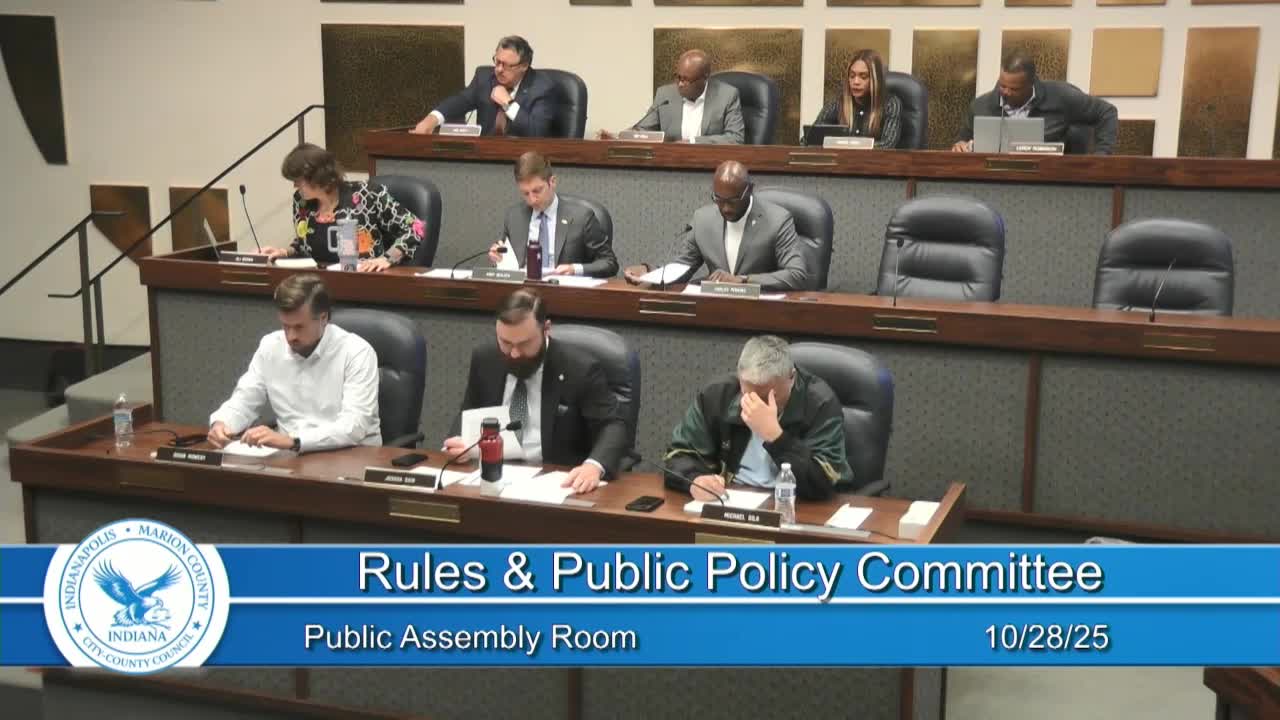
Indianapolis rules committee weighs independent oversight, new reporting channels in harassment policy review
Loading...
Summary
The Indianapolis City‑County Rules Committee on Oct. 28 reviewed steps the city‑county enterprise has taken to update workplace harassment policies and heard outside advice on possible structural changes, including a move to independent oversight of investigations.
The Indianapolis City‑County Rules Committee on Oct. 28 reviewed steps the city‑county enterprise has taken to update workplace harassment policies and heard outside advice on possible structural changes, including a move to independent oversight of investigations.
Corporation Counsel Brandon Bealer told the committee that "harassment training was made mandatory in the city code back in 2019" and that, by executive order in August 2024, annual harassment training was expanded to all employees; supervisors continue to have a biennial obligation under the ordinance. Bealer said the city uses the learning platform Lessonly, conducts in‑person training for employees without email access and set a Nov. 30 deadline this year for the current annual training.
Why it matters: Committee members said the central questions are how to restore employee trust and how to protect survivors while preserving investigators' ability to do thorough reviews. Several councilors expressed concern that routing complaints to the mayor's office — the "20 Fifth Floor" — discourages reporting and urged mechanisms that would ensure independence in investigations of senior officials.
Most of the committee's presentation time was given to details of systems already in place and planned. Bealer said the city conducted demonstrations of six third‑party anonymous reporting vendors and selected Speakfully; Speakfully was promoted in HR communications and formally launched for the enterprise in January 2025 after an internal ISA tool was used temporarily. "We are proud to officially launch Speakfully at the beginning of this year," Bealer said. He reported roughly 123 submissions since launch and characterized about half as policy questions and the other half as complaints; he said "only 4" of those submissions were complaints alleging sexual harassment and that five county offices maintain separate HR units that handle their own matters.
Bealer also described employee resources available through the Employee Assistance Program and Marathon behavioral‑health services, noting Marathon now permits employees to schedule therapy without a referral. He recounted work by an internal planning group and two working groups — a harassment policy working group led by Chief Diversity Officer Ben Tapper and a company‑culture working group co‑led by the director of the office of audit and performance, Wes Jones, and Tapper — and said Raftelis was selected to run a cultural assessment survey and led nine subsequent focus groups. He said the survey achieved roughly a 30 percent participation rate and the city expects final results and recommendations by the end of the year.
Outside experts urged more specificity and independence. Emma Davidson Tribbs, cofounder and director of the National Women's Defense League, praised recommendations that would centralize investigative authority and called for "an unbiased third‑party support for reporting, investigations, and resolution." Tribbs urged the council to require multiple confidential reporting channels and recommended annual transparency reports that disclose aggregate complaint numbers and outcomes without identifying survivors.
Tracy Justice, director of government affairs for Indy SHRM, framed the legal context for public‑sector employers and cited federal case law to stress why accessible reporting, clear policies and routine training matter. Justice summarized the Supreme Court's Faragher/Burlington framework and more recent circuit holdings to underscore that employers who establish clear reporting systems and promptly investigate complaints reduce legal risk and provide better protection for employees.
Councilors pressed for practical fixes. Several asked whether a temporary ad hoc inspector general, an independent human‑resources board or an ombudsman could receive reports directly and investigate without routing through the mayor's office. Bealer said designing a truly independent entity raises public‑record and operational challenges because investigatory material can become public and survivors may need confidentiality; he acknowledged independent oversight remains an objective but said the city has not yet identified a legally sound model that preserves confidentiality while offering independence.
Public comment reinforced those concerns. Morgan Mickelson, a former city sustainability director, urged the committee to "adamantly pursue an independent third‑party solution," to publish implementation measures and to expand direct outreach to employees who may distrust internal channels.
Procedural action: Councilor Michael Nielsen moved to extend speaker time for the meeting's public comment period from two minutes to four minutes; the motion was seconded and adopted by voice vote (ayes recorded; no roll call). The committee chair said the survey results and final recommendations from Raftelis will be public documents and that the committee will continue to refine recommendations, coordinate with HR and legal staff, and evaluate fiscal implications of structural changes before pursuing ordinance or administrative changes.
What remains unresolved: Council members repeatedly raised the problem of perceived conflicts when complaints route to the executive office and asked for options that would allow reports — especially those involving senior or elected officials — to be handled by an independent intake and investigative body. Experts recommended piloting an ombudsman or third‑party intake while the city develops long‑term structures and emphasized survivor confidentiality, retaliation protections and regular anonymous reporting audits as central safeguards.
Next steps: The committee will continue deliberations, seek more public engagement, review Raftelis's final survey and recommendations, and consult HR, the corporation counsel's office and external experts before drafting ordinances or formalizing statutory changes.