Dane County supervisors debate holding 20 deputy vacancies as compromise to preserve human services funding
Loading...
Summary
Dane County supervisors on Tuesday spent hours weighing how to cover a multiyear budget shortfall, debating whether to permanently eliminate vacant deputy positions or to budget salary savings by keeping a subset of positions unfilled.
Dane County supervisors on Tuesday spent hours weighing how to cover a multiyear budget shortfall, debating whether to permanently eliminate vacant deputy positions or to budget salary savings by keeping a subset of positions unfilled.
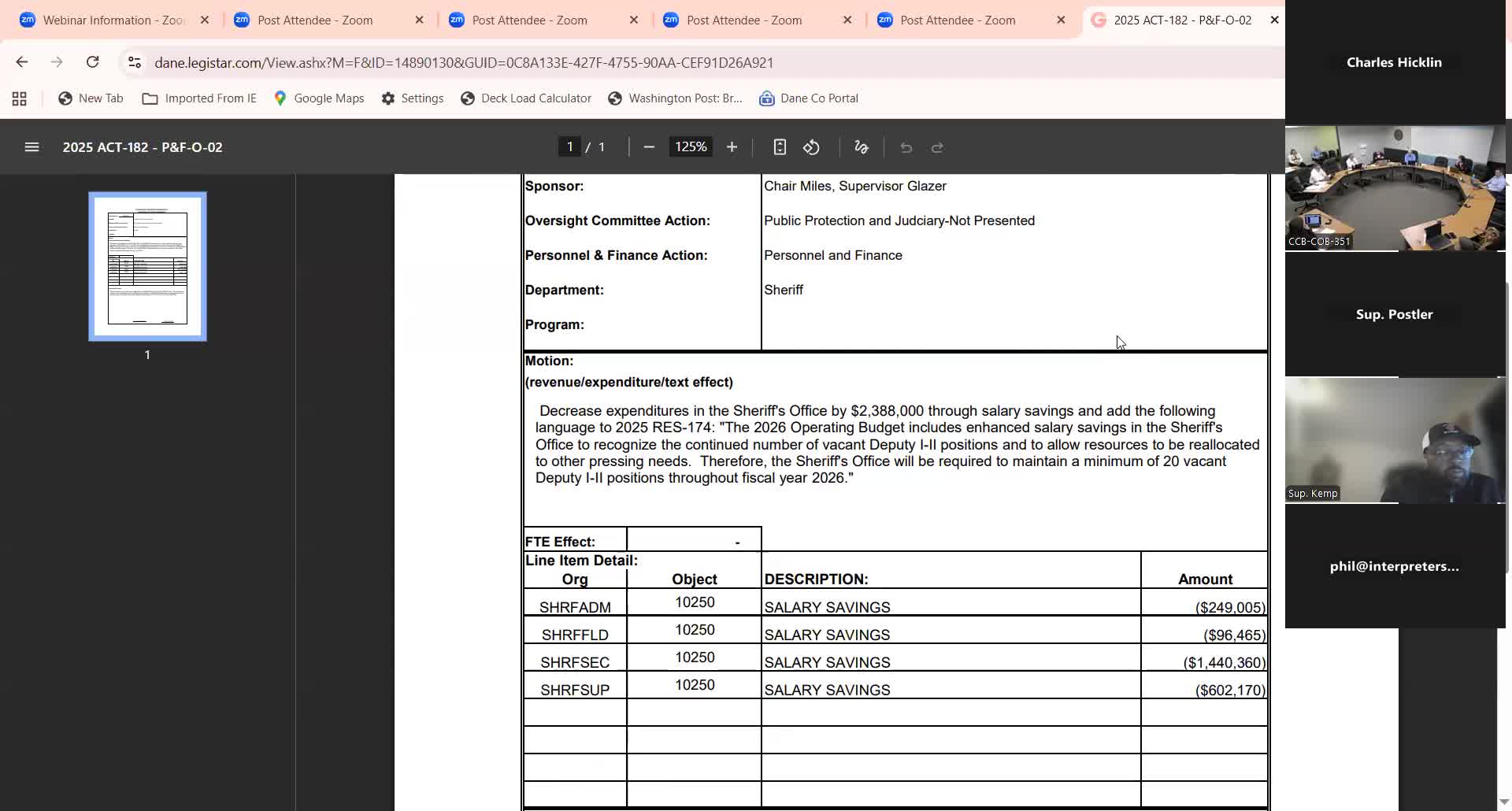
At the center of the debate is a trio of amendments from the Public Protection & Judiciary committee that would eliminate vacant deputy positions as offsets for restoring funding to human‑services and shelter contracts. Chair Miles and Supervisor Glaser proposed an alternative that would not defund positions but would require the sheriff to maintain 20 vacant deputy positions through 2026, producing roughly $2,380,000 in salary savings toward the county’s 4% target.
Supporters of the compromise framed it as a way to preserve critical shelter and purchase‑of‑service funding while recognizing recruitment challenges the sheriff faces. “That $2,380,000, in addition to the $1.5 million in federal hold revenue proposed elsewhere, combined equals the 4% GPR target,” Supervisor Glaser told the committee, arguing the change would be less disruptive than permanent eliminations.
Sheriff Kalvin Barrett and deputy representatives pressed back, saying vacancies have driven large overtime costs and that eliminating position authority now would limit the office’s ability to recover staffing over the next year. “We are mandated by Wisconsin state statute to operate the jail,” Sheriff Barrett said. “There are no days off. We have to man these positions 24/7, 365.” Brian Tischer, president of the Dane County Deputy Sheriffs Association, added an emotional plea against cuts: “Please don’t support these amendments,” he told supervisors.
Advocates for the human‑services amendments said the county’s safety net is already frayed and that cutting purchase‑of‑service funding would push more people into emergency systems and the jail. “We need to focus on priorities and funding where they are most needed,” said Paul Seaman of MOSES (Madison Organizing in Strength, Equity and Solidarity). Multiple nonprofit and shelter providers warned that a planned, purpose‑built men’s shelter will open with capacity of about 250 but that recent nights have seen more than 370 people seeking shelter.
Supervisors signaled they were inclined toward compromise but requested specific math showing exactly how the Miles/Glaser approach would map to the human‑services and shelter restorations. Several supervisors asked that the committee package be adjusted so a subset of PP&J amendments could be preserved alongside the 20‑vacancy approach; others said they would withhold support unless more of the POS restorations were protected in full.
Committee staff said no final vote was taken Tuesday; supervisors asked county staff to model combinations of offsets so the board can vote with a clearer accounting of which human‑services amendments would remain funded under the compromise.
If adopted, the compromise would be temporary budget authority intended to preserve flexibility for the sheriff while freeing some resources to maintain shelters, nonprofit contracts and other social‑service programs until the board finalizes a full budget package.