Get Full Government Meeting Transcripts, Videos, & Alerts Forever!
Get email alerts on the Los Alamos Project topic
No spam. Unsubscribe anytime.
Caltrans project manager details Los Alamos Connected Community project and targeted engagement tactics
Summary
Madeleine Jacobson, Caltrans senior transportation planner and project manager, described the Los Alamos Connected Community Project (State Route 135/Bell Street). She outlined the project’s planning history, targeted outreach to seniors and school communities, repeated ATP applications and lessons learned for community‑centered engagement.
Madeleine Jacobson, senior transportation planner at Caltrans and the project manager for the Los Alamos Connected Community Project, described the project’s origin, community engagement process and current status during the ATP Symposium plenary.
Jacobson said the project addresses gaps along State Route 135 (locally called Bell Street), the community’s main street, where essential services — the post office, health center, mobile home park, park and school — are located. She traced the project’s planning history to a 2011 Los Alamos Community Plan and a 2015 Pedestrian Circulation and Parking Plan and said those documents established the need the project seeks to fill.
Jacobson explained the project team pursued ATP funding across multiple cycles. In 2018 (ATP cycle 4) the team used postcards distributed through the local post office to collect resident feedback. During the COVID‑era application (cycle 5) outreach shifted to an online SurveyMonkey instrument that reached more than 200 residents — more than 10% of Los Alamos’s population, she said.
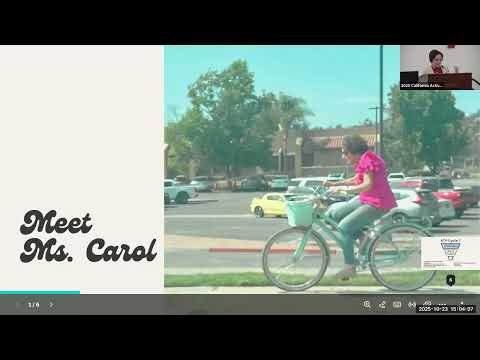
For the successful 2022 application, Jacobson said the team focused engagement on populations more vulnerable to traffic hazards. The outreach included tabling during school drop‑off and pickup, conducting a presentation and a simplified walk audit with the local senior center using an AARP checklist, and working with the Orcutt Unified School District. Jacobson said the project used a simple printed map at each public meeting to gather location‑specific input from parents, students and seniors.
Jacobson reported the project completed its environmental document in the prior year and that Caltrans is managing design and delivery within constrained department budgets. She said a non‑infrastructure component — educational or programmatic elements identified during outreach and supported by the local bicycle coalition — will proceed in parallel with construction.
Jacobson closed with lessons learned: build from larger planning efforts; partner with key stakeholders (schools, senior centers, local bicycle coalitions) to expand reach; use existing tools (AARP street checklists, established survey platforms); and, if unsuccessful in one ATP cycle, apply again and broaden engagement.