
Dunn County approves temporary asphalt plant at Downing Quarry with conditions
Get AI-powered insights, summaries, and transcripts
Sign Up Free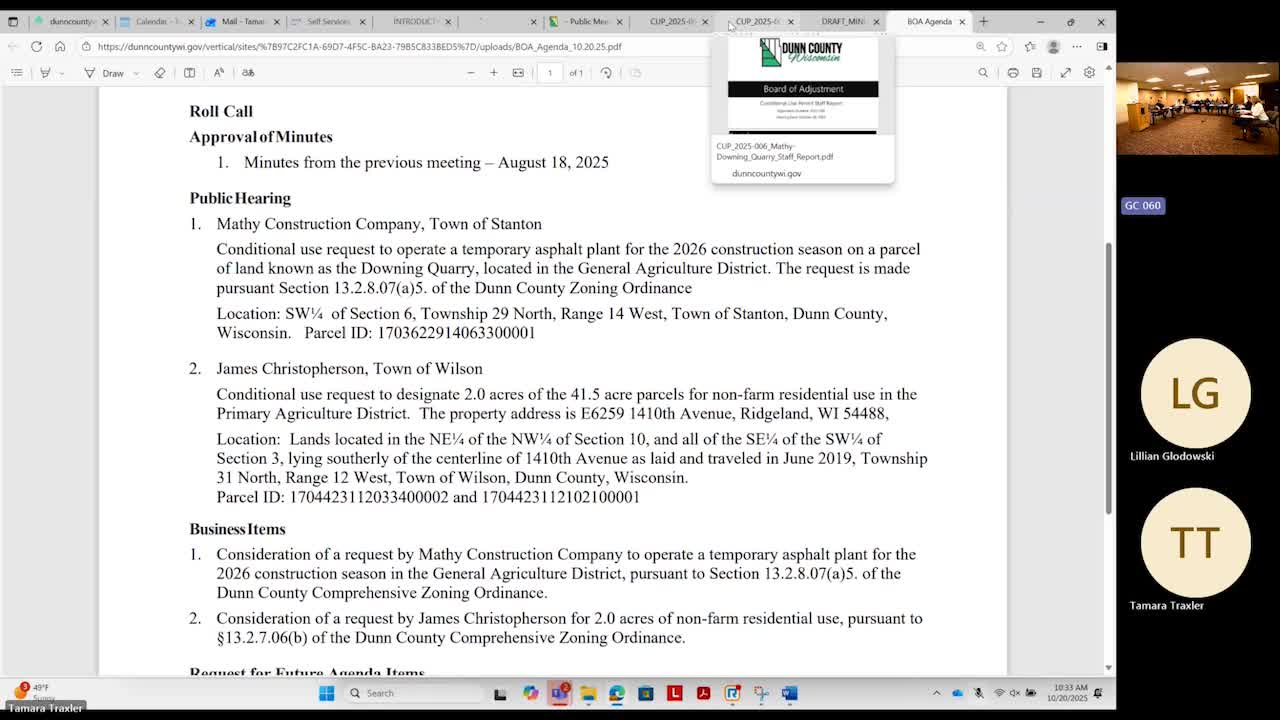
Summary
The Dunn County Board of Adjustment on Oct. 8 approved Mathey Construction’s request to operate a temporary asphalt plant at the Downing Quarry for the 2026 construction season, subject to conditions limiting plant production to 6 a.m. to 8 p.m. and requiring mitigation and notification measures.
The Dunn County Board of Adjustment on Oct. 8 approved Mathey Construction’s conditional-use request to operate a temporary asphalt plant at the Downing Quarry to serve the Wisconsin Department of Transportation Highway 128 paving project, voting 5–1.
The board attached conditions including limiting plant production operations to 6 a.m. to 8 p.m. Monday through Saturday, requiring the applicant to offer emergency‑responder outreach within the first three weeks of operation, provide a local point of contact for neighbors, and notify county staff when the plant is delivered, placed into operation and removed.
Tammy (zoning staff) told the board the proposed site is a previously disturbed portion of the Downing Quarry (address listed as 1131 County Road W), a 32‑acre parcel. The mobile plant would primarily serve WisDOT project 8650-0074 (State Highway 128, from U.S. Highway 12 to State Road 170) and could also supply Dunn and Saint Croix county highway departments and local municipalities. Staff said the quarry has operated since 1968 and is permitted under chapter 20 of the Dunn County zoning ordinance for mining and reclamation. Staff noted that state agencies — the Wisconsin Department of Transportation, Department of Natural Resources and Department of Agriculture, Trade and Consumer Protection — regulate aspects of asphalt production including mix quality, air emissions, stormwater and fuel storage.
Candy Anderson, representing Mathey Construction, Monarch Paving and Milestone Materials, said mobile asphalt plants typically remain on a single site about 6–8 weeks but requested authority for the 2026 construction season to allow flexibility for weather and project scheduling. Anderson said the company would notify county staff when the plant moves in and out and described standard mitigation: water trucks and roadway sweeping to control dust, baghouse filters to capture particulates, automated monitoring that will force plant shutdown if emissions limits are exceeded, and the use of an odor neutralizer product (described in testimony as Ecosorb).
"We do have bag houses on them. ... The outside of the bag actually catches the dust and the particulate matter so that it stays on the bags instead of going into the air," Anderson said. She added that plants submit compliance reports to the DNR and that the company performs annual environmental reporting.
Neighbors at the hearing raised health, noise, traffic and groundwater concerns. Eileen Michalski (N9282 County Road Q, Downing) asked whether air pollutants would be measured and said published health assessments show associations between asphalt production and respiratory and cardiovascular conditions. "If we smell the asphalt plant, are we breathing these pollutants?" Michalski asked.
Jess Ishens, also of County Road Q, told the board she was worried about exposure because her property is downwind and asked the board to limit any extension of the proposed hours. "The last thing we want is to have our windows open on a lovely summer evening and hear all sorts of trucks at 2, 3 a.m. in the morning moving around," Ishens said.
Nearby landowner Gene Schult (1101 County Road W) said he was primarily concerned with hauling impacts on County Road W, asked about well protection and restoration of the site after operations, and requested assurance that neighbors would be notified before blasts; Anderson said the operation maintains a blast call list and notifies emergency responders before moving the plant.
Board members pressed for clarity on hours, Saturday use and the length of the operation. Several members said a limit on production hours but allowance for setup/teardown and occasional Saturday work (to keep the plant moving between jobs or to recover from weather delays) was reasonable. The board added a condition that local emergency services be contacted and offered training specific to industrial and mining incidents within the first three weeks of operation.
The board’s motion (moved by Chair Crystal Halverson, seconded by Tim Lino) listed nine conditions, including: adherence to commitments made in the application and at the hearing; final approval contingent on formal action by the town; operation only during the 2026 construction season with plant production operations limited to 6 a.m.–8 p.m. Monday–Saturday; emergency responder outreach in the first three weeks; a neighbor point of contact and county notification when the plant is placed and removed; and compliance with all applicable local, state and federal permits. The motion passed 5–1; Heather Seaburn cast the lone "nay."
The board noted that state permits still apply (air quality, stormwater, fuel storage, and DOT material specifications) and that the county’s approval does not replace any other required state or federal permits. Written decisions will be filed in the zoning office and may be appealed to Dunn County Circuit Court within 30 days after the decision is filed.
— Actions and key details from the hearing —
• Applicant: Mathey Construction, agent Monarch Paving; on-site manager: Nick Clobis.
• Location: Downing Quarry, County Road W (32-acre parcel); operation planned within previously disturbed quarry area.
• Intended use: Temporary mobile asphalt plant primarily to serve WisDOT Hwy 128 project; company said plant typically on site 6–8 weeks but requested season-long authorization for schedule flexibility.
• Hours/operations conditions: Plant production operations limited to 6 a.m.–8 p.m. Monday–Saturday; additional hours allowed only for maintenance/setup/teardown; local emergency services to be offered training within first three weeks.
• Mitigation measures described: baghouse filters, automated emission monitoring, water trucks, roadway sweeping, odor neutralizer (Ecosorb), downward‑facing lighting if night maintenance required.
• Regulatory oversight: Wisconsin Department of Natural Resources (air/stormwater), Wisconsin Department of Transportation (mix quality/specs), DATCP (fuel storage), Dunn County Land Conservation Department (mining/reclamation, chapter 20).
• Notification/monitoring: Applicant required to notify county when plant is delivered, placed into operation and removed; county may request operation records; neighbor point-of-contact required; substantiated complaints may prompt review.
• Vote: 5 in favor, 1 opposed. Appeal period: 30 days to circuit court.
The board’s conditions aim to balance the county’s infrastructure needs — notably the local DOT paving project and potential cost savings for nearby townships — with neighborhood concerns about dust, emissions, traffic and emergency response. Neighbors and agencies retain the right to request county review if mitigation measures fail or substantiated complaints arise.