
Economic analysis: experts forecast local jobs and roughly $23 million in property taxes over life of project
Get AI-powered insights, summaries, and transcripts
Subscribe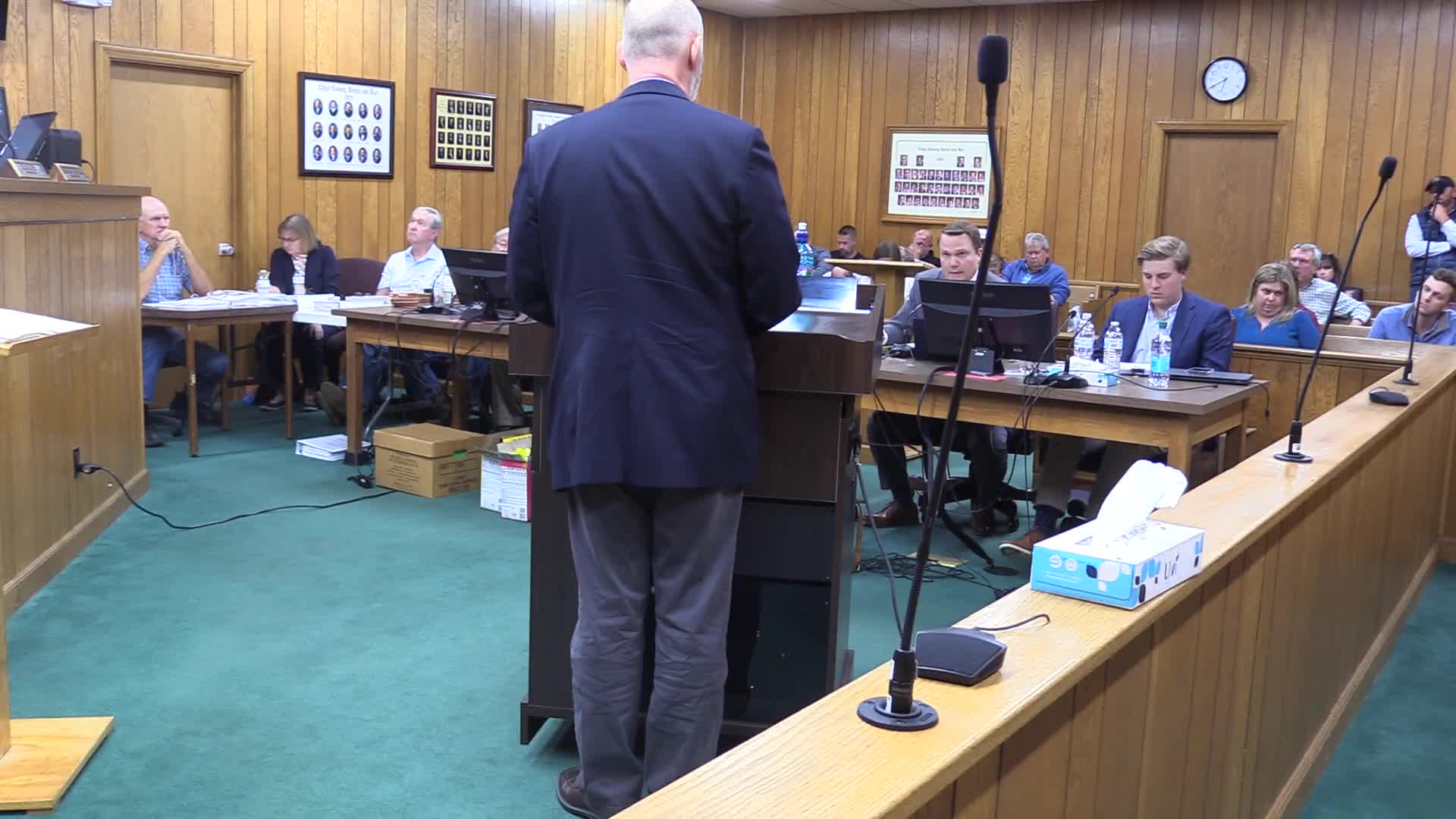
Summary
An independent economist testified that the Stateline Energy Center would create a modest number of local construction and permanent jobs, and yield roughly $23 million in property-tax revenue to local taxing districts over a conservative modeled life; the largest single recipient would be the local school district.
David Loomis, an economist and principal of Strategic Economic Research LLC, presented an IMPLAN-based economic impact study for the proposed Stateline Energy Center and battery storage facility.
Loomis explained the analysis distinguishes direct (on-site construction and operations), indirect (local supply chain) and induced (household spending) impacts. To be conservative he modeled sourcing assumptions that limited the share of construction labor and services coming from Edgar County itself, while capturing a larger regional employment effect within Illinois.
On the tax side Loomis relied on Illinois law that values certain solar installations per megawatt of capacity (adjusted annually by a trending consumer-price index factor) and applies a statutory depreciation schedule. Using a conservative inflation forecast and a 25-year analysis horizon, Loomis reported roughly $23.0 million in total property-tax receipts to taxing entities over the analysis period, with Paris Community Unit School District 4 projected to receive about $13.3 million of that total.
When asked to provide an exhibit-level figure the witness supplied a 2029 fair cash value estimate of $20,632,617 and an equalized assessed value (EAV) of $6,877,539 for the project footprint, which county staff said they would use in further fiscal review.
Loomis and board members discussed modeling assumptions: he described his choices for a conservative horizon (25 years), conservative local-sourcing assumptions, and a moderate inflation forecast. He told the board that if the project were repowered or its operational life extended, tax receipts would continue beyond the modeled horizon and could increase if taxing rates or inflation were higher than modeled.
Members of local trades and unions testified in support of the project, promising locally sourced construction labor and training opportunities under project-labor arrangements; contractor witnesses and union representatives said workers and related spending historically bring material retail and service revenue to host counties during construction.