
Engineer outlines $25.25 million decommissioning plan; county questions missing details and seal
Get AI-powered insights, summaries, and transcripts
Subscribe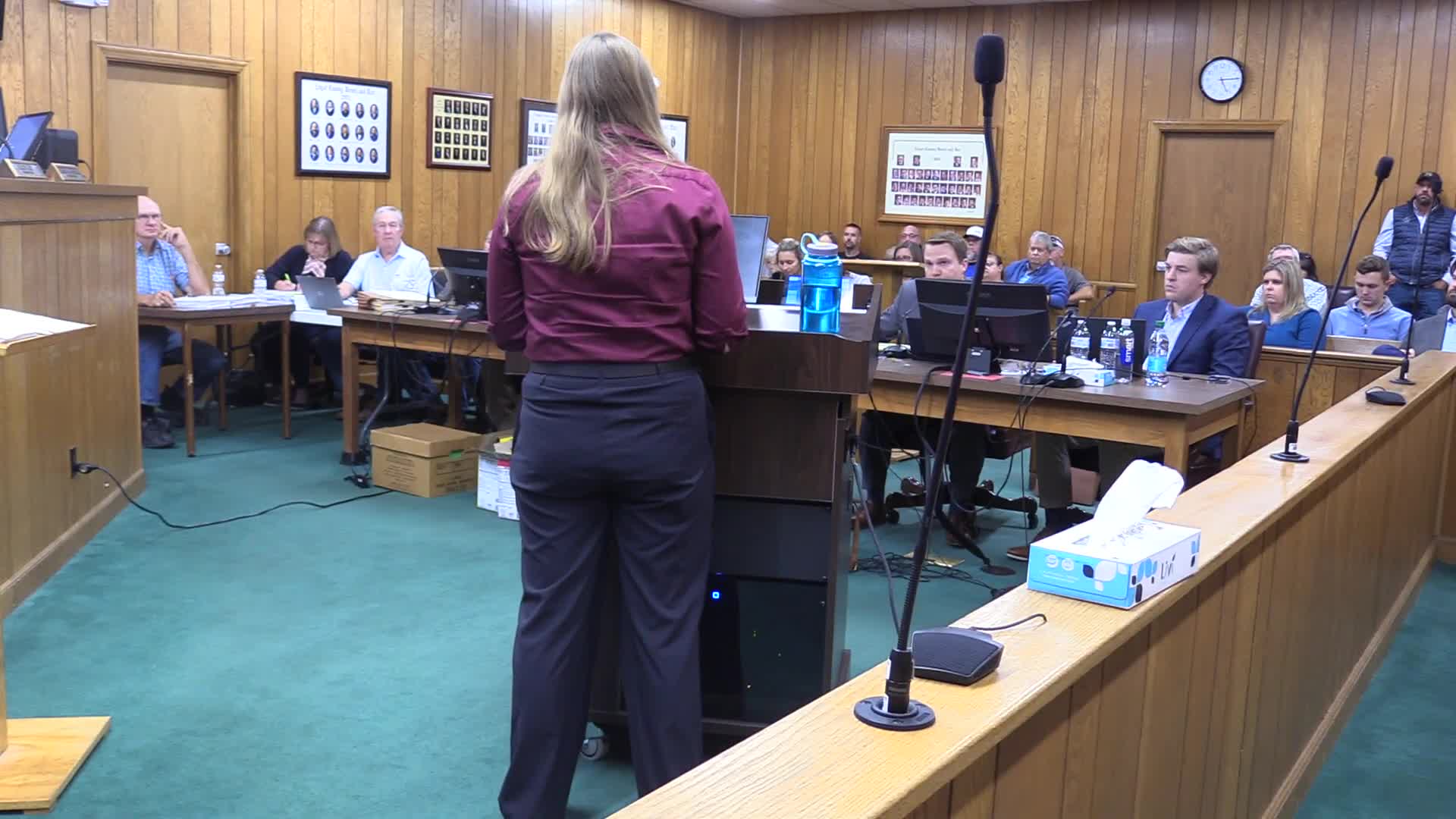
Summary
Anne Rowley, a project engineer for TRC Companies, presented a preliminary decommissioning plan that estimates the gross cost at $25,249,600.40 for Stateline Energy Center, but county attorneys and board members said the exhibit omits items the Agricultural Impact Mitigation Agreement and state siting statute require.
Anne Rowley, a project manager and senior project engineer at TRC Companies, told the Edgar County Board during a public hearing that her firm prepared the preliminary decommissioning plan for Stateline Energy Center LLC by compiling the applicant’s site civil drawings, counting quantities and applying Edgar County prevailing labor rates and standard contractor costs.
Rowley, who the applicant identified as an expert in civil site design, said the estimate is preliminary and intended to be refined later with final building-permit drawings. “The total gross cost was $25,249,600.40 currently,” she said as she summarized the line-item spreadsheet her team produced.
The decommissioning estimate includes removal of structures and access roads unless a landowner requests to keep them, erosion-control measures, and contractor overhead and insurance, Rowley said. She explained the county typically would review and may require updates of the plan during the project’s life. She also confirmed that the AIMA requires completion of decommissioning within 12 months of the trigger event.
County counsel Brian Kite pressed Rowley about technical and legal gaps in the exhibit she submitted. Kite noted several AIMA provisions and asked where the plan shows the original construction cost and identification of drainage tiles. Rowley acknowledged that the decommissioning exhibit does not include a separate listing of original construction costs and that drainage-tile locations were not shown because a site-specific tile survey and site plan were not included in the preliminary submission.
Kite and other board members also asked whether the decommissioning document had been signed and sealed consistent with the Illinois Professional Engineering Practice Act. Rowley said the exhibit had not been sealed because the county had not required sealing at the preliminary stage, but she indicated TRC could provide a sealed version if the county wanted one. On that point she testified: the document “is not signed and sealed in the exhibit,” and later, when asked whether it could be sealed, said “We can seal it tonight.”
Board members and members of the public pressed for clarifications about what is removed during decommissioning — for example the depth and extent of concrete pads and gravel access roads — and whether soil disturbed by foundations or roads would be returned to the site. Rowley said grading is typically minimized so the topography and drainage patterns are substantially restored and that utilities buried deeper than 5 feet may remain if the landowner wants them to.
The exchange highlighted a gap between what the AIMA and the siting statute describe as requirements for construction/deconstruction plans and what had been submitted so far: the county’s counsel and staff said the exhibit lacked several AIMA elements (original construction cost accounting, mapped drainage tiles, prescribed weed-control measures and a finalized lead-management plan), while Rowley described the submission as a preliminary, engineering-level cost estimate that would be refined during the permitting stage.
The hearing was recessed and the board continued the review to Nov. 5, when the county indicated it would expect further documentation, and when the hearing record will be completed before the board deliberates and votes.