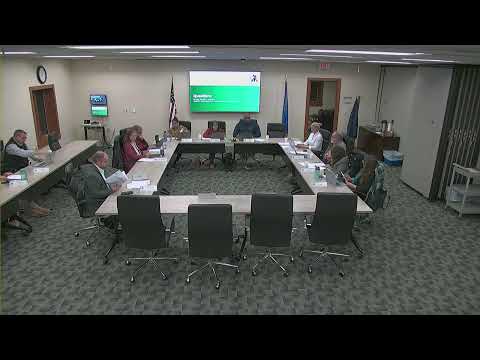
Sheboygan Area School District adopts $193.6 million 2025-26 budget; tax levy certified at $39.07 million
Loading...
Summary
The Sheboygan Area School District Board of Education voted to adopt the district's 2025'26 original budget of $193,551,082.94 and certified a property tax revenue amount of $39,065,700 after a public hearing and staff presentation on state aid, revenue limits and voucher costs.
The Sheboygan Area School District Board of Education voted to adopt the district's 2025'26 original budget in the amount of $193,551,082.94 and certified a property tax revenue amount of $39,065,700 at the board's public meeting. Board members moved and seconded the recommendation from administration and approved the measure by voice vote.
The vote followed a detailed presentation by district staff explaining how state revenue limits, resident-enrollment counts and the state budget affected the district's revenue composition. Mark, a district staff member who led the presentation, told the board that the district's three-year enrollment average and the state'determined per-pupil revenue amount together set a revenue cap that the district fills with a combination of general state aid and local property tax. He said the district's three-year average enrollment dropped and the state provided no increase in general state aid in the most recent state budget, creating a larger local levy burden.
"Property values went up," Mark said, "and we lost about $2.6 million in general state aid from last year. That's a significant shift of the tax burden from the state to our local property tax owners." He also told the board the district's funding mix shifted to roughly 75% state aid and 25% local tax in the current calculation, compared with about 79%/21% previously.
Board discussion emphasized two budget drivers singled out by staff: an unexpected increase in open-enrollment tuition payments and a growing levy for the state private-school voucher program. The presentation noted a $4,376,000 increase in the levy for district operations and an additional $712,608 increase tied to the voucher program; together, the administration said, those changes produced a combined levy increase of more than $5 million.
Mark described the voucher levy as a growing line item whose dollars flow through the district tax levy but are paid to participating private schools. "We're levying $11,790 for each voucher student charged to us," he said, noting the voucher portion of the levy totals roughly $7.2 million and accounts for about 18% of the district's levy in the current calculation. Board members and staff discussed the lack of a separate line on local tax bills showing voucher amounts and said the format of county tax bills and local procedures affect whether that separation can appear without broader municipal action.
Administrators told the board they balanced the budget without using operational referendum dollars, explaining the district had constrained costs through staff attrition, negotiated increases tied to the CPI and a medical-insurance platform change that produced no premium increase for 2026. They also credited an increase in special-education reimbursement (described by staff as a 10% bump for the current year) with helping the operational fund balance.
The board moved to adopt the budget and certify the levy at the administration's recommendation. The motion was made and seconded; the board approved it by voice vote. The meeting minutes record: "All in favor, say aye. Aye. Motion carries." The motion did not list individual recorded roll-call votes.
The board also held a public hearing earlier in the meeting during which staff explained revenue caps, the district's resident-enrollment calculation and the declining-enrollment exemption. District staff stressed that, because the state did not increase general state aid in the most recent state budget, the local property-tax burden increased even though the total revenue limit that the district may draw from state aid plus levy remains a fixed calculation.
This item was the primary formal action taken during the meeting. The board later voted unanimously by roll call to enter closed session under Wisconsin Statute 19.85(1)(c) for the superintendent's annual performance evaluation.
Quotes used in this article are verbatim from the meeting transcript and are attributed to speakers who spoke on the record.