
MWRD outlines stormwater programs, urges Berwyn to apply for green infrastructure and flood grants
Get AI-powered insights, summaries, and transcripts
Subscribe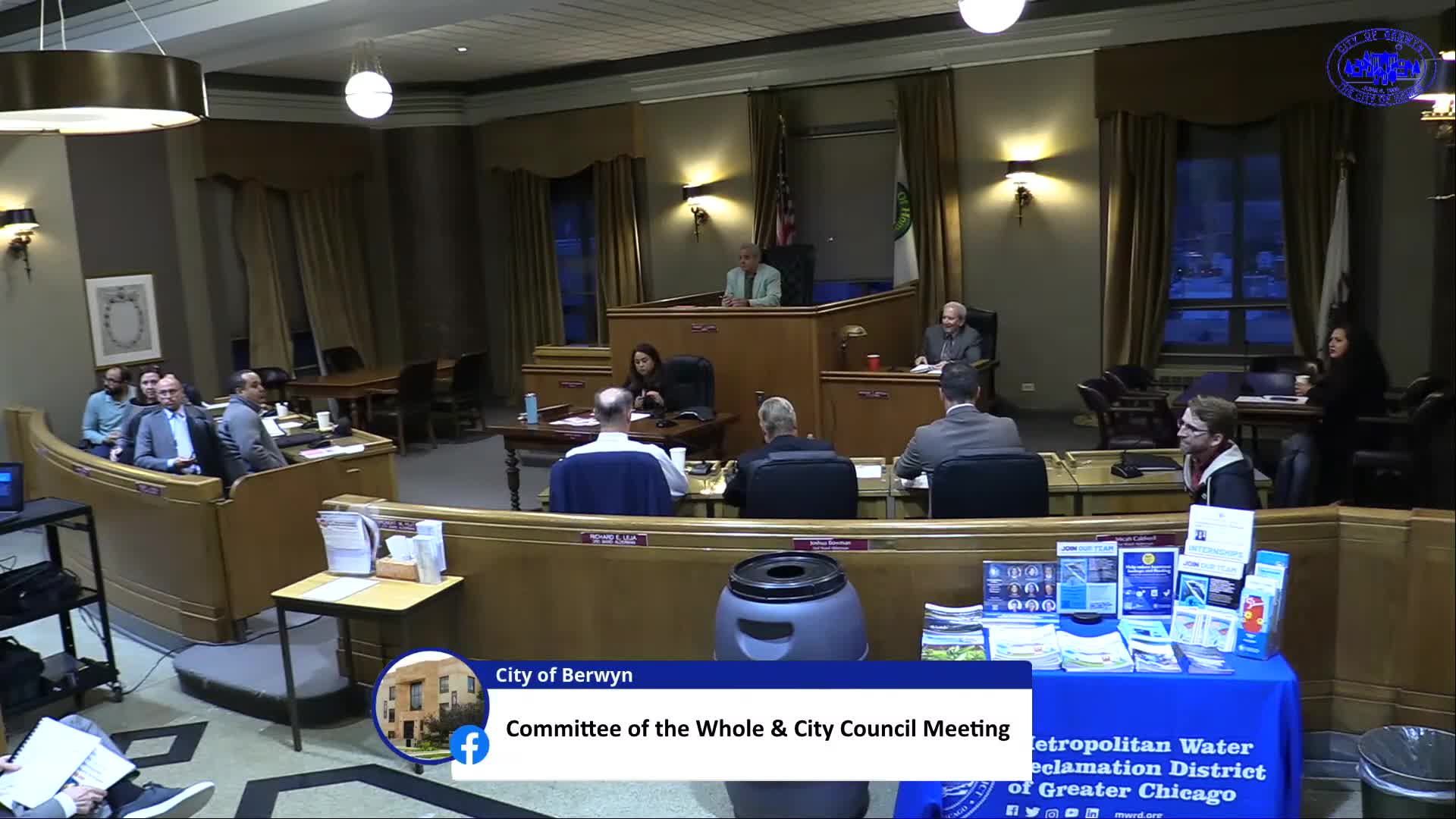
Summary
At a Berwyn Committee of the Whole meeting, Metropolitan Water Reclamation District officials described how combined sewers, deep tunnels and reservoirs work together to reduce flooding and water pollution and urged municipalities to apply for partnership grants, green schoolyard pilots and downspout-disconnection programs.
Kevin Fitzpatrick, assistant director of engineering for the Metropolitan Water Reclamation District of Greater Chicago, told the Berwyn Committee of the Whole that the district’s long-term mission began in 1889 to protect Lake Michigan and the region’s drinking water and now includes countywide stormwater management authority since 2004.
“The Water Reclamation District was created a long time ago, back in 1889,” Fitzpatrick said, summarizing the agency’s history and role in wastewater treatment and stormwater programs. He described how older municipalities such as Berwyn have combined sewer systems that carry sanitary waste and stormwater in the same pipes, which can cause combined sewer overflows and basement backups in large storms.
Fitzpatrick reviewed the Tunnel and Reservoir Plan (TARP), a deep-tunnel system constructed after a 1972 board decision to capture excess combined sewer flow and store it until it can be treated. He said the district’s seven water reclamation plants clean about 1.2 billion gallons of wastewater per day and that reservoirs such as Thornton (about 8 billion gallons) and McCook (Stage 1: 3.5 billion gallons; planned Stage 2: ~6.5 billion gallons) provide downstream capacity for peak storms.
“Stage 2 is the last piece of the whole TARP puzzle,” Fitzpatrick said; he told the committee that McCook Stage 2 depends on quarry mining schedules and that MWRD currently expects the additional capacity to come online around 2032.
The MWRD presentation emphasized local partnership programs launched after the 2013 storms. Fitzpatrick outlined four programs available for municipalities: the Green Infrastructure Partnership Program (permeable pavement, green alleys, rain gardens), the Stormwater Management Partnership Program (local storage tanks and right-of-way detention), a Flood-Prone Property Acquisition Program for voluntary buyouts within the floodplain, and a Conceptual Projects program to help communities study options.
Staff described existing and planned projects in Berwyn, including green alleys and a planned permeable parking project estimated to retain roughly 34,000 gallons at 30 Fourth Street (soil dependent). Fitzpatrick said the district has completed more than 280 partnership projects countywide and encouraged Berwyn to apply for available funding and technical assistance.
Officials also advised property-level actions for homeowners, including disconnecting downspouts from the sewer, installing rain barrels, backflow preventers and, where feasible, overhead sewer systems to convert basements to living space. Fitzpatrick warned that backflow preventers reduce incoming sewage but require households to avoid using internal water during storms or risk flooding themselves.
In Q&A, Fitzpatrick clarified that opening river locks to relieve localized flooding requires coordination with the U.S. Army Corps of Engineers and a suitable hydraulic gradient; opening locks too early, he said, can worsen conditions. He also noted that green-alley retention varies by soil type and that MWRD requires municipalities to disconnect downspouts when participating in its programs.
MWRD left contact information and printed materials for Berwyn and encouraged elected officials, municipal engineers and public-works staff to attend the Lower Des Plaines Watershed Planning Council meeting scheduled the next day.
Ending: The presentation was informational; no formal action was taken by the committee. Staff recommended Berwyn continue coordinating with MWRD and apply to the district’s partnership programs where local soil and right-of-way conditions allow.