Get Full Government Meeting Transcripts, Videos, & Alerts Forever!
Get email alerts on the Traffic Calming topic
No spam. Unsubscribe anytime.
Santa Clara residents back speed humps for Harold Avenue but site consent remains incomplete
Summary
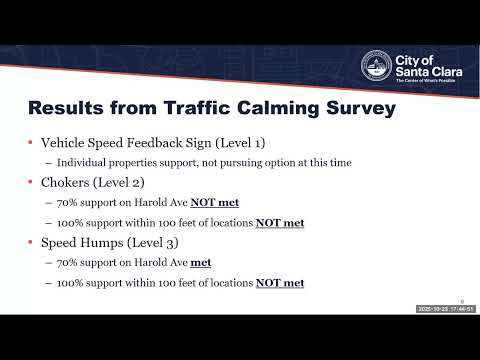
City survey met the program's 70% streetwide threshold for speed humps on Harold Avenue; however, required unanimous consent from property owners within 100 feet of one of two proposed hump locations near Forest Avenue was not achieved. Staff will present the results to City Council, which may approve, deny or waive program requirements.
City of Santa Clara traffic staff told residents at a community meeting that a 2024 traffic study and a subsequent neighborhood survey found sufficient streetwide support to install speed humps on Harold Avenue, but local consent rules mean work could be delayed unless property owners near one proposed location agree.
Chase Levasseur, associate engineer with the traffic division, said the study confirmed Harold Avenue qualified for level-2 and level-3 traffic calming and that speed humps "received overwhelming support" on the street and "we did meet that 70% threshold" of property owners along Harold Avenue favoring speed humps. The city's Neighborhood Traffic Calming Program requires a second test: "we need 100% support from the property owners within 100 feet of the proposed speed hump," Levasseur said.
The city proposed two speed humps for the length of Harold Avenue. The location nearest Stevens Creek Boulevard received the required local consent from property owners within 100 feet, Levasseur said. Two alternate locations near Forest Avenue (labeled options 2A and 2B) were put to property owners, but staff reported they did not receive unanimous consent from owners within 100 feet of either 2A or 2B.
Residents at the meeting urged staff to help neighbors visualize the alternatives. Cindy, a Harold Avenue resident, asked whether staff could mark the 2A/2B locations in the street "so then we can get the neighbors and talk about it, a little bit more quickly." Staff responded that markings were done in the field during a prior community meeting and again the morning of the current meeting and that they will update the map used for outreach.
Declaring the program rules, Levasseur said that the project team will compile the survey findings and other materials into a report for City Council. "City Council does have the authority to waive certain requirements for the program," he said, but staff characterized such waivers as uncommon. When asked whether one hump could be installed instead of two, Levasseur said, "It'll be 2 or or nothing," and explained that two humps are the recommended minimum spacing for the length of Harold Avenue to achieve the intended traffic-calming effect. He added that council could still choose to approve a single location, though he described that as less effective.
Staff clarified procedural points: only property owner responses count toward the Neighborhood Traffic Calming Program thresholds (responses from renters are recorded but do not change the owner-based percentage), and the city conducted multiple outreach efforts including reminder letters and door knocks. Staff said the project webpage will publish aggregated results and the meeting recording; individual homeowners' survey responses will remain confidential.
Next steps: staff will finalize a report presenting the 70% streetwide support for speed humps and the lack of unanimous consent for the Forest Avenue alternatives, then present that report to City Council for a final decision. The staff presentation noted a target timeframe of February 2026 for council consideration, and provided the project webpage and an email address for further questions.
Contact: pwtrafficoperations@santaclaraca.gov and the City of Santa Clara project webpage (santaclaraca.gov).