Get Full Government Meeting Transcripts, Videos, & Alerts Forever!
Get email alerts on the Bylaws topic
No spam. Unsubscribe anytime.
Sun City working group proposes major bylaw rewrite to widen member input, change motion and voting rules
Summary
Preston Keis, chair of the Bylaws Working Group, presented a line-by-line rewrite intended to align RCSC bylaws with the Arizona Nonprofit Corporation Act and to expand member input through a six-month motion window, online voting and stricter proxy rules.
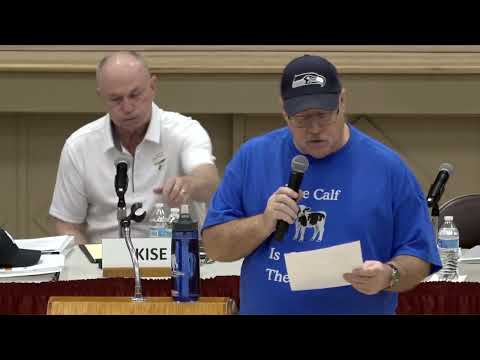
Preston Keis, chair of the Bylaws Working Group, presented a line-by-line rewrite of the Recreation Centers of Sun City Incorporated—s bylaws at an Oct. 18 town hall, saying the changes aim to bring RCSC into compliance with the Arizona Nonprofit Corporation Act (ANCA) and to "increase member input" after a contentious March membership meeting. "We had 12 motions that members had forwarded for consideration for the meeting, but none of them were moved forward," Keis said.
The working group—s recommendations would change how member motions are handled. Under the proposal, members could submit motions from the day after the annual membership meeting through September; each motion would be reviewed by RCSC—s bylaws attorney to determine if it is a "proper member subject" under ANCA. Motions would be posted on the RCSC website for six months of member input and refinement; the motion maker would retain ownership of the text. Finalized motions would be posted in December and voted on during a specified January-to-February window. Keis said the group intends to offer online, proxy and in-person voting and that a third-party service would tabulate electronic votes.
The working group emphasized that ANCA requires a two-thirds threshold for bylaw or articles-of-incorporation changes; therefore the draft raises the voting bar from a simple majority. Keis said the group also proposed counting votes cast across the multi-week online voting period toward the 500-member quorum instead of requiring 500 people to attend a single meeting in person.
Proxies would be reformed. The draft would require a member surrender a specific proxy for each individual motion (a proxy would expire after that motion). "If you want the proxy holder to cast your vote on seven motions, you will need seven specific proxies," Keis said, describing the intent to ensure proxy holders vote with informed direction from the people who granted them authority.
The rewrite includes other structural changes: a clarified parliamentary-authority hierarchy (Arizona law and corporate documents first, then bylaws, special rules, and then Robert—s Rules), removal of the 75-mile rule for owners living outside a 75-mile radius, clarified definitions of "owner" and "non-owner," and a severability clause to keep the rest of the bylaws operative if a court strikes a portion.
Committee and governance changes were also proposed. The draft would limit a committee chair—s vote in committee meetings to breaking ties only; it would allow committees such as finance and long-range planning to meet in July and August when budget and planning work occurs; and it would permit ad hoc working groups. The board would be prohibited from waiving required second readings or other procedural protections for bylaw changes.
The working group said it consulted an outside attorney, identified in the meeting as Ashley Spear, to interpret ANCA and confirm what matters are "proper member subjects" (matters that directly govern member rights, privileges and qualifications). Keis told members that issues tied to the corporation—s business affairs (for example, decisions to build or renovate facilities) are generally not proper member subjects; those motions could still be considered but would be nonbinding recommendations to the board.
Members expressed mixed reactions at the town hall. Some speakers pressed the board about the length and wording of the revised "business affairs" paragraph. Ritchie Miller criticized it as "wordy" and said the changes undermined the concise spirit he expects of bylaws. Director Gray and other board members responded that the language is lengthy because it reflects attorney guidance and helps delineate what matters members may lawfully decide.
Other contentious issues raised in public comment included whether electronic voting and counting votes over a multi-week window comply with Arizona statutes about voting without a meeting (a question several members asked the working group to get clarified from counsel), the potential cost of mailing ballots to the full membership, and concerns about proxy control. Keis said the group would seek additional legal input and that the process is meant to maximize member participation while remaining cost-conscious.
Keis announced next steps: a second town hall Oct. 20, a working-group meeting Oct. 23 to review input, a first reading in a special session Oct. 29 and a second reading and vote in a special session Nov. 10. "We—ll post the amendments on the RCSC website for member input," he said.
The draft is procedural and statutory in emphasis rather than programmatic; it focuses on voting windows, attorney review, quorum definition, proxy structure and rules for committee conduct rather than prescribing specific facility projects. The working group said any changes will be resubmitted to the attorney for a final legal review before special-session votes.