VBCPS proposes revised secondary math sequence after cohort analysis showing middle-school declines
Summary
After presenting NWMAP and SOL trend data showing declines in some middle-school math results, VBCPS staff laid out a revised math sequence for implementation in 2026–27 that aims to reduce teacher preps, create clearer on/off ramps, expand probability and statistics to a yearlong course, and establish an Algebra 2 honors pathway.
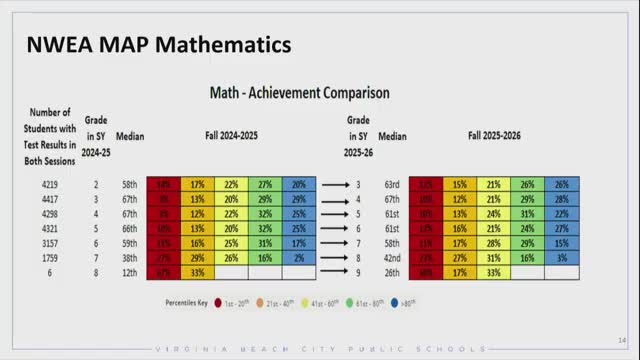
Tom Quinn presented fall NWMAP and Virginia SOL data showing mixed results across grades. At the division level, grades 3 and 5 showed modest increases while middle school grades—particularly grade 7—declined. Quinn reported recalculated grade-level averages (combining course enrollments) of 74.8 percent for grade 6, 73.8 percent for grade 7 and 77.6 percent for grade 8; each was about 6–7 percentage points higher than the state average under the recalculation method referenced in the presentation.
Quinn described a cohort analysis of 831 students who progressed from a 2021 grade-5 cohort through successive grade-level SOLs; of those 831 students, staff reported 160 with Individualized Education Programs (IEPs), 32 identified as English learners and 3 who fell into both categories. Quinn said the department used that analysis to identify placement and sequencing adjustments and to refine transition rubrics under policy 6-39 (placement criteria derived from state guidance and local rubrics).
To address the trends the division proposes to implement a refined high-school math sequence in 2026–27 that includes: ensuring all students have an opportunity to complete Algebra I and Geometry; offering Algebra II (and Algebra II honors) prior to graduation; establishing Algebra, Functions and Data Analysis (AFDA/APTA) as a bridge course; sunsetting several semester/tandem offerings (discrete math, trigonometry, and semester probability & statistics) while expanding probability & statistics to a yearlong course; and promoting data science pathways and STEM-aligned sequences. Quinn said the changes are intended to reduce the number of teacher preps, help transient students who transfer into or out of the district, and better prepare students for standardized tests such as the PSAT and SAT.
The department described completed and in-progress actions: summer professional learning, revised unit assessments aligned to VDOE performance-level descriptors, targeted intervention resources for Thrive Time, and a teacher cohort professional learning group of 29 teachers from 15 schools focused on middle- and high-school math instructional practices.
Board members asked clarifying questions about student placement, the effect of curriculum changes on students already in junior/senior year, and implementation timing. Staff said they will meet with high-school principals and continue refining registration and placement conversations before rollout.