Get Full Government Meeting Transcripts, Videos, & Alerts Forever!
Get email alerts on the Land Use Rezoning topic
No spam. Unsubscribe anytime.
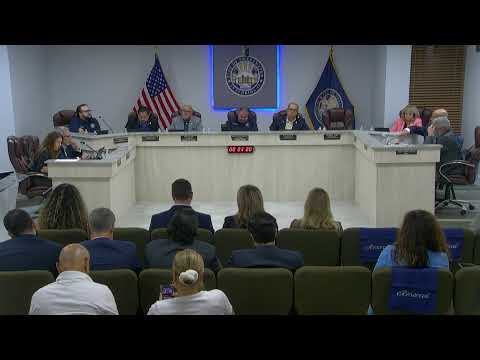
Sweetwater commission approves first readings to create Flagler City Center amid protests from former Little Abner residents
Summary
The City of Sweetwater commission voted on Oct. 29 to approve first readings of four ordinances to establish the Flagler City Center land‑use and zoning district for roughly 104 acres that include the former Little Abner mobile‑home park.
The City of Sweetwater commission voted on Oct. 29 to approve first readings of four ordinances to establish the Flagler City Center land‑use and zoning district for approximately 104 acres that include the former Little Abner mobile‑home park.
Residents and advocates who addressed the commission during an extended public‑comment period said the project’s approval at first reading comes amid unfinished relocation and legal disputes. "I'm a mom of four kids… due to this rezoning and stuff, I don't have nowhere to go," Samantha Morales told the commission, adding that state law and City Ordinance 4390 require notice and a relocation study in cases of mobile‑home park displacement.
The project team, represented by Alejandro Arias, described the proposal as a large, phased mixed‑use redevelopment centered between Northwest Seventh Street and West Flagler Street. Arias said the program covers about 104 acres and would include residential, commercial, institutional and open‑space uses, “at least 1,000 residential units that will be dedicated as attainable housing and or workforce housing,” and infrastructure and design standards enforced through a master development agreement and urban design regulations. The presentation included a cited project cost figure and employment and revenue estimates provided by the applicant during the meeting.
Why it matters: The first readings move the city's comprehensive‑plan and zoning amendments into state review and set the procedural path for later approval of a master development agreement and second‑reading votes. For residents and housing advocates, the votes are consequential because they change future land‑use designations on property where hundreds of mobile‑home households lived until recent evictions.
What residents told the commission: Multiple former Little Abner residents and supporters described a sequence of evictions, sealed mobile homes and demolitions that they say occurred with inadequate relocation measures and unsafe conditions. Enrique Celaya said demolition work exposed families to “toxic substance[s] such as asbestos” and alleged that the stress of the evictions contributed to deaths in the community. Sarah Blanco and others described children with autism who were displaced and residents who lost homes and savings.
Legal status and the city’s counsel: Attorneys and the applicant’s litigation counsel described the court record differently than some public commenters. City special counsel Cesar Mastray and CREI litigation counsel George Piedra told the commission that a trial court entered final judgments and that writs of possession issued by the clerk were executed by the Miami‑Dade Sheriff. Piedra said the judgment favoring CREI was dismissed with prejudice at the trial court and is the subject of an appeal, and that there is currently no stay of enforcement. "With prejudice means that the case is over with finality," Piedra said while explaining the trial court disposition and appeal status.
City staff and counsel advised commissioners that, in their view, the statutory and ordinance requirements that trigger a relocation study (City Ordinance 4390; cited state statute discussed at the meeting) apply when a rezoning or other official action would remove residents who remain lawfully in possession at the time of the application. Several city attorneys and officials told the commission that writs had been executed and that, as of the application date, there were no lawful residents remaining on the affected parcels. Planning Director Jorge Vera confirmed the city received the rezoning application on Aug. 4, 2025.
Relocation offers: During the meeting, counsel described state‑formula relocation payments that the city’s staff characterized as a range roughly between $1,500 and $2,500 depending on unit type, and applicant counsel stated that CREI offered a combined package that the counsel described as exceeding $16,000 per household. The amount and components of any relocation package were presented by counsel and disputed in public comment; the commission did not adopt or ratify any specific relocation amount during the meeting.
The votes: Commissioners approved first readings of four separate ordinances related to Flagler City Center: (1) a future land‑use map amendment to establish the Flagler City Center land‑use designation; (2) a text amendment to add the Flagler City Center district to the comprehensive‑plan future land‑use element; (3) a zoning map amendment to create the Flagler City Center zoning district for the parcels identified in the agenda; and (4) a text amendment to the land‑development code establishing the Flagler City Center district’s regulations. Each item passed on first reading by roll call (motion moved by Commissioner Jose Matty and seconded by Commissioner Idania Yano for the initial item; subsequent motions and roll calls were recorded), and the chair announced the items will be transmitted to the state for review before second reading and final action.
Next steps: Under the local process described at the meeting, the land‑use amendments will be transmitted to the state for review (applicant counsel said the Florida Department of Commerce and the Florida Department of Transportation will review elements including traffic impacts). The applicant said it expects to negotiate a master development agreement, urban design regulations and a master development plan that will return to the commission for second reading and final approvals.
What the commission did not do tonight: The commission’s votes on first reading were procedural steps to transmit land‑use and text amendments for state review and to schedule additional approvals. Commissioners and city counsel emphasized that final official action cannot be completed until the full local and state review process (including second readings and the mayor’s signature) has run its course.
Community context and outstanding issues: Residents said court appeals and what they described as incomplete relocation and environmental protections remain unresolved. Attorneys and city staff said trial‑court judgments and writs of possession have been executed and that no judge has entered a stay. The record and competing accounts presented at the meeting point to ongoing factual and legal disputes that could affect later stages of land‑use and development approvals.