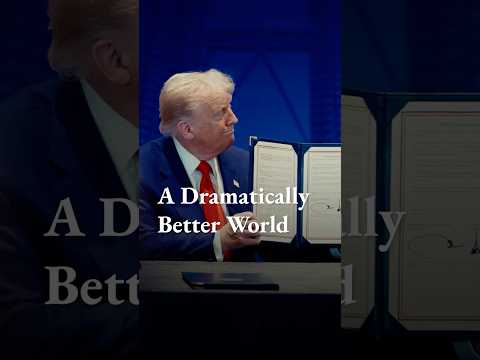
U.S. official announces U.S.-Malaysia trade deal and Kuala Lumpur Peace Accords at ASEAN summit
Loading...
Summary
Speaker (Official) said at the ASEAN Summit in Kuala Lumpur that a "major trade deal" between the United States and Malaysia was signed and that the speaker participated in the signing of the "Kuala Lumpur Peace Accords," which the speaker described as ending hostilities between Cambodia and Thailand.
Speaker (Official) said at the ASEAN Summit in Kuala Lumpur that "the prime minister and I signed a major trade deal between The United States and Malaysia," and that they "took part in the signing of a historic peace agreement ending the hostilities between Cambodia and Thailand," which the speaker called the "Kuala Lumpur Peace Accords." The speaker also praised "hundreds of our incredible Japanese partners" and described Japan as having its "first female prime minister in the history of Japan," and later said APEC unites economies as the United States works to build a "free and open Indo Pacific."
The announcements were delivered in a short address recorded in the meeting transcript. The transcript does not identify the speaker by name or title and provides no details about the trade deal's terms, signatories beyond "The United States and Malaysia," or the text, signatories, or implementing arrangements for the Kuala Lumpur Peace Accords. The speaker's reference to "the first female prime minister in the history of Japan" is recorded as the speaker's characterization; the transcript does not identify that official by name or provide corroborating detail.
Why this matters: a bilateral trade deal between the United States and Malaysia and a formal peace accord resolving hostilities between Cambodia and Thailand would both carry diplomatic and economic implications across the region, including for trade policy, investment, and security. The address also framed APEC (Asia-Pacific Economic Cooperation) as a venue for expanded economic ties and industrial investment in the Indo-Pacific.
What was said and what is missing: the speaker described the trade agreement as "major" but the transcript contains no information on tariff changes, regulatory commitments, dates of effect, or which U.S. or Malaysian officials signed the agreement. The transcript likewise records the name "Kuala Lumpur Peace Accords" and the claim that it ends hostilities between Cambodia and Thailand but does not provide the accord's text, the parties' signatures, implementation steps, or whether the accord is bilateral or multilateral. The address included a rhetorical line, "America is back," and broad language about "forging a free and open Indo Pacific" and "building new factories," but did not attach these statements to specific policy actions in the transcript.
Quotes from the transcript are reproduced verbatim and attributed to Speaker (Official). The transcript records the following excerpts supporting this article: "signed a major trade deal between The United States and Malaysia," "took part in the signing of a historic peace agreement ending the hostilities between Cambodia and Thailand," "Kuala Lumpur Peace Accords," "hundreds of our incredible Japanese partners," "the first female prime minister in the history of Japan," and "America is back" and "free and open Indo Pacific."
Missing detail that may be reported later: terms and legal texts for the trade deal and peace accord; names and offices of signatories; implementation timetables; and any supplementary documents filed with the U.S. Department of State or other agencies. The transcript does not state whether APEC meetings produced parallel agreements, nor does it identify which agencies will lead implementation.