
Hawaii ETS launches 10th annual code challenge with new deployment credits, strict open-source rules
Get AI-powered insights, summaries, and transcripts
Subscribe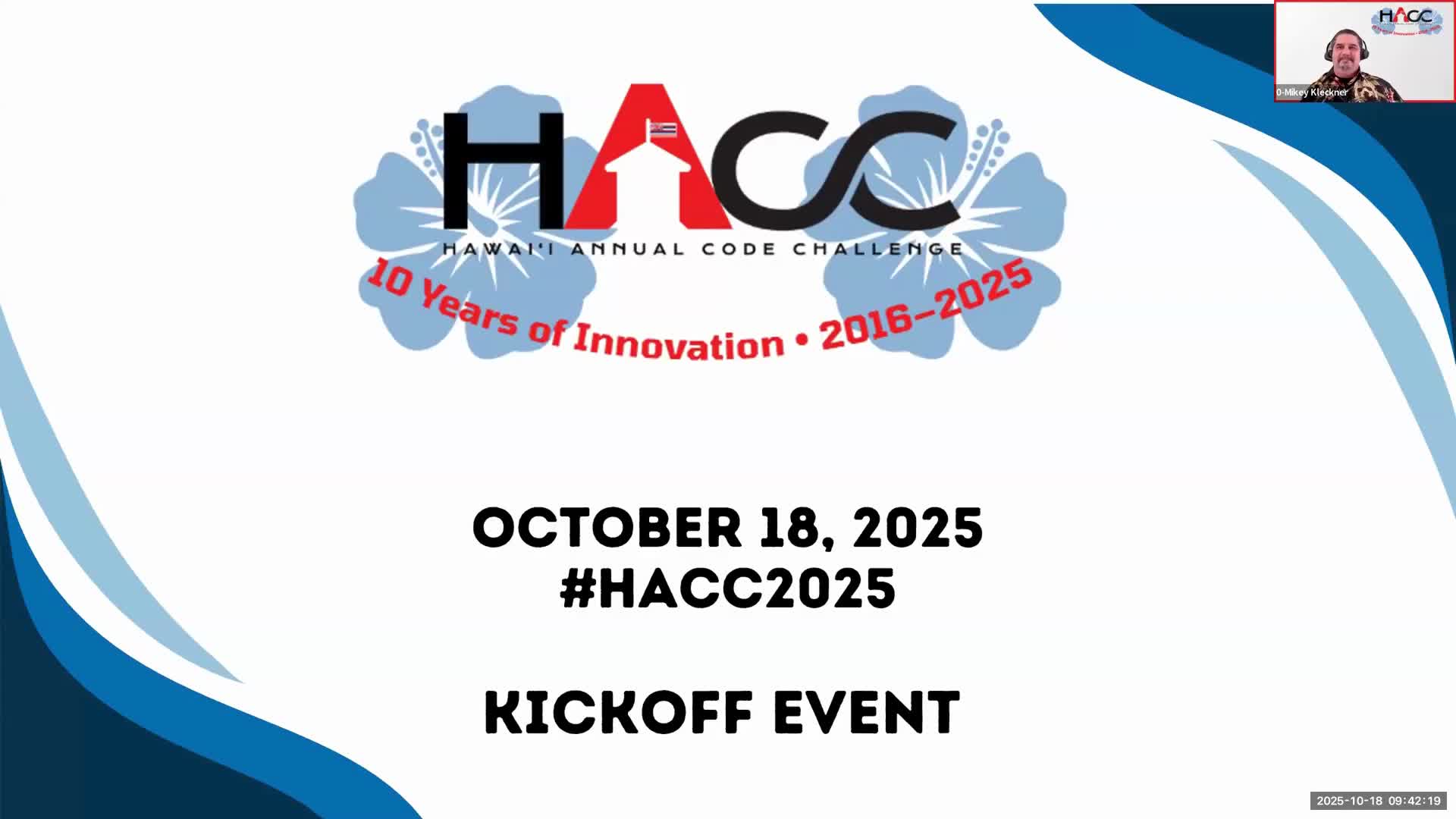
Summary
The Office of Enterprise Technology Services opened the 2025 Hawaii Code Challenge kickoff with rules, deadlines, GitHub logistics and a limited AWS deployment-credit program for participants.
Mikey Kleckner, time and attendance business analyst at the Department of Accounting and General Services’ Office of Enterprise Technology Services, opened the virtual kickoff for the tenth Hawaii Annual Code Challenge and outlined rules, deadlines and prize categories for the event.
The event is intended to “encourage folks to be engaged in Hawaii’s government and community by seeking innovative and creative ways to improve delivery of information and services,” Kleckner said. He stressed participants must join the event Slack workspace and remain present for prize drawings and workshops.
Organizers said work for the technical review must be posted to GitHub repositories created under the event organization (Hack25) and that all submissions will be treated as open source through the technical-review date. “If when the tech review judges go in there and they find something that says copyright, you're immediately eliminated,” said Thelma Elaine, the event’s lead organizer. Elaine went through rules for minors, team composition and open-source requirements and said project submission forms are due by 9 a.m. on Monday, Nov. 17.
George Lee, who will lead technical review, described the review process and deployment expectations. He said technical review begins Nov. 17 at 9 a.m., aims for a quick two-day turnaround, and that teams should provide a deployed URL or be prepared to demonstrate native mobile apps directly to judges. Lee also asked teams to provide any necessary authentication (admin) credentials privately via Slack direct message, not in public channels or repositories.
Alan Nguyen, representing Amazon Web Services, said AWS is offering sponsored resources for deployment and introduced an Amazon product called Curo, an AI-assisted integrated development environment. Nguyen said AWS will provide credits “up to $5,000 or more like a thousand dollars per team” and that organizers will allocate credits to several teams for deployment purposes. Organizers clarified the credits are intended for deployment resources rather than premium access to third-party AI tooling to maintain fairness.
Organizers reviewed judging categories and prizes. Each division — middle/high school, college and professional — will award first place $3,000, second place $2,000 and third place $1,000. Technical review scoring is described as a multi-step process (technical implementation and presentation) that yields a composite percentage; the maximum number of finalist teams is capped (25). An audience-favorite award is also planned.
Logistics covered at the kickoff included a schedule of workshops (an October design-thinking session with IBM and a November security-and-pitching workshop), an in-person presentation and judging day at West Oʻahu, and guidance on using the Hack25 GitHub organization. Elaine and Lee said repositories will be created for teams after team rosters are finalized, and teams must use the event-assigned repository until after the technical-review cutoff.
Organizers answered several participant questions during the session, clarifying that the event is open only to Hawaii residents and students currently living or attending school in Hawaii, that minors must have parental permission, and that team sizes vary though the “sweet spot” is about five to six members. The kickoff recording, slides and challenge pages will be posted to the event website and relevant Slack channels.
More substantive follow-up directions from the organizers: staff will create Hack25 GitHub repositories for each team after team registration is finalized; technical-review judges will expect code visible in the repositories by Nov. 17; AWS credits will be distributed to teams by request through organizers (George Lee and Thelma Elaine); and all non-sensitive communications with challenge authors should occur in public Slack channels so that answers are visible to all teams.
The session included sponsor acknowledgements from Google for Government, Microsoft, Amazon Web Services, Salesforce, Hawaiian Electric, IBM, Oracle and others, and thanked Garrett Yoshimi at the University of Hawaii for arranging the in-person judging venue at West Oʻahu.