Get Full Government Meeting Transcripts, Videos, & Alerts Forever!
Ohio House Energy Committee adopts amendment to substitute House Bill 15 after hours of testimony from utilities, advocates
Summary
Lawmakers in the Ohio House Energy Committee adopted a sub-bill to substitute House Bill 15 and heard extended opponent and interested-party testimony on rate-making changes, the legacy generation resource (OVEC) rider, expanded Power Siting Board jurisdiction, community energy pilots, and transmission planning reforms.
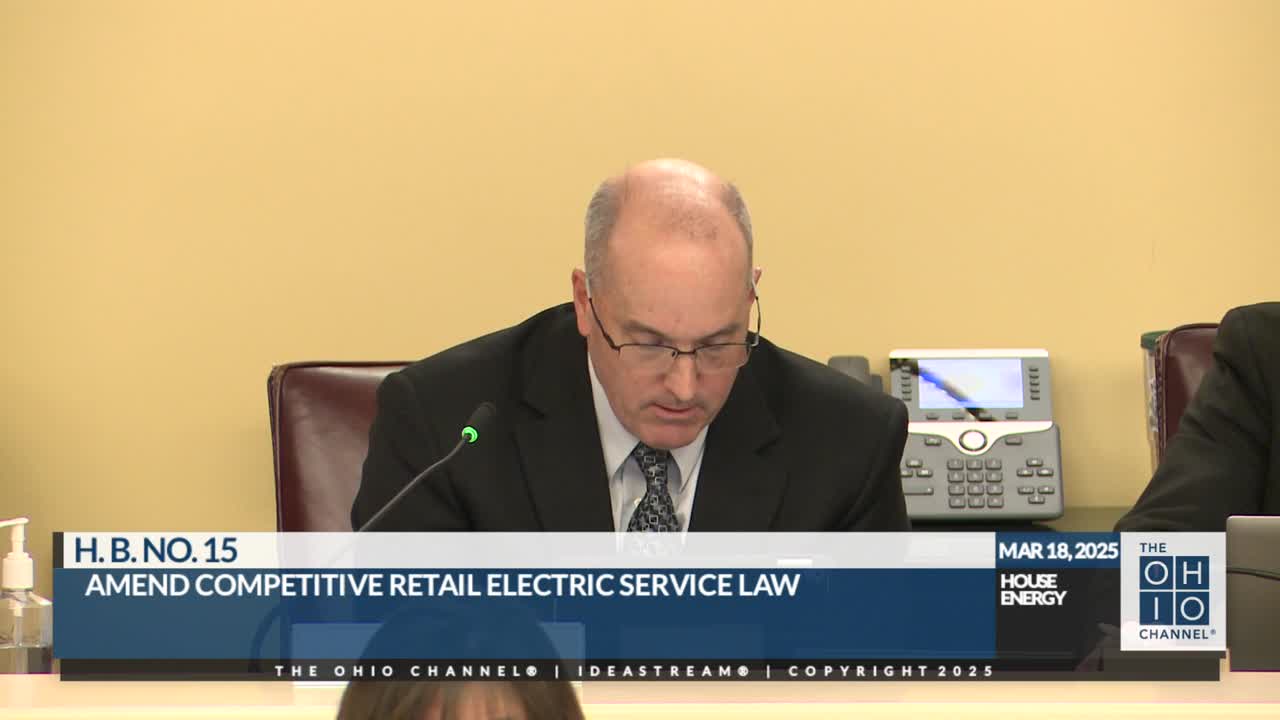
At a hearing of the Ohio House Energy Committee, members adopted an amendment to substitute House Bill 15 and took several hours of testimony from investor-owned utilities, industry groups, advocates and think tanks about the bill's rate‑making, siting, and generation provisions.
The committee formally adopted the sub bill identified in the hearing as L13606-68085 after Vice Chair Klopfenstein moved to amend House Bill 15 with that substitute and members indicated no objections. Chair Holmes then opened the hearing for opponent and interested-party testimony on the substitute bill.
Why it matters: the substitute bill would change how distribution rates are set and recovered, alter siting thresholds for transmission projects, and repeal or alter the statutory treatment of legacy generation resources (OVEC) that utilities and some municipal/co-op owners have relied on for cost recovery. Proponents and opponents told lawmakers the same provisions have large implications for reliability, project timelines, customer bills and economic development.
Rate-making and regulatory lag: utility witnesses urged changes to the bill's three‑year forward-looking rate plan and true-up mechanics. Amy Spiller, president of Duke Energy Ohio, told the committee that while the bill “adopts a forward looking framework for rate making,” it still “erodes confidence in the ability to make sound and timely business decisions” and does not fully address regulatory lag. Spiller said regulatory lag—“the time between which an investment is made, or an expense is incurred, and when those investments or expenses are recovered through utility rates”—raises utilities' cost of capital and,…
Already have an account? Log in
Subscribe to keep reading
Unlock the rest of this article — and every article on Citizen Portal.
- Unlimited articles
- AI-powered breakdowns of topics, speakers, decisions, and budgets
- Instant alerts when your location has a new meeting
- Follow topics and more locations
- 1,000 AI Insights / month, plus AI Chat