Get Full Government Meeting Transcripts, Videos, & Alerts Forever!
Get email alerts on the Energy And Natural Resources topic
No spam. Unsubscribe anytime.
Ohio House Energy Committee adopts amendment to substitute House Bill 15 after hours of testimony from utilities, advocates
Summary
Lawmakers in the Ohio House Energy Committee adopted a sub-bill to substitute House Bill 15 and heard extended opponent and interested-party testimony on rate-making changes, the legacy generation resource (OVEC) rider, expanded Power Siting Board jurisdiction, community energy pilots, and transmission planning reforms.
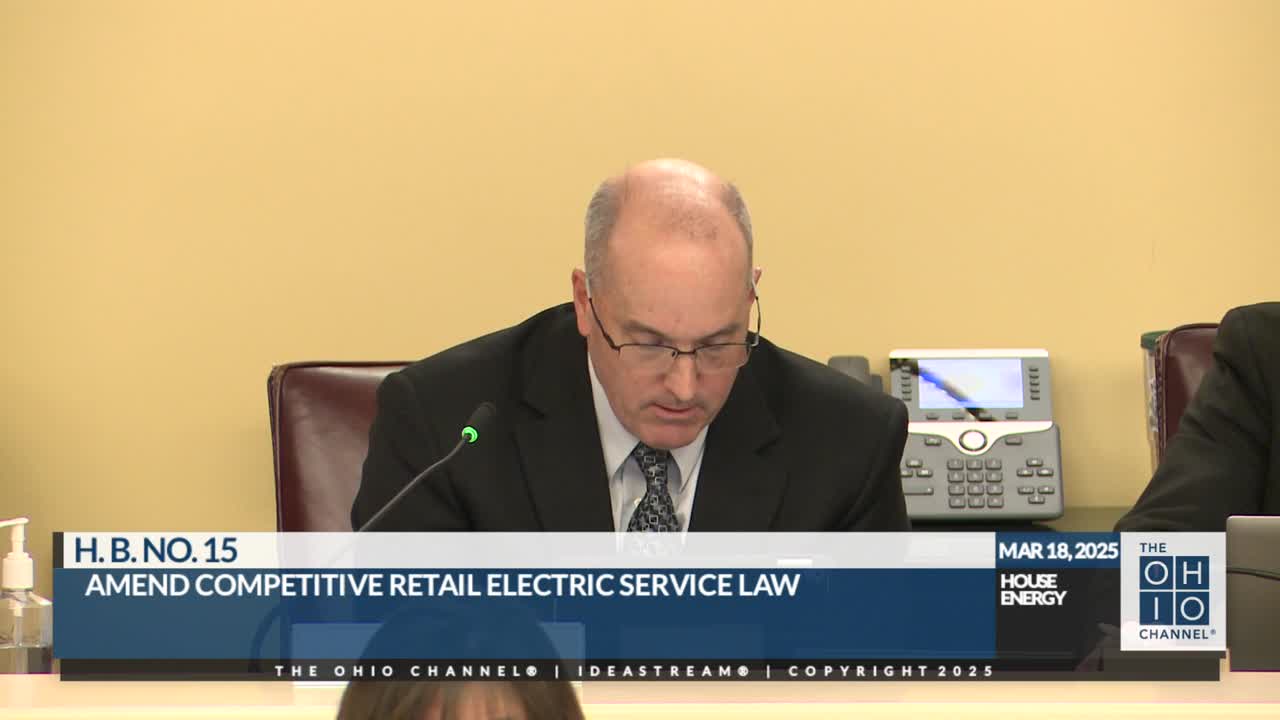
At a hearing of the Ohio House Energy Committee, members adopted an amendment to substitute House Bill 15 and took several hours of testimony from investor-owned utilities, industry groups, advocates and think tanks about the bill's rate‑making, siting, and generation provisions.
The committee formally adopted the sub bill identified in the hearing as L13606-68085 after Vice Chair Klopfenstein moved to amend House Bill 15 with that substitute and members indicated no objections. Chair Holmes then opened the hearing for opponent and interested-party testimony on the substitute bill.
Why it matters: the substitute bill would change how distribution rates are set and recovered, alter siting thresholds for transmission projects, and repeal or alter the statutory treatment of legacy generation resources (OVEC) that utilities and some municipal/co-op owners have relied on for cost recovery. Proponents and opponents told lawmakers the same provisions have large implications for reliability, project timelines, customer bills and economic development.
Rate-making and regulatory lag: utility witnesses urged changes to the bill's three‑year forward-looking rate plan and true-up mechanics. Amy Spiller, president of Duke Energy Ohio, told the committee that while the bill “adopts a forward looking framework for rate making,” it still “erodes confidence in the ability to make sound and timely business decisions” and does not fully address regulatory lag. Spiller said regulatory lag—“the time between which an investment is made, or an expense is incurred, and when those investments or expenses are recovered through utility rates”—raises utilities' cost of capital and, ultimately, customer costs. She and other utility witnesses proposed additional true-up and annual updates to better align rates with actual costs.
Legacy generation (OVEC) and glide-path requests: utilities repeatedly opposed an abrupt repeal of the legacy generation resource (LGR) statute, which several witnesses said was enacted to allow cost recovery tied to Ohio entities' historical interests in Ohio Valley Electric Corporation plants. Spiller noted Duke Energy Ohio made business decisions relying on the LGR's statutory sunset date of 12/31/2030 and asked for a “reasonable transition period” (she suggested 2028 as an example). AEP Ohio and AES Ohio also urged a glide path or other grandfathering so companies and customers can manage financial impacts.
Power siting board jurisdiction and timelines: the substitute bill lowers the voltage threshold for Ohio Power Siting Board jurisdiction from 100 kV to 60 kV, a change utilities said would substantially increase the number of certification filings and slow projects. Spiller warned the change “would triple the number of project applications our company would be required to file” and that OPSB certification decisions are immediately appealable to the Ohio Supreme Court, introducing the risk of long delays for reliability and economic development projects. AEP and AES echoed concerns that lowering the threshold would add regulatory costs and bureaucracy without demonstrable public benefit.
Community energy and cost‑shift concerns: multiple utility witnesses criticized the bill's community energy (virtual net‑metering/subscription) provisions as written, arguing the program would shift grid‑service and transmission costs to non‑subscribing customers. Spiller said subscribing customers “are using both the transmission and the distribution grids to physically obtain the power that they consume 100% of the time,” and that credits for subscribers would have to be paid for by other customers unless the law is carefully limited. AES and AEP said the provisions, as drafted, risk creating an implicit subsidy that residential customers would bear.
Advanced transmission technology, heat maps and studies: the bill requires applicants and the OPSB to address advanced transmission technologies and to publish transmission capacity/heat maps. Utilities testified the study and modeling requirements would add cost and time to applications; AEP described the mapping and added studies as likely to be expensive and quickly outdated. By contrast, Greg Lawson of the Buckeye Institute testified in support of heat maps and the bill's broader market reforms, calling the package “two of the most free market energy policies that Ohio will have had an opportunity to embrace probably since deregulation in the 1990s,” and arguing greater transparency can help developers and customers plan.
Environmental and local concerns: environmental advocates told the committee they support a community energy pilot within the bill but opposed other provisions. Cathy Becker, an environmental advocate, said she would “strongly support the community energy pilot program” because it could help residents pool load and build distributed generation. Patricia Bridal of the Ohio Nuclear Free Network urged against labeling fossil and nuclear projects as “green” and warned of long‑term costs and public‑health risks she associates with nuclear and certain fossil fuel projects.
Reliability and generation closures: Randy Imminger of the Energy Policy Network and other witnesses voiced concern about resource adequacy if baseload plants close faster than replacement generation comes online. Imminger cited federal analyses that flagged near‑term elevated reliability risk and urged policies that preserve or repower existing baseload units while new capacity is developed.
Votes at a glance: Vice Chair Klopfenstein moved to amend House Bill 15 with substitute L13606-68085; the committee adopted the sub bill by voice after members signaled no objection. (Motion text in the record: “I move to amend House Bill 15 with sub bill L13606-six 80 eight-five.”) No roll‑call vote was recorded in the transcript excerpt; the chair stated, “Seeing no objections, the motion is agreed to and the sub bill is adopted.”
What committee members asked and next steps: committee members pressed utilities on how the LGR glide path should work, on whether community energy credits would shift costs, and on the net benefit of expanded OPSB jurisdiction. Committee staff announced a follow‑up meeting to consider a dash‑6 sub bill. Lawmakers and witnesses said they expect additional drafting and stakeholder work before final passage.
Ending: the hearing produced a clear record of utility opposition on finance, siting and community energy provisions and interest‑group support for some distributed energy elements. Committee members signaled appetite both for changes the bill would make to rate processes and for further amendments to address cost‑shift, grandfathering and procedural concerns before the bill advances.