Get Full Government Meeting Transcripts, Videos, & Alerts Forever!
Get email alerts on the Energy And Natural Resources topic
No spam. Unsubscribe anytime.
House Energy Committee adopts substitute for House Bill 15 after tax, PUCO and net‑metering changes
Summary
At its fourth hearing the House Energy Committee agreed, without objection, to adopt a substitute version of House Bill 15 that reduces certain taxes on new generation, sets decision timelines for the Public Utilities Commission of Ohio and the Ohio Power Siting Board, and changes rules for storage and behind‑the‑meter generation.
The House Energy Committee on the bill’s fourth hearing adopted a substitute for House Bill 15 that sponsors said lowers taxes on new generation, creates decision “shot clocks” for the Public Utilities Commission of Ohio (PUCO) and the Ohio Power Siting Board, and adjusts net‑metering and storage tax treatment.
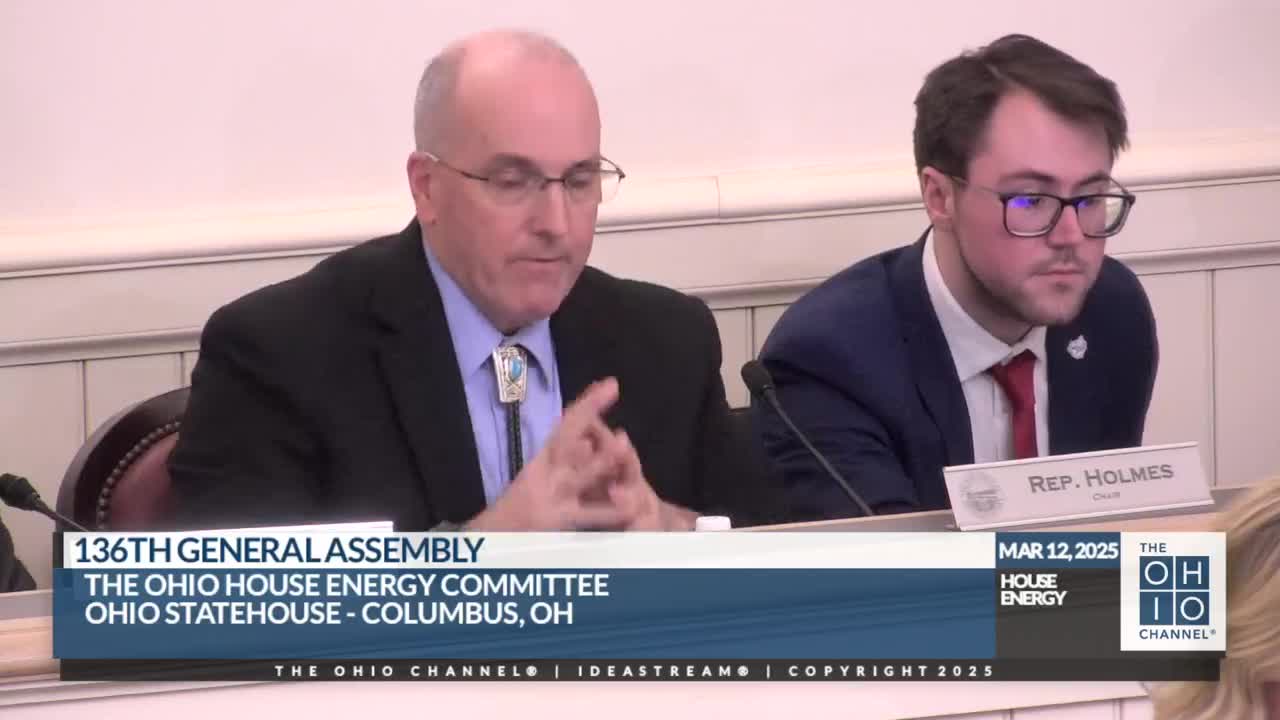
Committee leaders said the substitute reflects months of stakeholder input and technical edits. “I move to amend House Bill 15 with Sub Bill 130 six‑six 80 eight‑three,” Vice Chair Klopfenstein said when offering the amendment; Chair Holmes then announced, “Without objection, the motion is agreed to and the sub bill is adopted,” concluding the fourth hearing.
Why it matters: Sponsors said the package is intended to make Ohio more competitive for new generation investment while preserving some local revenues and shortening regulatory timelines that sponsors and utilities said often delay projects.
Key provisions and how they would work
- TPP tax on new generation: The substitute lowers the tangible personal property (TPP) tax on new generation and energy conversion equipment from 25% to 7% for new projects, according to sponsors. Existing facilities would remain taxed at the current rates. Committee discussion stressed the change is intended to keep Ohio competitive for new investment while maintaining local revenue streams for currently taxed facilities.
- Priority investment areas: Local communities may apply to the Department of Development for a “priority investment area” designation. If granted, sponsors said the Ohio Power Siting Board’s decision window would be reduced to 45 days and new generation, transmission, distribution or pipeline infrastructure in those areas would be exempt from the TPP tax for five years before reverting to the 7% rate.
- Storage treated like generation for facility taxes: The substitute treats energy storage facilities like generation facilities for equipment/facility taxation (not as a per‑kilowatt‑hour usage tax), which committee members said is intended to avoid double taxation when stored energy is later used.
- Transmission and distribution taxes and incentives: Sponsors said the amendment reduces tax burdens on new transmission/distribution and pipeline infrastructure (a cited reduction from 87% to 25% for new transmission in sponsor remarks) and clarifies that payments‑in‑lieu‑of‑tax agreements continue to operate.
- PUCO rate‑case and related reforms: The substitute would establish a PUCO “shot clock” for rate cases (sponsor discussion referenced a 346‑day target), require a staff report at about 180 days, and allow a temporary rate to go into effect if a case is not completed by day 275 based on the staff report midpoint or lesser recommendation; the temporary rate would be subject to later refund and reconciliation. The bill also authorizes multi‑year rate plans over up to three consecutive years with an annual true‑up and would require utilities to file rate cases at least every three years.
- Ohio Power Siting Board jurisdiction and expedited processes: The amendment lowers the review threshold for transmission projects (discussed in committee as from 100 down to 60, as described by the sponsor), and it creates expedited review timelines when utilities own rights of way. Sponsors said these changes aim to reduce approval delays for projects.
- Repeal and audits: The substitute would repeal the OVEC rider on enactment and reinstate an audit process for the legacy generation rider so PUCO can complete its review, per sponsor remarks.
- Solar Generation Fund and MOUs: The amendment would halt future collections for the solar generation fund and retain existing memoranda of understanding (MOUs) with solar projects that elected to collect payouts, with sponsors saying remaining balances would be refunded to ratepayers and the timeline would align with the bill’s stated ESP expiration date of May 31, 2028 (or an earlier stated expiration date, as applicable).
- Net metering, behind‑the‑meter generation and utility ownership: The substitute would align net‑metering rules across technologies (wind, solar, biomass, landfill gas, hydropower, microturbines and fuel cells), exempt certain mercantile self‑supply systems from being treated as utilities, exempt electric cooperatives from some behind‑the‑meter rules based on their nonprofit structure, and prohibit electric distribution utilities from owning behind‑the‑meter generation (sponsors cited the change as preserving a market role for independent generators).
- Transparency and planning tools: Electric distribution utilities would be required to publish capacity/hosting‑capacity heat maps and update them quarterly; PUCO would be required to hold annual stakeholder meetings on the maps and publish an annual statewide reliability report, sponsors said. The bill also requires data gathering on grid‑enhancing technologies and directs PUCO to study use of advanced transmission technologies.
Discussion, questions and next steps
Committee members asked for clarification on several technical points, including whether existing generation would remain at the higher tax rate (sponsors said existing valuation and taxation would remain unchanged) and whether storage would be taxed twice (sponsors said the provision taxes the storage facility as equipment, not a use/kilowatt‑hour tax). Members also discussed outreach to PUCO and utilities about the proposed shot clocks and the need to balance speed with careful review to protect ratepayers.
Committee leaders said two committee hearings are scheduled next week: opponent and interested‑party testimony Tuesday, followed by proponents and a planned vote Wednesday. Sponsors and staff indicated they expect mostly technical “tweak” amendments prior to the Tuesday hearing.
Action taken
Vice Chair Klopfenstein moved the amendment described above. The committee adopted the substitute by voice vote without objection; no roll‑call tally was recorded in the transcript.