Get Full Government Meeting Transcripts, Videos, & Alerts Forever!
Get email alerts on the Demand Response topic
No spam. Unsubscribe anytime.
Committee hears first reading of demand response bill that would require PUCO oversight, opt-in protections and PJM market participation
Summary
House Bill 427, introduced and amended in committee, would set guardrails for voluntary demand response programs: opt-in enrollment, right to override, PUCO cost-effectiveness review and a three-year PUCO report; sponsors said programs can lower peak demand and bid aggregated reductions into the PJM capacity market.
The House Energy Committee held the first hearing on House Bill 427, a measure to formalize guardrails for voluntary demand response programs and expand the ability of utilities and competitive retail electric service providers to bid aggregated demand reductions into the PJM capacity market.
Representative Klopfenstein, the bill sponsor, introduced the measure and explained it is designed to address rising electric costs and grid reliability by modernizing demand-side tools rather than creating new mandatory programs. “Demand response programs allow customers to voluntarily agree to small temporary adjustments such as raising the thermostat by a degree or 2 or cycling off appliances like water heaters,” Representative Klopfenstein said. “These programs are completely voluntary.”
Key provisions and sponsor statements
Sponsor testimony said the bill does not create demand response programs but sets consumer protections and oversight requirements, including:
- Voluntary opt-in enrollment and the right for consumers to override an event; sponsors said consumers may also disenroll from programs. - PUCO review and approval of demand-response programs to ensure cost effectiveness. - A PUCO report back to the legislature after three years with recommendations to improve customer benefits. - Authorization for utilities and competitive retail suppliers to bid demand response into PJM’s markets (described in testimony as virtual power-plant participation).
Quantitative details cited in committee
Sponsor testimony provided several numerical contexts: electric bills were said to have increased by an average of $30 per month statewide over the prior year and were projected to rise another 5% in 2026. Sponsor cited a Midwest Energy Efficiency Alliance analysis projecting statewide net savings ranging from approximately $34.5 million to $104 million depending on participation scenarios. Enrollment figures noted in testimony included nearly 18,000 participants in AEP territory and more than 106,000 enrolled in water-heater switching programs across electric cooperatives, plus over 16,000 air-conditioner switch enrollments in cooperatives.
Questions from members focused on cost allocation, program design, smart meters versus load-management switches, emergency use for public-safety events, and whether consumers without smart thermostats could participate. The sponsor explained many programs use radio-controlled load-management switches on equipment such as heat pumps or hot-water heaters rather than consumer thermostats, and that smart thermostats can be used but are not required for participation.
Committee action and next steps
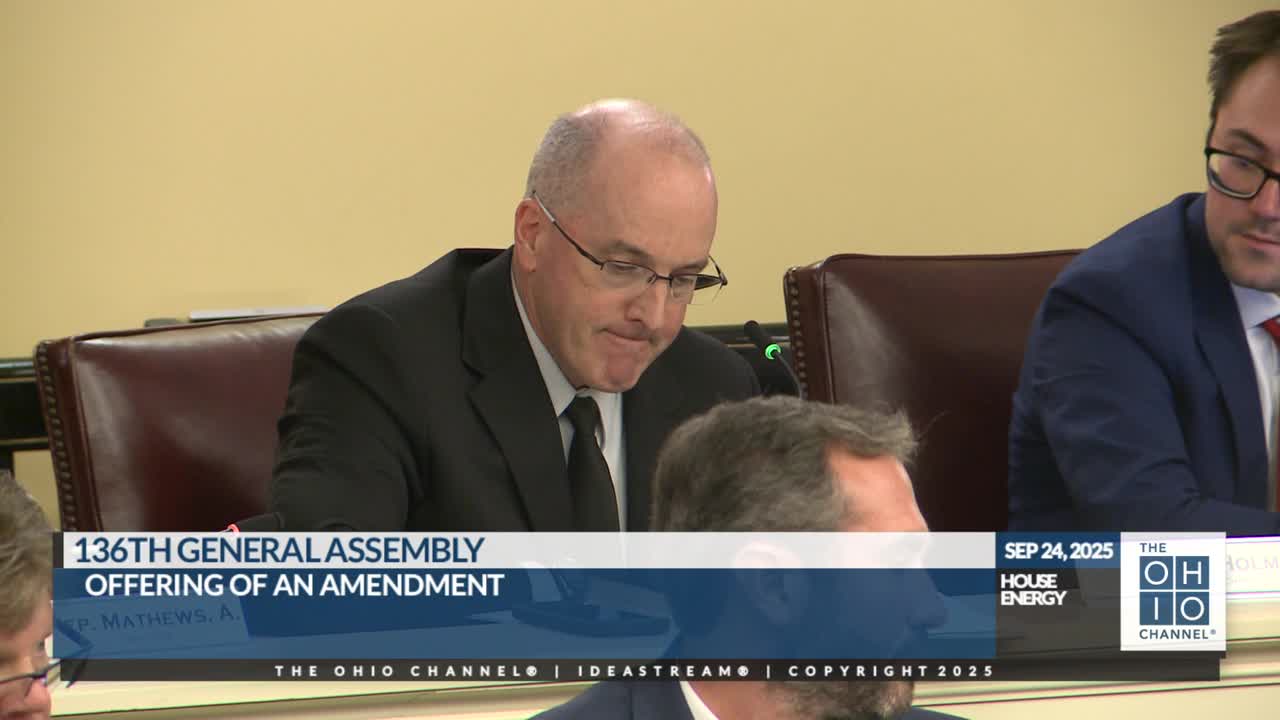
An amendment (0815) introduced by the sponsor to clarify opt-in protections and to standardize terminology between "demand reduction" and "demand response" was adopted without objection and made part of the bill. The committee concluded the first hearing and did not take outside testimony at this session.
Why it matters
Testimony framed demand response as a tool to lower peaks, enhance grid reliability and reduce reliance on expensive peaker generation. Supporters argued participation helps all ratepayers by lowering peak-driven supply costs; members asked for more detail on PUCO’s cost-effectiveness methodology and on how programs will serve lower-income consumers.