Get Full Government Meeting Transcripts, Videos, & Alerts Forever!
Get email alerts on the Energy Policy topic
No spam. Unsubscribe anytime.
House Energy Committee hears broad proponent testimony on House Bill 15 to remake Ohio power markets
Summary
COLUMBUS — The Ohio House Energy Committee spent more than three hours on proponent testimony for House Bill 15, a sweeping rewrite of state electricity policy that would remove several legacy subsidies, end the electric security plan (ESP) mechanism, prohibit distribution utilities from owning generation and create a new Consumer Choice Billing program.
COLUMBUS — The Ohio House Energy Committee spent more than three hours on proponent testimony for House Bill 15, a sweeping rewrite of state electricity policy that would remove several legacy subsidies, end the electric security plan (ESP) mechanism, prohibit distribution utilities from owning generation and create a new Consumer Choice Billing program.
The hearing brought dozens of business groups, generators, consumer advocates and policy organizations to the podium to support the bill’s stated goal of restoring competitive markets for power generation and protecting residential customers from certain charges. Maureen Willis, director of the Ohio Consumers’ Council, testified “OCC supports HB 15” and said the agency represents “Ohio’s 4,500,000 residential utility households.”
Why it matters: Proponents said HB 15 would put generation procurement back to market forces instead of allowing utilities to collect above‑market charges through ESP riders, reforms they said would lower costs, encourage investment in new generation and reduce ratepayer subsidies for legacy plants.
What supporters told the committee
- Market and consumer arguments: Witnesses from industry and consumer groups told the committee that Ohio’s experience with competition has produced sustained customer savings. Melvin Nickerson, director of government affairs for NRG, said competitive markets are “working abundantly, robustly for Ohio.” Kim Boiko, testifying for the Ohio Manufacturers Association, cited a Cleveland State study and told members that “between 2011 and ’18, businesses and residential customers have saved approximately $24,000,000,000, with an expected additional $3,000,000,000 per year in savings going forward.”
- Ending legacy subsidies and ESPs: Multiple witnesses urged immediate repeal of the OVEC (Ohio Valley Electric Corporation) legacy subsidies created by prior legislation and the repeal of the solar generation fund. Industry and trade groups characterized those payments as ratepayer subsidies embedded in riders and said the subsidies distort markets and impose large costs on customers. The Ohio Manufacturers Association said Ohioans have already paid “over $670,000,000 for these OVEC plants.” Several proponents asked that any legacy subsidies end on the bill’s effective date rather than phase out later.
- Consumer protections and choice billing: The bill would require the standard service offer (SSO) to be procured through a competitive, market‑rate bid process and would create a Consumer Choice Billing program allowing suppliers to directly bill customers. Supporters said direct billing can enable innovative products and lower costs; Arnie Quinn of Vistra noted that consumer choice billing has been used in other markets and enables programs such as time‑of‑use or nights‑and‑weekends offers. At the same time, the Ohio Consumers’ Council urged safeguards: Willis recommended banning door‑to‑door solicitation and said consolidated billing “is duplicative” and should not be paid for by utility customers.
- Data centers and economic development: Generators and developers framed HB 15 as a signal to attract large energy users such as data centers. Melvin Nickerson said repeal of generation‑specific taxes and removing subsidies would “send a strong message that Ohio is open for more business.” Other witnesses argued a clearer and more predictable market would reduce development risk for new merchant generation.
Transmission, supplemental projects and transparency
A recurring and sharply detailed topic at the hearing was transmission spending and the so‑called “supplemental” transmission projects that proponents said are being built with little state oversight. David Perwanyo of the Ohio Energy Leadership Council and others described a regulatory gap: many smaller transmission upgrades (often cited at 69 kilovolts) are classified as supplemental and do not receive the same PJM or state scrutiny as large regional projects. Perwanyo urged giving the Ohio Power Siting Board or the Public Utilities Commission of Ohio greater authority to review these projects, and to require heat maps showing where transmission capacity exists.
Perwanyo warned committee members that supplemental projects have been a major driver of rising transmission riders, saying utilities have “jammed” supplemental projects into the pipeline because they receive cost recovery and a guaranteed return. He presented figures showing sharp year‑over‑year increases in per‑kilowatt transmission demand charges for large industrial users across multiple utility territories.
Questions and caveats raised by proponents
Even among supporters, witnesses recommended changes. Several trade groups urged legislative language to preserve specific grid‑reliability programs now authorized under ESPs — notably interruptible or reliability programs used by large industrial customers — so those programs are not unintentionally lost if ESPs are eliminated. The Ohio Energy Leadership Council and others said they are working on targeted amendments that would preserve reliability programs while removing the broader ESP framework.
Civil‑society and environmental views
Environmental and consumer advocates supported ending ESP riders and legacy subsidies but urged pairing market reforms with stronger energy efficiency and demand‑response programs. The Environmental Law & Policy Center and the Ohio Environmental Council Action Fund recommended adding voluntary energy efficiency measures and improved demand‑response options for residential and small business customers to reduce peak load and lower the need for new capacity.
Direct quotes from the hearing (selected)
- “OCC supports HB 15,” — Maureen Willis, Ohio Consumers’ Council. - “The competitive market has worked to bring lower prices and greater innovation for Ohio families and businesses,” — Maureen Willis. - “Between 2011 and ’18, businesses and residential customers have saved approximately $24,000,000,000,” — Kim Boiko, Ohio Manufacturers Association. - “Competitive markets are working abundantly, robustly for Ohio,” — Melvin Nickerson, NRG. - “They’re jamming through these projects on the supplemental side,” — David Perwanyo, Ohio Energy Leadership Council (on supplemental transmission projects).
What the committee will do next
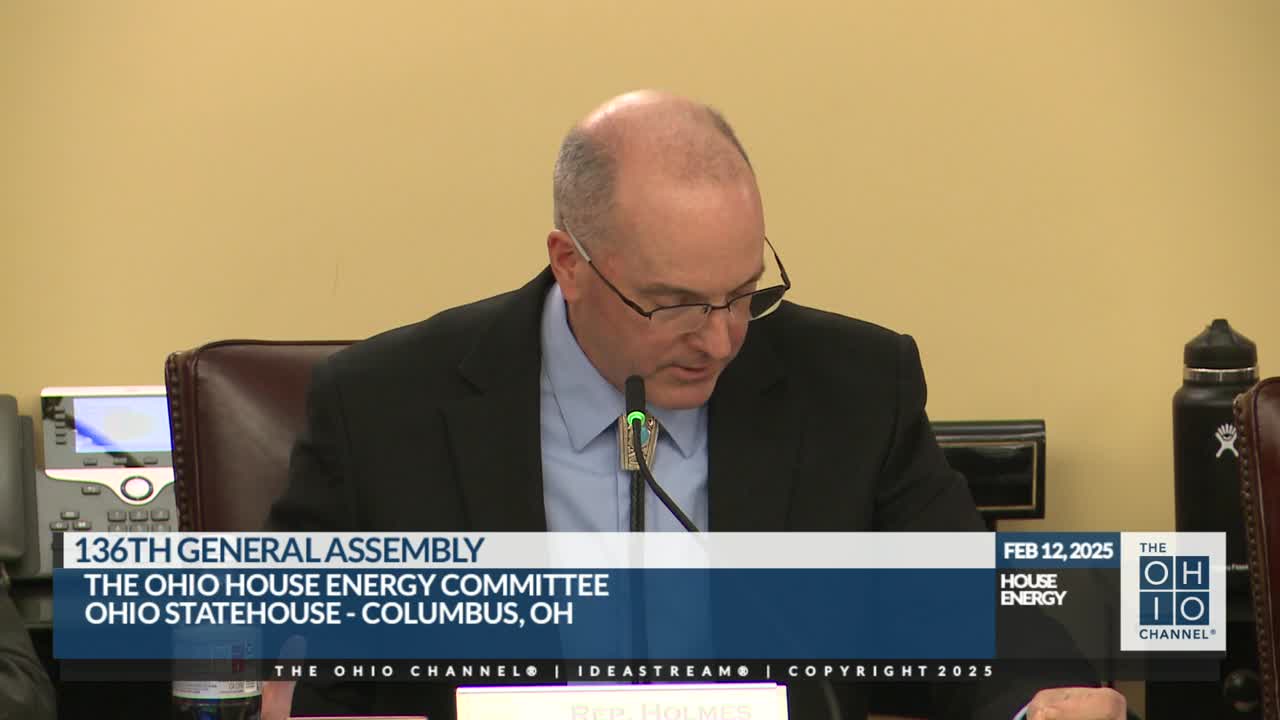
Chair Holmes closed the hearing with procedural remarks: the committee approved the prior meeting minutes and said opponents would be invited to present at the next scheduled hearing, which the chair set for two weeks. No committee votes on the bill were taken at this session.
Why it matters locally
HB 15 addresses several fault lines in Ohio energy policy: whether generation should be procured through competitive market bids or by utility‑driven riders (ESPs); whether certain legacy payments to coal plants and targeted solar funds should continue; and how to balance consumer protections with market access for third‑party suppliers. Committee members heard a mixture of industry support for market reform and targeted cautions to preserve reliability programs and ensure data and billing protections for residential consumers.
Bottom line
Proponents told the House Energy Committee that HB 15 would restore the state’s 1999 vision of competitive generation markets, remove subsidies they say have driven up customer charges and encourage new merchant investment. Supporters asked the committee to refine the bill to protect critical reliability programs and to require greater transparency on transmission projects and customer data handling. The committee did not take a vote and will hear opponents in the committee’s next scheduled meeting.