Get Full Government Meeting Transcripts, Videos, & Alerts Forever!
Get email alerts on the Energy Transmission topic
No spam. Unsubscribe anytime.
Uvalde County adopts resolution opposing proposed 765-kV Howard–Solstice transmission line
Summary
After a presentation by CPS Energy and AEP Texas on a proposed 765-kilovolt transmission line, public commenters raised concerns about property values, tourism and health. Uvalde County Commissioners Court voted to adopt a resolution opposing routes through the county.
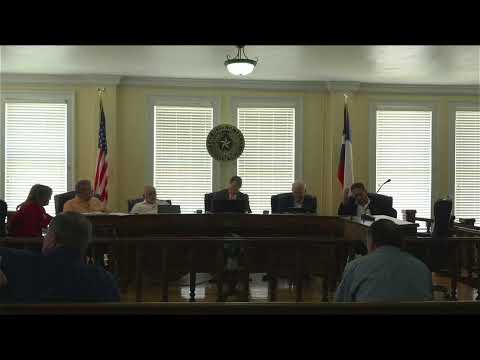
UVALDE, Texas — Uvalde County Commissioners Court on Oct. 14 voted to adopt a resolution opposing a proposed 765-kilovolt (kV) transmission line that would be part of a joint Howard-to-Solstice project by CPS Energy and AEP Texas.
Kirk Rasmussen, representing CPS Energy, described the project as part of a transmission plan ordered after the Texas Legislature passed House Bill 5066 in 2023 and approved by the Public Utility Commission of Texas. Rasmussen said the Howard-to-Solstice corridor would be a high-voltage transmission route roughly 330–370 miles long and that the new 765-kV lines would be single-circuit lattice towers with three sets of conductors and a typical right-of-way about 200 feet wide. "The lines will be single circuit, which means there's gonna be 3 sets of wires, on lattice towers," Rasmussen told the court.
Rasmussen described the utilities' public outreach: multiple open houses in the project study area, thousands of public responses collected and a planned application to the Public Utility Commission of Texas in February that will include an environmental assessment, detailed route alternatives and a record of public comments. He said landowners crossed by a final route or with habitable structures within 500 feet would receive formal notice, and interested parties would have 30 days after filing to seek party status in the PUCT process. Rasmussen projected design and survey work to begin in 2028 and the line to enter service around 2030.
Why it matters: The proposed line is part of a statewide reliability plan that utilities say can replace multiple 345-kV circuits with a single 765-kV corridor; opponents say local economic, environmental and property impacts outweigh any benefit to distant load centers such as the Permian Basin.
Public commenters urged the court to oppose routes that cross Uvalde County. Diana Alvedo Carew, a Uvalde County resident, said local concerns are personal and economic and asked the court to "pass a resolution stating that you do not want it to, the route to go through Uvalde County." Christy Gardas, executive director of the Texas Hill Country River Region, said, "When we look at this project there's no positive economic impact for our area. It's just a path that goes to the Permian Basin where other people make money… it’s not us." Judith Louie raised concerns about a one-time payment versus a lifelong impact: "we are gonna get paid 1 time, 1 payment for a lifetime of impact on our land."
Court action: After the presentation and public comment, Commissioner Copeland moved to adopt a resolution opposing the transmission line passing through Uvalde County; Commissioner Barzett seconded. The court approved the motion by voice vote.
Key technical and process details reported to the court - Voltage and design: proposed 765 kV single-circuit lattice towers; towers typically around 150 feet in height; right-of-way about 200 feet wide (Kirk Rasmussen). - Project length: roughly 330–370 miles between Howard Station (southwest of San Antonio) and Solstice Station (near Fort Stockton) as presented by the utilities. - Routing process: utilities presented multiple geographically diverse preliminary segments, held public open houses and solicited comments; the utilities plan to file a PUCT application in February that will include a 40-plus-factor evaluation and environmental assessment. - Public participation: landowners crossed by a final route or with habitable structures within 500 feet will receive notice; interested parties have 30 days after filing to request intervention; the PUCT typically refers the case to the State Office of Administrative Hearings, which may hold contested hearings. - Timeline: utilities estimated filing in February, Commission consideration roughly a year later (September–October timeframe), survey/design work beginning around 2028 and in-service targeted for 2030 (per Rasmussen).
Comments and concerns raised during testimony centered on property values, tourism and ecological impacts in the Texas Hill Country, potential effects on water and agricultural operations, and the adequacy of alternatives that would parallel existing highways or avoid sensitive areas. Commissioners questioned the routing methodology, whether routes could parallel roadways or avoid state land and how cost and aesthetics factor into the PUCT’s deliberations.
The court did not take any additional formal action on permitting or landowner negotiations during the meeting; the adopted resolution records the county’s opposition for the public record.