Get Full Government Meeting Transcripts, Videos, & Alerts Forever!
Get email alerts on the State Legislature Bonding topic
No spam. Unsubscribe anytime.
Duluth lobbyist warns of tight 2025 Minnesota session, says city priorities are positioned for bonding
Summary
Flaherty & Hood lobbyist Eric Simonson told the Duluth City Council that razor-thin control of the Minnesota Legislature and a shrinking budget forecast will make 2025a0a challenging bonding and budget year, but he said Duluth's capital requests have secured initial support from area legislators.
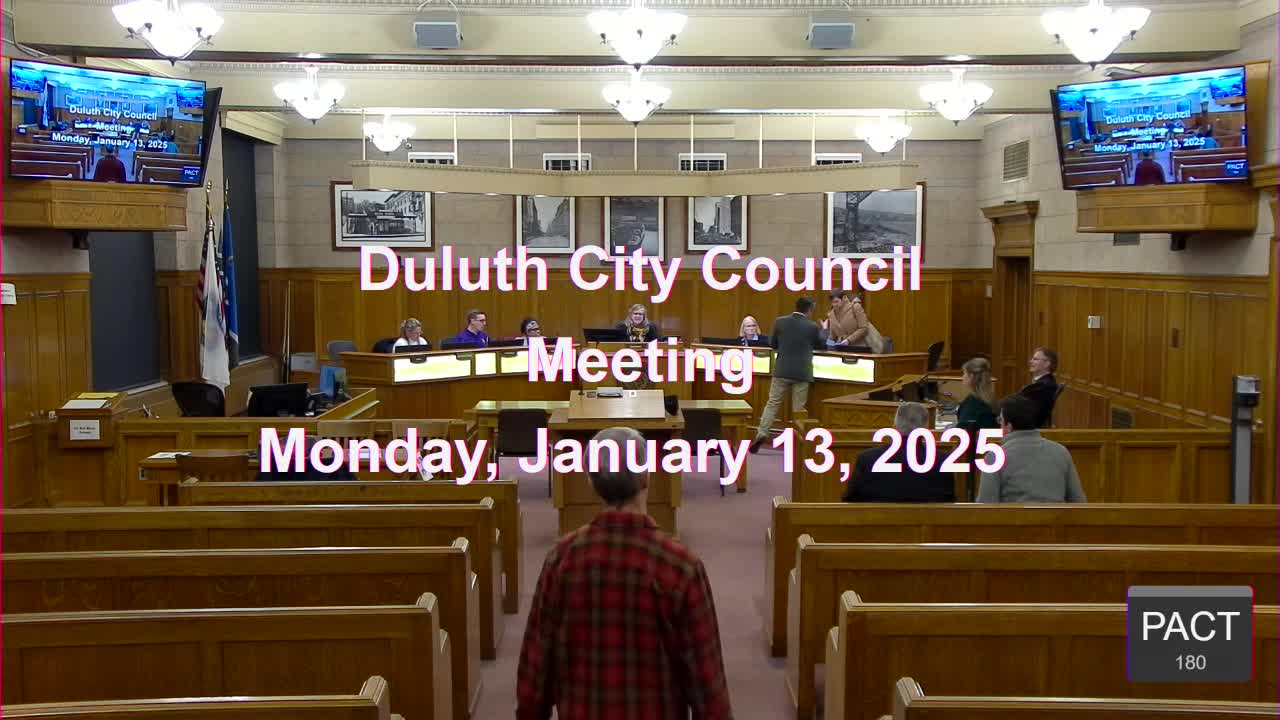
Eric Simonson, a lobbyist with the law firm Flaherty & Hood, briefed the Duluth City Council at a Committee of the Whole meeting on the start of the 2025 Minnesota legislative session and how it could affect Duluth's capital and tax-policy priorities.
"It will be a challenging legislative session for sure," Simonson said, citing narrow majorities and unresolved special elections. He told councilors that, at the opening of session, the Minnesota Senate could be effectively tied until a Jan. 28 special election is certified and that several outstanding court challenges in House races have left control of the Minnesota House of Representatives unsettled.
The briefing laid out why those contests matter for Duluth: 2025 is a budget year, Simonson said, and the state's fiscal forecast constrains how much can be spent on a capital investment (bonding) bill. He noted the November forecast showed a roughly $616 million positive balance for FY2627 and that the February forecast will further guide lawmakers. "When the legislature puts together their bonding bill... the forecast tells the legislature how much the state can afford," Simonson said.
Why it matters: Duluth is seeking state support for several major capital projects, including repairs to the Aerial Lift Bridge and upgrades to a regional water-treatment plant. Simonson said those projects have broad name recognition and regional partners, which can help secure support. "The beauty of your project is that it has a regional component to it," he said of the water system, noting other cities served by the same system could help broaden advocacy.
Simonson also described work on a Duluth tax-policy proposal that would encourage conversion of underused buildings, saying he has begun discussions with other municipalities such as St. Paul and that bills for Duluth capital priorities are being drafted.
Questions from councilors focused on local government aid and project traction. Councilor Forsman asked whether there will be movement on local government aid (LGA) or bills to protect it. Simonson said city groups are discussing an "automatic inflator" for LGA to keep aid in line with inflation, but cautioned that "the legislature is probably not gonna have a lot of appetite for new spending." Councilor Mayo asked about the likelihood of Duluth's top priorities being included in a bonding bill; Simonson replied that the projects have traction and that visibility and regional benefit help their chances.
Simonson said he has already met with the Duluth delegation and that bills for the city's capital investment projects are being drafted. He also reported scheduling meetings for Mayor Emily Reinert (mayor referenced by Simonson) with key committee chairs and executive-branch staff to advocate for Duluth projects.
The presentation closed with Simonson offering to return with updates as the session progresses. "As often as you need me to be here, I will come," he said when asked about periodic updates to council.
Ending: Councilors said they welcome continued updates as the legislature organizes and the February budget forecast arrives, which will clarify bonding capacity and likely shape the prospects for Duluth's projects.