Get Full Government Meeting Transcripts, Videos, & Alerts Forever!
Get email alerts on the Animal Health topic
No spam. Unsubscribe anytime.
Minnesota Board of Animal Health details continued avian influenza, rabies, swine threats and response needs
Summary
At a regular meeting in Saint Paul, Board of Animal Health staff outlined ongoing surveillance and response efforts for highly pathogenic avian influenza (H5N1), rabies, African swine fever and other animal disease threats; directors voted to adopt updated bylaws and approved routine meeting minutes and agenda.
The Minnesota Board of Animal Health spent the bulk of its meeting in Saint Paul reviewing an array of active animal-disease threats and the agency’s readiness, while adopting updated board bylaws.
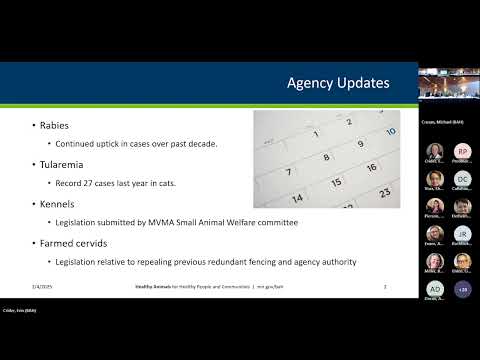
Board Executive Director Brian Hapes told directors that highly pathogenic avian influenza (H5N1) and an uptick in rabies cases continue to demand most of the agency’s staff time. He said the agency is tracking a nationwide decrease in H5N1 detections in some sectors even as the virus persists in wild birds and sporadically appears in commercial poultry and other species, including occasional detections in domestic cats and dairy cattle.
Hapes said the state remains on alert for African swine fever (ASF) given its continuing global circulation and recent detections in Mexico and the Caribbean. He and other presenters urged producers and the public to report loose swine and to coordinate with the Department of Natural Resources when wild or feral pigs are suspected.
Board district and field veterinarians described ongoing approvals and updates to the state’s ASF response plan, secure-pork-supply and traceability initiatives, and the U.S. voluntary US-SHIP program for swine biosecurity and continuity of business. The board’s veterinary diagnostic laboratory reported that it is handling large volumes of PCR and serology tests across poultry, livestock and other species and is expanding staffing and laboratory automation to boost capacity.
Public-health partners reported active human monitoring related to H5N1 exposures. Stacy Holzard of the Minnesota Department of Health said public-health teams have monitored people exposed to infected animals — including more than 100 dairy-related exposures — and have not detected sustained person-to-person spread. Department of Health staff reiterated occupational-health guidance for veterinarians and farm workers.
Discussion at the meeting repeatedly returned to funding and staffing concerns. Hapes told directors that roughly 20% of the Board’s current budget comes from federal sources and said a federal spending freeze and tighter budgets make it harder to sustain long-term outbreak response. Board members and staff urged more stable state funding to support a permanent emergency-response capacity rather than rotating existing staff into long deployments.
The board voted to adopt a revised set of bylaws at the meeting; motions to approve the December meeting minutes and the current meeting agenda also passed by voice vote.
Directors said they plan to prepare a focused, written request for lawmakers describing specific staffing and funding needs for sustained animal‑disease response, and to coordinate that request with the Department of Agriculture, the Department of Health and industry partners ahead of the legislative session.