Get Full Government Meeting Transcripts, Videos, & Alerts Forever!
Get email alerts on the Encampments Homelessness topic
No spam. Unsubscribe anytime.
Council hears details and tensions on D.C. encampment closures, outreach spending and compensation for people with lived experience
Summary
Deputy Mayor Turnich described reductions in encampments and a guarantee of shelter offers on closures while answering questions about a FY24 transfer of $444,000 to DHS for outreach. Interagency Council on Homelessness leaders and councilmembers pressed for clarity on staffing, spending pressures and stipends for people with lived experience.
During the Committee on Health—s performance oversight discussion on Feb. 20, Deputy Mayor Wayne Turnich detailed the administration—s encampment response, announced numeric trends and answered questions about funding transfers and practices.
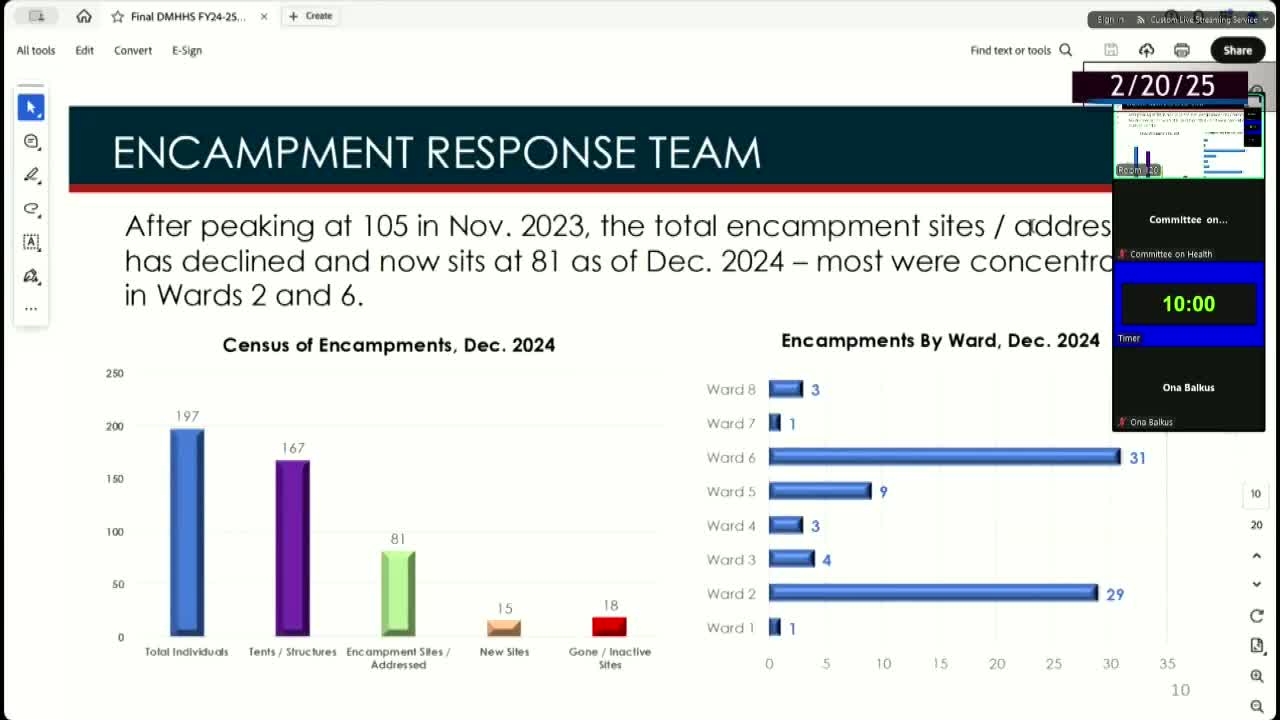
Turnich said encampments peaked at about 105 sites in November 2023 and had declined to roughly 81 sites by December 2024. "We have reduced the number of encampments, from, at they peaked in, at 105 in November of 20 23. They now ... sit at about 81," he said. He emphasized the administration—s policy that closures are conducted with offers of alternatives; when a site is closed, residents are offered shelter. "Our guarantee is that when we close an encampment, everybody in the encampment will have the opportunity to, enter shelter. We can't make them go, but we can say we are not leaving you with no option as we close this site," Turnich said.
Councilmember Christina Henderson pressed Turnich about a September—s funding transfer: DMHHS reported transferring about $444,000 in FY24 to the Department of Human Services for additional outreach services. Turnich explained the transfer was made because outreach needs had been increasing: "I suspect that it's a matter of need ... an assessment was made that more dollars were needed on that front and it was transferred to DHS as a result."
Committee members also raised administrative and operational concerns. Henderson questioned a shift in published notice windows for closures: in prior materials the agencies listed a one-month notice before full cleanup closures; current materials said the required legal notice is 14 days. Turnich said the District is "legally required to give 2 weeks" but added outreach teams often give more time, and in some public-health emergencies the timeline can be shorter.
Interagency Council on Homelessness Executive Director Teresa Silla clarified points raised about the ICH—s budget and participation. In response to committee questions about so-called "spending pressures" for ICH, she said some items had been mischaracterized. She confirmed a line item of $20,000 in the ICH budget to pay small stipends to the council—s four or five lived-experience representatives (up to $250 per month, capped at five meetings). "If we were actually reimbursing people with lived experience for their time, we would get participation across the ICH infrastructure," she said.
Other operational issues discussed included: site closures near shelters, which raised questions about shelter condition and acceptance; the interagency MOU process that kept ICH staff funded through DHS (Turnich said the administration planned to transfer those FTEs into DMHHS during the next budget process); and coordination with federal and municipal land owners such as the National Park Service and school system for sites on federal property.
Why it matters: Encampment policy touches housing, public health, civil liberties and shelter capacity. The committee sought clarity on funding flows, notice practices and supports for residents impacted by site closures.
What—s next: Committee members asked for more detailed follow-up including a list of working groups for ICH, meeting notes, updated shelter renovation timelines (including New York Avenue and CCNV), and further data on the FY24 outreach spending transferred to DHS.