
Wake County approves schematic design for Sandy Plains Public Safety Station to shorten northern response times
Get AI-powered insights, summaries, and transcripts
Subscribe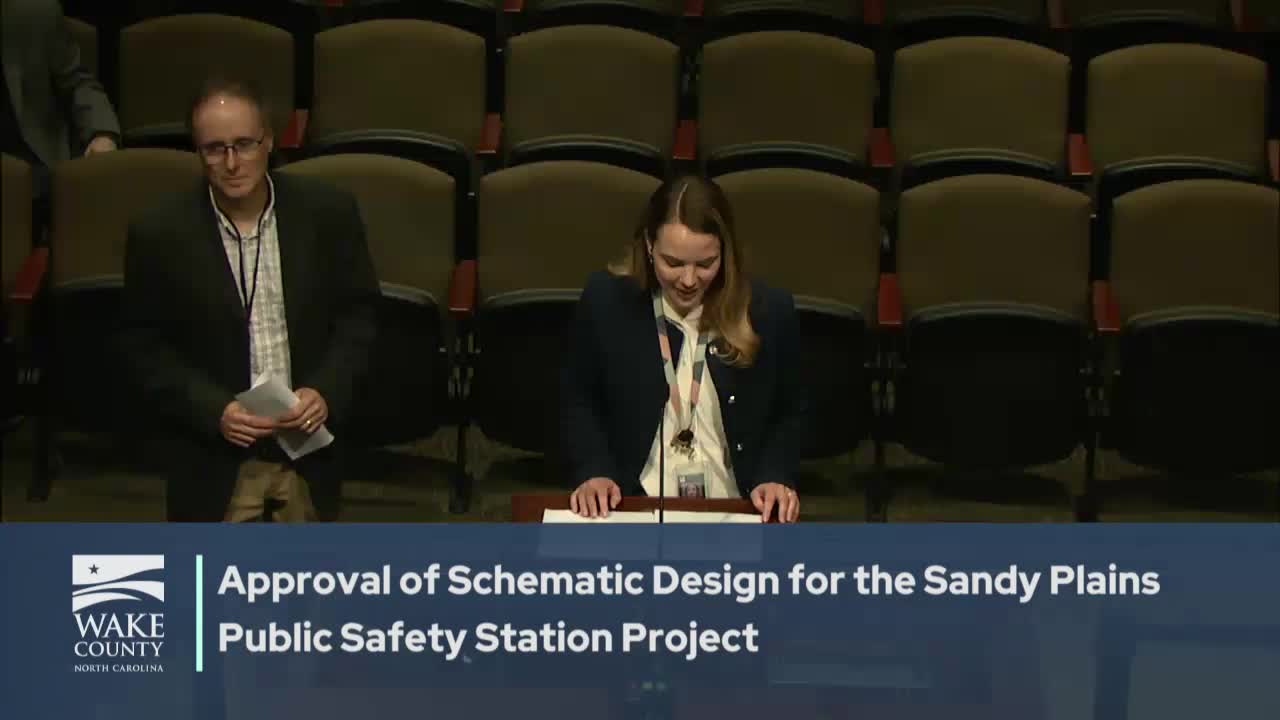
Summary
The Board approved schematic design for an 8,500-square-foot Sandy Plains Public Safety Station in northern Wake County that will house Northern Wake Fire, Wake County EMS and a sheriff drop‑in area. Commissioners voted unanimously to approve the design after staff presentations on site, building and sustainability features.
The Wake County Board of Commissioners on Feb. 17 approved the schematic design for the Sandy Plains Public Safety Station, a joint facility intended to improve emergency response in the northern part of the county.
Sarah Richter, project manager for Wake County Facilities Design and Construction, presented the schematic design and said the site is in the northernmost portion of Wake County in an area referred to as “The Hook.” Richter said response times in the area can exceed 14 minutes and that the new station is intended to reduce response times to about 5 to 7 minutes.
Richter said the county purchased the site in 2024 through Parks and Recreation open‑space funding and that the county will use a minimal footprint and reimburse parks and open space for the portion of land disturbed. She said the facility will be jointly occupied by Northern Wake Fire, Wake County EMS and will include a sheriff’s drop‑in work area.
Project architect Mike Esposito of ADW Architects reviewed the floor plan and elevations. The schematic describes an approximately 8,500‑square‑foot, single‑story building with three apparatus bays (brush truck with swift‑water rescue boat, an engine and an EMS apparatus), support spaces, a fitness area, locker and shower facilities, a mezzanine for storage, and living/bunk areas for staff. Site features listed by staff include a vehicle drive apron with on‑site turnaround, 17 parking spaces, on‑site stormwater control, and well and septic service (no public utilities at the site).
Richter said the building is proposed as all‑electric — using high‑efficiency heat pumps — with photovoltaic panels, high‑performance windows and doors, air scrubbers in the apparatus bay to treat diesel particulates, native landscaping, and infrastructure for future EV charging. She described the building character as “residential in nature” with brick and hardboard siding to fit the rural surroundings.
Staff outlined a project schedule that aims to complete design by early summer, bid the project in the fall and open the building in fall 2026. Commissioners asked about potential future expansion (staff said expansion would be difficult because of impervious surface limits on the property) and about on‑site well testing; staff reported draw‑down testing showed adequate supply and that county Water Services will perform safety testing for radon and contaminants.
Multiple commissioners expressed support for the project and for staff’s community engagement. Commissioner Thomas moved to approve the schematic design and Commissioner Waters seconded; the board voted unanimously to approve the schematic design.
Action recorded: board approved schematic design for Sandy Plains Public Safety Station.