Get Full Government Meeting Transcripts, Videos, & Alerts Forever!
Get email alerts on the District Budget topic
No spam. Unsubscribe anytime.
Budget workshop outlines revenue mix, referendum impact and projected pressures on Princeton schools
Summary
District staff presented a large-picture budget workshop covering revenues, the recently passed referendum, calendar adjustments, rising costs for health care and transportation, and timelines for the tentative and final budget adoptions.
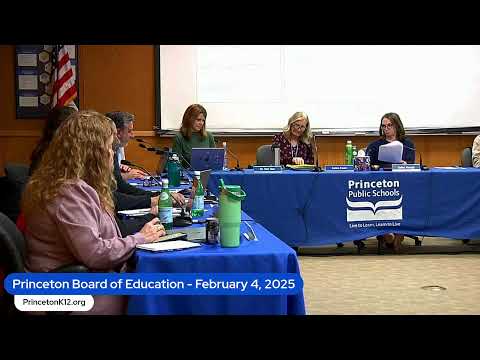
Princeton Public Schools staff presented a budget workshop to the Princeton Board of Education on Feb. 4, 2025, outlining the district’s revenue mix, the financial effects of a recently passed referendum and projected budget pressures for the coming years.
Matt Bolden, speaking for district finance staff, said local sources provide about 92% of the district’s revenue while state funding accounts for roughly 8 percent. He told the board that a recent referendum passed by voters will increase the district’s debt service levy to support capital projects and that Moody’s will re-review the district’s bond rating as new debt is issued. “We maintained our AAA rating,” he said of past issuance, noting the larger borrowing planned will receive scrutiny.
Bolden walked the board through the budget calendar: the governor’s budget address and state aid release are scheduled for late February, the board aims to adopt a tentative budget March 18 (statutory submission follows) and the public hearing and final adoption are scheduled for April 29. He said the district uses a largely zero-based budgeting approach and has been holding staffing stable in recent years.
Superintendent Dr. Foster thanked voters for passing the referendum and described steps the district is taking to ensure student safety and communicate with families about federal executive orders. Dr. Foster also outlined adjustments to school calendars: for 2024–25 the district will move a flex professional-development day that had been scheduled for June 3 in response to the change in the state primary date; for 2025–26 she said the board will designate Nov. 4 as a school day (election-day scheduling) and close Jan. 2 so students and staff return Jan. 5, and she described other scheduling shifts the administration plans to present to the board.
Committee members and the public asked about several expense drivers: healthcare costs, which the administration said are a major pressure; out-of-district special education tuition, which can be volatile; rising transportation and contracted-service costs; and charter tuition impacts. Bolden said the university’s multiyear pledge to the district supplements operating and special-program funding but that charter tuition and state categorical flows affect net resources.
Board members asked about transportation options, opt-outs for families, and shared services with Montgomery (maintenance and bus repair). Bolden said shared services have helped reduce costs and improve vehicle maintenance and inspection timeliness.
Bolden summarized reserves and fund-balance strategy: the district has been building fund balance and capital reserves while noting New Jersey’s strict rules on allowable reserves and the state’s 2% tax-cap limitation. He warned that, absent extraordinary revenue events, the district faces recurring gaps that will require choices about services, use of reserves or pursuing voter approval of operating increases.
The board heard the overview, asked questions and was told the administration will continue to update numbers as state aid and final figures become available.