Get Full Government Meeting Transcripts, Videos, & Alerts Forever!
Get email alerts on the Alternative Crisis Response Non Police Pilot topic
No spam. Unsubscribe anytime.
Columbus leaders outline expansion of non‑police crisis responses, commission outside review
Summary
City officials and community providers described existing co‑response and civilian crisis teams, estimated $7.5 million in city spending and 45 positions for 2025, and announced Mission Critical Partners will assess options for a non‑police response pilot. Community advocates urged faster action and 24/7 coverage.
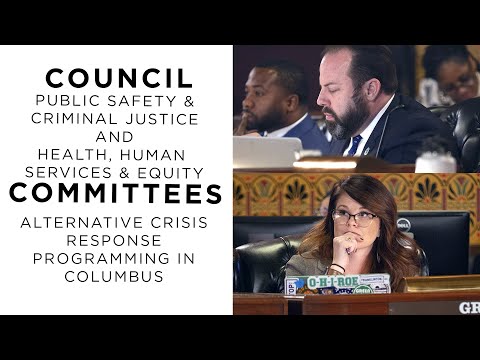
Council President Harden and city staff on Wednesday detailed Columbus’s network of alternative crisis response programs and announced a contracted assessment to guide a planned non‑police response pilot.
The presentations — from Columbus Public Health, the Division of Public Safety, Columbus Police and community providers — reviewed co‑response teams such as the Mobile Crisis Response (MCR), the REACT overdose teams, the SPARC social‑services outreach teams, and the Right Response Unit (RRU) embedded in 911. Deputy Director Michael Halloran of the Department of Public Safety told council the city’s budgeted estimate for 2025 is “a little bit over $7,500,000” covering 45 positions across safety and health departments.
The review and recommendation work will be done by Mission Critical Partners, an outside consulting team the city hired to assess existing programs, advise on administration and governance, and recommend how to pilot a fully non‑police response option. Bonnie Mainy, senior adviser for Mission Critical Partners, said the firm will gather qualitative and quantitative data, hold listening sessions and publish a practical, phased report in mid‑summer after on‑site work and stakeholder interviews.
Why it matters: Council members and community speakers said quicker progress is needed because lives have been lost in crisis calls that proponents say could be handled by non‑police responders. City leaders framed the consultant engagement as a step to scale and integrate programs that are already operating across agencies and nonprofit partners.
City and provider overviews
Deputy Director Michael Halloran summarized three goals for alternative response: connect people in crisis with the right resource, reduce reliance on traditional patrol/EMS, and improve/innovate responses. Halloran and other presenters described multiple existing programs: - REACT and SPARC: multi‑agency teams led by Columbus Fire and partners that respond to overdoses and medically fragile or behaviorally vulnerable residents. Officials said teams have reduced repeat EMS and 911 calls among the highest utilizers by about 40 percent. - Mobile Crisis Response (MCR): a co‑response model (police officer paired with clinician) that Halloran said ran 10 a.m. to midnight in 2024; the division reported MCR handled roughly 3,100 mental‑health calls in 2024 (about 14 percent of mental‑health calls), while Columbus Police received about 21,970 mental‑health calls in 2024. - Right Response Unit (RRU): embedded clinicians in the 911 center that triaged 5,594 calls in 2024 and resolved roughly 40 percent without dispatching police, according to Chris Mayfield, 911 emergency communications center manager. - MRSS (Mobile Response and Stabilization Services) at Nationwide Children’s: a state program under OhioRISE for youth up to 21 that aims to respond within 60 minutes and stabilize in‑home when safe; Jessica Michael said MRSS in Franklin County has served about 1,300 unique patients and responded to more than 2,000 crises since fall 2022 and uses law‑enforcement support in roughly 4 percent of field responses. - NET Care civilian mobile teams: Heather Stumpf said NET Care operates seven clinician/peer teams that work 8 a.m.–10 p.m. and will launch the county’s first 24‑hour civilian mobile crisis service within roughly a month.
Operational notes and near‑term changes
Presenters described several near‑term or planned changes: six unmarked vehicles for MCR were procured; vehicles for SPARC and REACT are being upfitted for service (target spring 2025); the city is upgrading 911 software and exploring direct transfer of 911 mental‑health calls to 988 during RRU off‑hours; and the Franklin County Crisis Care Center is scheduled to open before summer as an adult crisis destination.
Mission Critical Partners engagement
Bonnie Mainy of Mission Critical Partners reviewed the firm’s four‑phase scope: discovery (data reviews, interviews and ride‑alongs), analysis, a draft report and a final actionable plan. She said the firm will examine governance and administrative options, risk allocation (which calls go to 988, RRU, MCR or a non‑police team), funding and sustainable finance strategies, and community engagement best practices. Mainy said the consultants will aim for recommendations that are practical and phased rather than “0 to 100.”
Community requests and concerns
Community members speaking during public comment asked for a permanent, community advisory board; 24/7 non‑police coverage; formal integration of peer supporters into teams; and clearer paths to billing or sustainable revenue. Helen Ann Sweeney of BRAD (Columbus Safety Collective) urged that “peer supporters must be trained and hired to be non‑police crisis employees.” Channa Wiley, co‑chair of Columbus Safety Collective, told council “We refuse to wait any longer for basic community care,” and described the family impact of a fatal encounter she tied to a police response.
Council context and next steps
Council members said the city already operates many pieces of a crisis continuum but that integration, scaling and funding remain challenges. Several council members and presenters framed Mission Critical Partners’ work as a way to coordinate the existing programs, identify low‑cost wins and craft a sustainable pathway to a non‑police pilot. No formal votes or ordinance actions were taken at the hearing.
Ending
City staff and the consultant team will continue data collection and stakeholder interviews in the coming weeks; Mission Critical Partners expects a final report and recommendations in mid‑summer. In the meantime, providers and advocates urged quicker expansions of 24/7 non‑police capacity and stronger community oversight structures.