Get Full Government Meeting Transcripts, Videos, & Alerts Forever!
Get email alerts on the Education topic
No spam. Unsubscribe anytime.
Superintendent outlines enrollment, achievement, attendance and student-support trends in State of the District
Summary
Superintendent AJ Fielding presented the district’s annual State of the District: enrollment trends, demographics, academic progress (MAP testing gains in math), rising McKinney-Vento counts, staffing levels, and interventions including MTSS, phone pouches and hall-pass monitoring.
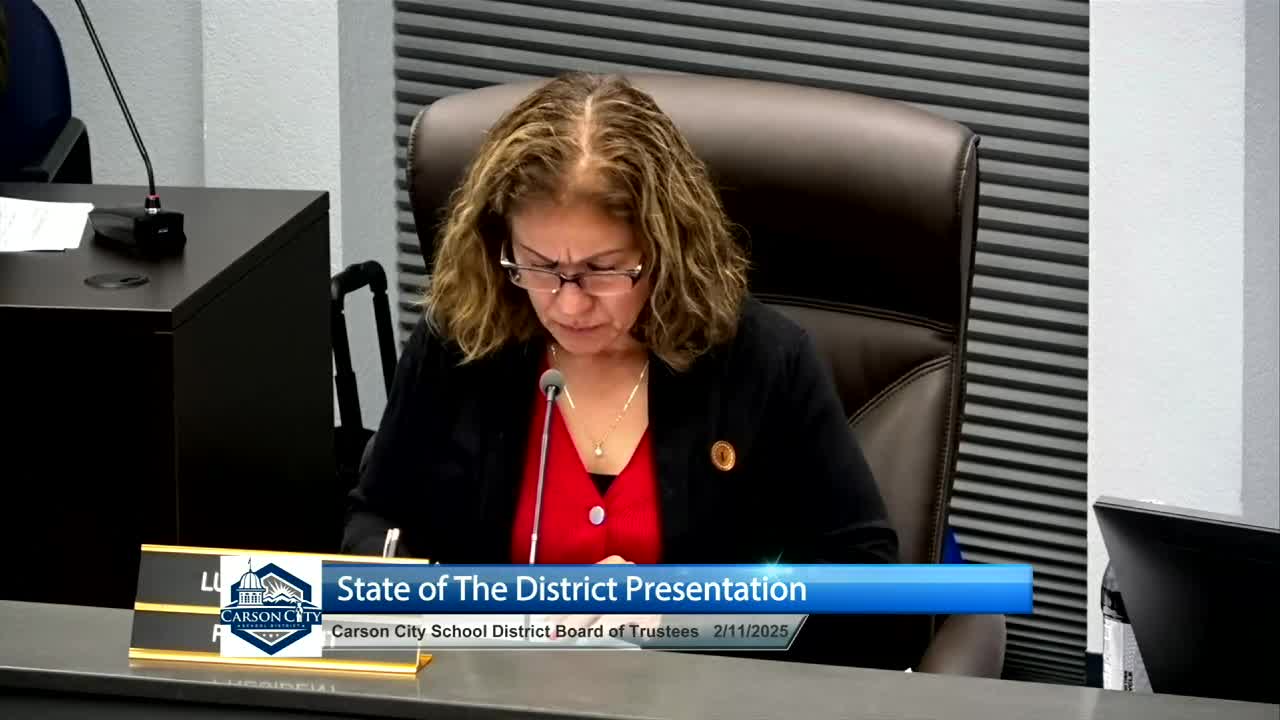
Superintendent AJ Fielding presented an annual “State of the District” overview to the Carson City School District Board of Trustees, summarizing enrollment, staffing, student demographics, attendance trends, academic measures and district initiatives.
Fielding told trustees that overall enrollment has trended downward since the early 2000s but that funded average daily enrollment (ADE) for the current year was projected to increase slightly “about 6” over last year. He said the district uses a daily-average calculation for funding rather than a single count day and cautioned that the final number depends on the remainder of the school year. Fielding noted long-term demographic shifts: 48.8% Hispanic, 42.1% White, 13.2% English learners, 12.8% of students with IEPs, and 67.2% qualifying for free or reduced-price meals (figures drawn from the Nevada report card cited in his presentation).
Why it matters: Fielding emphasized that student needs have changed and that those shifts affect instruction, staffing and supports the district must provide. He drew attention to transiency and housing insecurity as drivers of student instability.
Key data and initiatives Fielding described: - Enrollment and demographics: Funded enrollment is roughly in line with the district’s recent trend; Fielding characterized the long-term peak around 2002–2003 and said current enrollment is similar to mid-1990s levels. - English learners and special education: He cited about 13.2% of students as English learners and about 12.8% with IEPs; he said roughly 263 certified staff held English-learner endorsements (ELAD) districtwide. - Direct certification and family need: Fielding highlighted a rise in “direct certification”—students whose families qualify for certain federal supports—reported as roughly 44% (up from about 22–23% a decade earlier), an indicator of increased economic need among families. - Transiency and chronic absenteeism: Nevada has a high statewide transiency rate; Carson’s transiency was reported at about 15.2%. Chronic absenteeism climbed after COVID and peaked near 27.6% last year; he said recent trends are improving but work remains. - Graduation and college remediation: The district’s four-year graduation rate rebounded to 83.1% last year. For students enrolled in NSHE institutions, about 19.2% required remediation, near parity with some neighboring districts. - Staffing and budgets: Fielding reported about 939 total staff (503 certified, 388 classified), and said leadership/staffing costs in Carson were about 6.1% of budget—lower than many peer districts. He said raising that to a peer level (8.6%) would cost roughly $2 million. - Instructional improvement and assessment: Fielding highlighted winter MAP assessment results showing notable growth in math in the most recent test cycle, which he attributed in part to a new district math curriculum and prior work on proficiency scales. - Behavior and interventions: Fielding described several operational changes at secondary schools—hall-pass monitoring, redesigned restroom sightlines, and the use of phone pouches during class—and reported reductions in physical aggression and disrespect at secondary schools (20–60% reductions depending on measure and school). He said Carson High reported a 40–60% reduction in some behavior categories after these changes. - Student supports and McKinney-Vento: Fielding said McKinney-Vento enrollment—students in unstable housing situations—rose compared with last year. He cited that at the close of the 2023–24 school year there were 256 enrolled in the program and 303 served at some point during that year; as of January 2025 the program listed 288 enrolled and 326 served at some point during the current year, indicating a larger caseload this year than last. - MTSS and intervention time: The district’s multi-tiered system of supports (MTSS) work continues. Fielding said schools will include built-in intervention time next year so students can receive targeted academic or behavioral support during the school day.
Board response and follow-up requests: Trustees asked for additional breakdowns and requested more regular sharing of achievement measures. Trustee Walker and others commended the superintendent and staff for improvements and for progress on initiatives such as MAP gains, development of proficiency scales, and expanded intervention systems. Trustees asked for additional detail on multilingual learners and ELAD-certified teachers; Fielding said he would provide more granular lists and confirmed roughly 930 English-learner students and about 263 ELAD-endorsed teachers districtwide.
Fielding closed by noting continued capital needs (HVAC and boiler replacements at Carson High cited as a multiyear expenditure) and the coming end of some COVID-era federal grant streams. He said the district earned a clean financial audit for an 11th consecutive year and that legislative advocacy will remain a priority to reduce duplicative state reporting and secure funding for capital and special programs.
Provenance: Fielding’s State of the District presentation begins when he introduces the annual overview and continues through trustee questions and discussion on MTSS, enrollment, attendance, MAP results, McKinney-Vento counts and behavior interventions.