Get Full Government Meeting Transcripts, Videos, & Alerts Forever!
Get email alerts on the State Investments Precious Metals topic
No spam. Unsubscribe anytime.
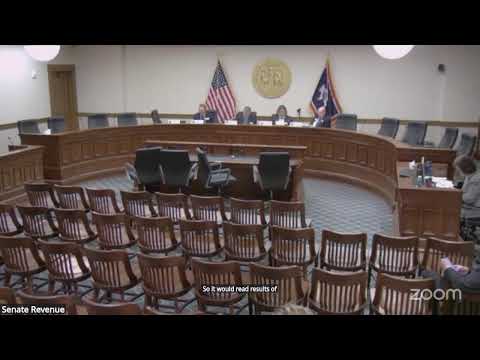
Revenue Committee debates ‘Wyoming Gold Act’ and lays bill over after discussion of storage, investment and study
Summary
Senate File 96 (the Wyoming Gold Act) would authorize the state treasurer to hold precious metals and require a study of accepting gold and silver as payment; the committee discussed guard/insurance, investment performance and who should conduct a study and decided to lay the bill over for further amendments and review.
Senate File 96, introduced by Senator Bob Ide of Natrona County, would authorize the state treasurer to hold up to $10 million in specie (gold and silver) across state-managed accounts and require a treasurer-conducted study on the role of precious metals in state stabilization. The Revenue Committee discussed investment performance, security and whether rulemaking or the legislature should commission the study.
Sponsor Senator Bob Ide framed the bill as a limited, precautionary diversification. “The state treasurer shall implement this article by holding no less than $10,000,000 in specie,” Ide said while describing the measure’s goal of preserving capital and hedging inflation and other risks. He described the proposal as “a minimal amount” intended to put the state “on the map” for holding physical precious metals and asked the committee for a favorable recommendation.
Dawn Williams, deputy state treasurer, and Patrick Fleming, chief investment officer for the State Treasurer’s office, both testified on operational and portfolio considerations. Williams requested removal of mandatory rulemaking language and questioned whether the treasurer’s office should be asked to conduct the legislative study. “If you do leave this language in here ... there is no funding in the bill for a study,” Williams said, urging the committee to consider who would be best suited to perform that work.
Fleming, the treasurer’s chief investment officer, summarized the office’s investment mandate and cautioned that precious metals have underperformed other asset classes over long horizons. “From a CIO looking to invest in the highest risk-adjusted return instrument, that's our mandate,” Fleming said, and he provided 1-, 3-, 5-, 10-, 20- and 30-year comparisons showing equity returns have outpaced gold over many multi-decade periods. Fleming also explained operational costs: buying, taking delivery, insuring and storing physical metal add costs and logistics; storage and handling would reduce net returns.
Public commenters and local officials weighed in on feasibility and security. Kathy Ide reported a storage-fee estimate from a Casper facility of approximately 0.25% per annum on stored metal. Sweetwater County Treasurer Mark Cowan warned the committee that bullion as currency is impracticable and noted the U.S. Treasury holds vastly more gold than any state; he said bullion is better considered as an asset than an operational currency.
Committee members pressed on several cross-cutting questions: would holdings be permanent or sold as markets change; which accounts would hold specie; whether a treasurer-directed purchase would bypass existing investment-committee review; and what rules or safeguards would be required for custody, audits and insurance. Senator Ide and others discussed concentrating holdings within permanent state funds rather than across hundreds of smaller accounts to simplify administration.
The committee considered procedural changes in an amendment offered by Senator Pappas to replace several uses of “shall” with “may” and to make the study optional; the committee voted on that amendment and the amendment did not carry. With additional drafting time needed, the chair said the bill would be held over for further work. The chairman indicated the bill will be the committee's first order of business on Friday to allow members and staff time to prepare focused amendments and receive requested legal and fiscal input.
Ending: The committee left SF96 open for amendment rather than advancing it; members asked for clearer rule language, third-party study options and precise accounting for where metal would be held before taking the bill up again.