Get Full Government Meeting Transcripts, Videos, & Alerts Forever!
Get email alerts on the Taxes Sales Use topic
No spam. Unsubscribe anytime.
Committee approves bill to shift 4 percentage points of statewide sales tax back to cities and counties
Summary
The Revenue Committee advanced Senate File 60, which lowers the state's share of the statewide 4% sales tax from 69% to 65% and increases the local distribution share, producing an estimated $38.6 million returned to local governments in fiscal year 2026; the committee voted 5-0 to pass the bill out of committee.
Senate File 60, a bill that would change the statewide sales- and use-tax distribution formula so the state keeps 65% rather than 69% of the statewide 4% tax, was advanced by the Revenue Committee after public testimony and technical explanation from the Department of Revenue.
Sponsor Senator Tim French, Senate District 18, told the committee the bill is “pretty simple” and “just changes the percentage” so that “the state share goes from 69% to 65%.” He said the change would increase distributions back to cities, towns and counties by about $38,600,000 in the bill’s first year (fiscal 2026). “It sends more money back out,” French said.
Brett Fanning, excise tax administrator at the Wyoming Department of Revenue, described the mechanics of distribution and the bill’s narrow scope. “On page number 2, lines 6 and 7, just as Senator French had outlined, this is just updating the percentage,” Fanning said. He explained that the bill removes obsolete statutory language but does not alter the statute guaranteeing direct distributions to counties and municipalities.
The nut graf: The bill reduces the state's retained share of the statewide 4% sales tax and increases the portion distributed to local governments, a change that committee members and several local officials said would provide recurring revenue for local services but not fully replace property-tax revenue.
Committee and public testimony emphasized local impacts and limits. Jim Ford, a member of the Campbell County Commission speaking for the State County Commissioners Association, said the association supports the bill as “bringing some additional revenues back to the localities” but warned it should not be viewed as a direct substitute for property-tax relief because distribution is population-based. Kelly Millar, clerk-treasurer for the Town of Upton, gave town-level estimates: she said the change would increase distributions to the Town of Austin by about $12,000 annually and to Cody by about $154,000, while noting the town’s estimated loss tied to the long-term homeowners property-tax exemption would be roughly $31,000.
Fanning walked the committee through how sales and use tax are divided: under current law, the statewide 4% is collected, 69% flows to the state general fund, and the remaining roughly 31% is distributed back to local governments with 1% of that retained for administrative purposes. Under SF60 the state share becomes 65% and the local-distribution slice becomes effectively 35% before the 1% administrative deduction. Fanning reiterated that the direct-distribution guarantees to counties and towns remain unchanged by the bill.
The committee heard additional testimony on local public-safety and operational needs. Mike Thompson, chief of police for Evansville, told the committee that direct-distribution dollars “are very pivotal to what our communities do in public safety,” citing rising equipment and vehicle costs.
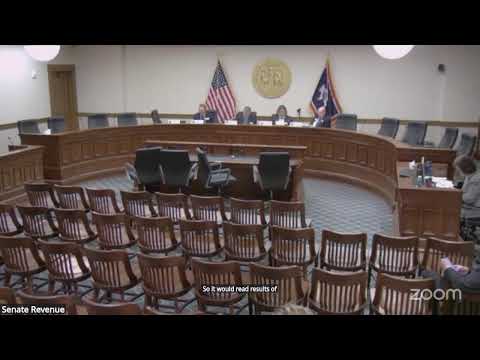
After public comment, Senator Kaes moved the bill and Senator Bridal seconded. The Revenue Committee took a roll-call vote: Senators Case (Aye), French (Aye), Eyed (Aye), Pappas (Aye) and Chairman McEwen (Aye). The committee recorded five ayes and passed SF60 out of committee.
The bill, as explained to the committee, would take effect July 1, 2025, and the Department of Revenue described the change as an IT update that is administratively straightforward. The department’s fiscal note supplied to the committee projects the first-year local distribution increase at approximately $38.6 million for fiscal 2026.
Ending: The committee advanced SF60 to the floor with unanimous committee support; proponents framed the change as a way to provide predictable, ongoing revenue to local governments rather than a one-time aid or a direct property-tax swap.