Get Full Government Meeting Transcripts, Videos, & Alerts Forever!
Get email alerts on the Grants And Sponsorships topic
No spam. Unsubscribe anytime.
OHA committee reviews redesigned event grants and moves to align funding with strategic outcomes
Summary
The Office of Hawaiian Affairs Budget and Finance Committee reviewed a consolidated event grants and sponsorship process intended to streamline awards, require reporting and brand recognition, and align grants to OHA strategic outcomes. Trustees raised concerns about small nonprofit access, geographic equity and carryover policy.
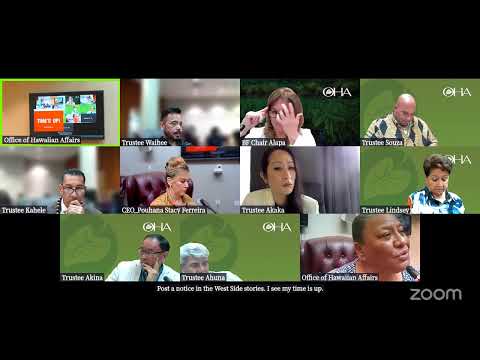
The Office of Hawaiian Affairs (OHA) Budget and Finance Committee on Tuesday heard a briefing on a redesigned event grants and sponsorship program meant to consolidate separate funding streams and tie awards more directly to the agency’s strategic outcomes.
Ke Hau Pu'u, Chief Operating Officer, and Kapuhana Stacy Ferreira outlined the consolidated application and review process — which the administration is calling Ho'akuakua'lahui — that combines legacy sponsorships, Board of Trustees sponsorships, rural community sponsorships and Ahaukui grants into a single, more rigorous pathway for event funding.
The redesign aims to make sponsorships and event grants "fair and equitable," according to Ke Hau Pu'u, who described combining two existing application streams into one and adding consistent eligibility checks, budget review and reporting requirements. He said the revised process was informed by work completed in March 2024 and by former staff who revised the prior programs.
The proposal keeps nonprofit status as an eligibility requirement and adds standard documentation (IRS determination letter, W-9), a review rubric and quarterly recommendations to the board. Ke Hau Pu'u said the administration will batch applications by event timing so submissions received at different lead times are evaluated together, and that recommendations would go to the board quarterly once the new process is implemented.
Key mechanics and limits described by administration staff include: - A single consolidated application and rubric to replace two separate processes. - Eligibility: nonprofits only; organization must submit IRS determination and W-9. - One OHA grant per event and one award per organization per fiscal year. - Maximum routine sponsorship: $25,000 (the Mary Monarch Festival has historically received that amount); typical awards have been in the $5,000–$15,000 range. - An explicit exception pathway for very large events (administration cited FESTPAC as an example and said the Board can approve amounts above $25,000, including an instance of $1,500,000 for a special sponsorship). - Rural community sponsorships: a smaller set-aside (noted at $1,000) for events in rural communities. - Application availability year-round but not earlier than 12 months before an event; evaluations will be batched and presented to the board quarterly. - Payment processing targeted for two to four weeks before events; award letters will include OHA logo assets and reporting requirements.
Trustees pressed administration on equity for smaller organizations, geographic distribution, and carryover policy. Trustee Lindsey asked specifically about small groups that request $1,000 to $1,500 for neighborhood events and warned that without guardrails those groups could be disadvantaged when competing against larger, legacy recipients. "I'm concerned about that because there are many, many small groups of nonprofits that ask us for just $1,000 or 1500 for, let's say, a Halloween party for the kids of the community," Lindsey said.
Trustee Ahuna raised questions about island distribution and whether grants would be statewide or allocated by island; administration clarified that the event sponsorships described are distinct from the larger community grants that fund multi‑figure projects. Trustee Wahe'e asked whether unspent grant funds could automatically roll into the next year’s same category; the interim corporation counsel and administration explained that current executive policy allows multiyear carryover but that use of carryover funds requires board action under existing policy (Executive Policy Manual provision 3.4.5g), and that a policy change would be needed to create automatic rollovers without board approval.
Several trustees recommended operational changes to increase transparency and community outreach. Trustee Souza suggested consolidating budget categories to allow more flexible reallocations within event funding, and Trustee Stevens recommended publicly listing why applicants were declined to increase transparency; administration said it would consult the practice used by Hawaiian Homes as a potential template.
Administration also described steps to improve OHA recognition for sponsored events. Staff said award letters will include logo assets and that the office can make placement of OHA branding a condition of award. The briefing noted that reporting requirements for sponsored events — including post-event reports, and images or video documentation when available — will be required under the new process.
Kapuhana Stacy Ferreira, who introduced the staff and said the administration intends to roll out the application "ASAP," explained that for the remainder of the fiscal year the office will continue to bring sponsorship approvals to the Board monthly while work continues to transition to quarterly board recommendations in the next fiscal cycle.
Public testimony reiterated community priorities. Jermaine Myers, an OHA beneficiary from the Waianae area, urged that fundraising be explicitly allowed under the revised criteria for events and asked that legacy events in his community be considered for sponsorship. He also requested that organizers provide photos and videos to document event impact and that OHA post outreach in locally read publications on the west side.
No formal funding decisions were made at the meeting. The committee adjourned by roll call vote at the end of the session.