Norman council reviews possible charter amendments on pay, term dates, auditor qualifications and TIF votes
Loading...
Summary
The Norman City Council on Oct. 28, 2025, discussed a set of potential charter amendments that would change elected-official pay, standardize swearing-in dates for terms and broaden qualifications for the city auditor, City Attorney Catherine Walker told the council.
The Norman City Council on Oct. 28, 2025, discussed a set of potential charter amendments that would change elected-official pay, standardize swearing-in dates for terms and broaden qualifications for the city auditor, City Attorney Catherine Walker told the council.
Walker said the measures trace to prior work by the Charter Review Commission and a 2022 ordinance that voters rejected; she said the earlier proposal included a $8,100 annual mayor stipend and $5,400 annual councilmember stipend and the creation of a five-member compensation committee to review pay every three years using the consumer price index and the city budget. "What the Charter Review Commission recommended last time was a range, and council ended up settling on $8,100 for the mayor per year and then $5,400 per year for council members," Walker said.
The proposed swearing-in change would move the start of terms to a uniform date — the first Tuesday after a scheduled runoff election — to avoid staggered start dates across offices. Walker explained the shift would be phased so as not to cut short current terms; she said even-numbered wards would see the change beginning in 2028 and the mayor's date would not be fully aligned until 2031. "Moving that swear in date to closer to the date of the election," Walker said, "...we didn't want to impact the end of any existing terms."
Walker also described edits to the auditor qualification language that would add flexibility for certification: in addition to the existing Certified Public Accountant (CPA) requirement, the charter text would list a certified internal auditor, certified fraud examiner or "other equivalent professional certification" as acceptable qualifications.
Councilors raised practical and political questions. Several asked whether salaries should be presented on the ballot as monthly rather than annual amounts to avoid voter confusion; Walker confirmed charter language could list monthly figures. Councilors also asked about implementation timing and whether salary changes should apply to the next election cycle or the next budget year; Walker said the charter commission had preferred changes begin with the next election cycle and noted that even if voters approve an amendment, state certification and Attorney General review can delay implementation from as quickly as 90 days to as long as nearly a year.
A separate but related issue was whether the charter should require a public vote on tax-increment financing projects. Walker said state election statutes and language in Title 11 that governs municipalities create a constraint: the election board may only conduct elections expressly authorized by state law, and initiative/referendum processes for cities are tightly defined. "There are cases going years back where that has happened, but there's an AG's opinion out there, as I recall, that seems to suggest that we can't do that," Walker said.
Councilors proposed alternative approaches to increase public involvement without running afoul of state election law, including a citizen review step early in the TIF process, an oversight committee for large projects and using ordinance-driven procedures to require supermajority council votes or additional public input. Walker urged that some changes could be implemented by ordinance or policy if council preferred testing procedures before embedding them in the charter.
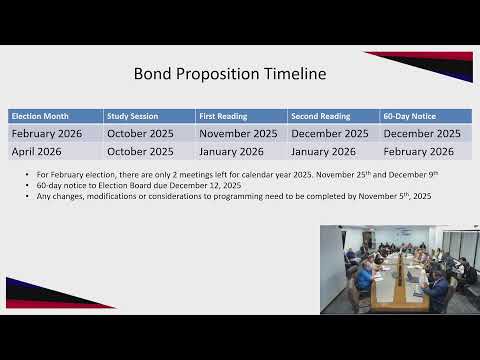
On timing for charter amendments, councilors said an April 2026 citywide election would give staff and council more time for public education and ordinance drafting compared with a February 2026 timeline, which requires a faster first reading deadline in November. Councilor Grant and others voiced support for April to allow more civic outreach; Walker noted the practical constraint that governor certification and AG review can delay when approved amendments take effect.
Council direction: staff will draft charter amendment language for council review with a view toward placing measures on an April 2026 citywide ballot, and staff will continue to research statutory constraints around TIF votes and implementation timing.
Why it matters: these charter edits affect who is eligible to run or serve in certain offices, how the public will see proposed pay figures on ballots, the timing of newly elected officials assuming office and the process for oversight of public financing mechanisms such as TIFs. Changes to charter language can require voter approval and then state certification before they take effect.