
Lake Chamina LID wins county approval for 2026 budget; high-water project repair remains unresolved
Get AI-powered insights, summaries, and transcripts
Subscribe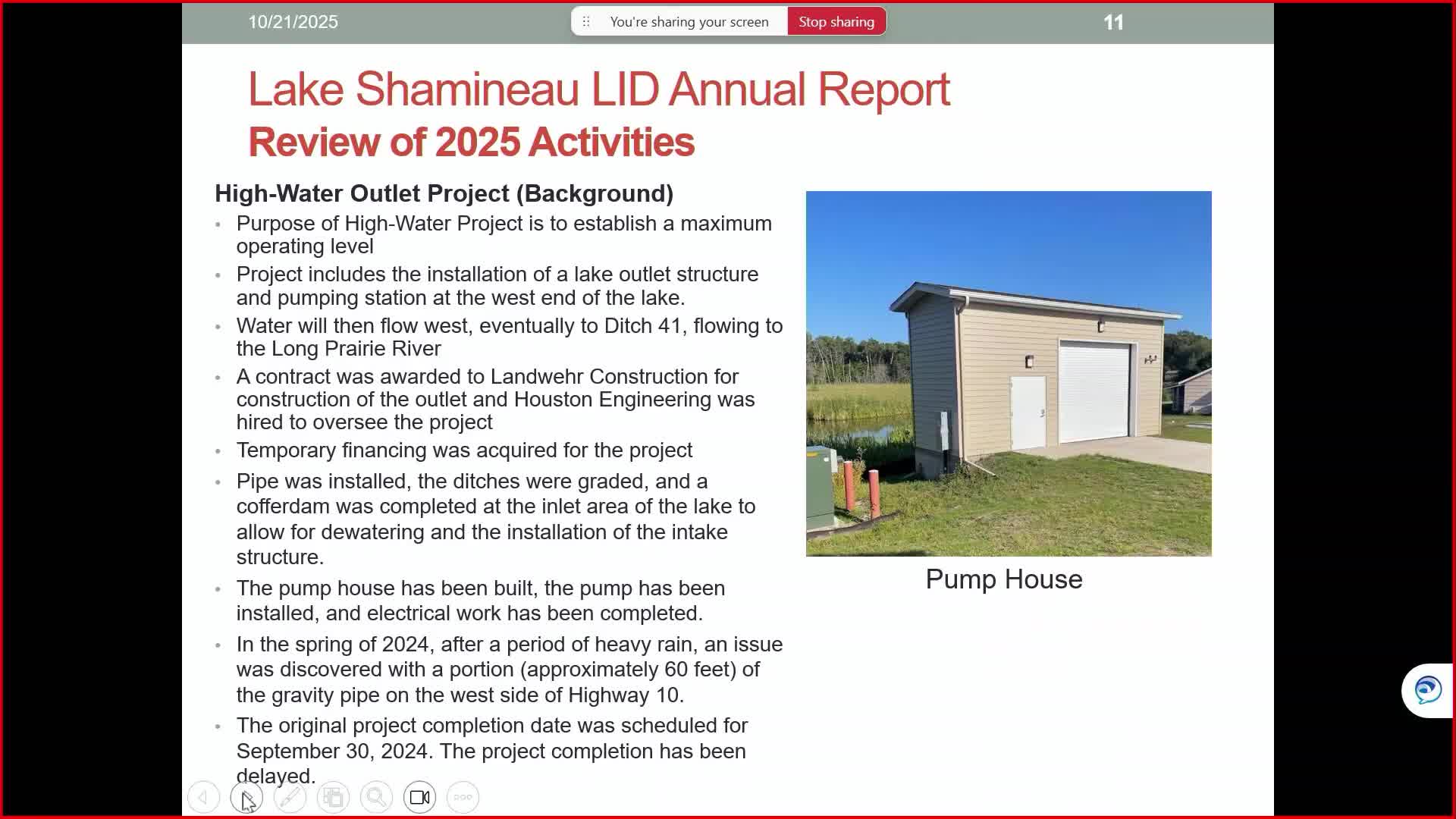
Summary
The board approved the Lake Chamina Lake Improvement District’s 2026 budget and performance plan but heard that a construction defect discovered after heavy rain has delayed completion of the high‑water outlet project and triggered a legal dispute with contractors; the LID is exploring a force‑main extension as an alternative repair option.
The Morrison County Board approved the Lake Chamina Lake Improvement District’s (LID) 2026 performance plan and budget on Oct. 21 after an extended presentation by LID administrator Cindy Kevin.
Kevin told the board the LID’s 2025 activities included aquatic invasive species (AIS) surveys and treatments, a five-person ambassador program at two landings (730.5 hours of coverage), installation of zebra-mussel settling plates (seven deployed, none found so far) and a new motion-sensing light at the West Landing. The LID also conducted regular communications, mailed property-owner updates and completed an audit of its financial records.
The board heard an update on the LID’s high-water outlet project. Kevin said Landwehr Construction and Houston Engineering completed much of the outlet work, including a pump house, piping and a cofferdam, but a post‑construction failure in a gravity pipe west of Highway 10 after heavy rain in 2024 forced the LID to halt contractor payments. The LID has engaged a conflict‑resolution attorney, participated in mediation and subsequently filed a legal complaint against both Houston and Landwehr. The LID hired two independent engineering firms for soil testing and analysis and completed a pump analysis.
An alternative repair under evaluation would extend the force main roughly 1,375 feet and bury it 2–3 feet deeper to reduce buoyancy; early internal analysis found the approach viable and potentially cost-effective. Kevin said final design, cost estimates and responsibility discussions are ongoing and that a resolution is unlikely before 2026.
On finances, Kevin reported the LID has paid nearly $4.9 million to date for the project, has received about $2.6 million in DNR reimbursements, and holds roughly $200,000 in interest earnings. She said the 2026 budgets are: non-project/administration $60,000; AIS $42,500; and high-water operations $56,000, with an estimated per-parcel charge of about $457.05 (final per-parcel amounts to be calculated with the county in November once parcel counts are final). The board moved and approved the LID performance plan and budget; the motion passed on recorded votes.