Get Full Government Meeting Transcripts, Videos, & Alerts Forever!
Get email alerts on the Joint Governance topic
No spam. Unsubscribe anytime.
La Cañada Unified and La Cañada Flintridge adopt joint‑governance framework
Summary
The La Cañada Unified School District Governing Board and the City of La Cañada Flintridge approved a joint‑governance resolution that formalizes a four‑tier structure for city–district collaboration and directs staff to create working groups to update operational agreements and develop a strategic master plan.
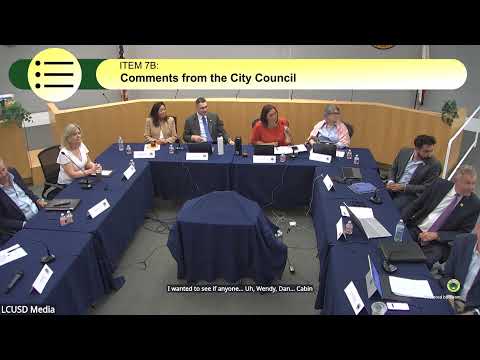
La Cañada Unified School Districtand the City of La Cañada Flintridge on Tuesday approved a resolution to formalize joint governance and create a multi‑tiered structure for collaboration on shared facilities and long‑range planning.
The resolution establishes a governance team of elected officials, an administrative team to set agendas, an operations team (a repurposed Joint Use committee) and specialized working teams to implement projects. In an amendment agreed during debate, officials softened prescriptive language in Exhibit A so the bodies "shall endeavor" or "attempt" to meet twice each year and added language allowing the mayor and the school board president (or their designees) to meet at least twice annually.
Board and council members said the change was intended to preserve flexibility while signalling a regular cadence of coordination. City and district staff described the resolution as a framework that moves the relationship from transactional coordination toward strategic planning and longer‑term projects.
The motion to adopt the resolution (with the Exhibit A changes) was moved and seconded on the district side and carried on that side; the city council adopted the same resolution by a recorded vote of 5‑0. (The transcript records the school board vote as "motion passes" but does not include a roll‑call tally for the board vote.)
Officials agreed that the resolution is the starting point for a sequence of work: staff will form ad hoc working groups, Mayor Kim Bowman and Board President Caroline Anderson will appoint representatives, and those groups will be asked to return with recommendations and schedules. The next joint governance meeting was tentatively scheduled for March, with staff asked to set a firm date and draft an agenda that will include progress on the newly formed work groups.
Why it matters: elected officials said the formal framework intends to protect and improve community access to jointly‑used facilities, reduce duplicated effort and provide continuity across elected terms. The adopted language preserves flexibility for additional meetings and the use of designees while signaling a public, repeatable process for joint decision‑making.
What officials said: district and city presenters explained the structure they recommended and said it codifies practices developed over the last two years. Officials repeatedly emphasized that the resolution creates a mechanism for long‑term strategic work rather than changing day‑to‑day operations immediately.
What happens next: staff from both agencies will convene the administrative and operations teams and begin forming working groups with specific deliverables. Those groups will address immediate items such as the Joint Use Master Agreement and longer‑term items such as master planning for shared assets.